
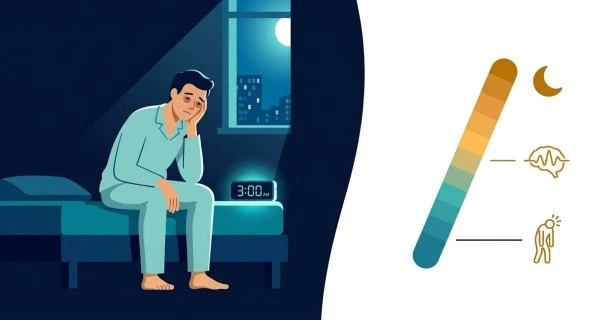
Take the 7-question Insomnia Severity Index (ISI) test to check your sleep disturbance score (0–28). Understand your results and when to see a sleep doctor.
Insomnia Severity Index (ISI) Calculator: Free Online Sleep Assessment
Use this Insomnia Severity Index (ISI) Calculator to evaluate the nature, severity, and daytime impact of your sleep difficulties over the past two weeks. Developed by sleep researcher Dr. Charles Morin, the ISI is a clinically validated, 7-question screening tool used by doctors and sleep specialists worldwide to measure insomnia symptoms.
How to Interpret Your Insomnia Severity Index Score
Each of the 7 questions on the Insomnia Severity Index is scored from 0 to 4, giving a total possible score ranging from 0 to 28. Use the table below to understand what your score means:
| Total ISI Score | Insomnia Severity Level | Clinical Meaning & Next Steps |
|---|---|---|
| 0 – 7 | No Clinically Significant Insomnia | Your sleep pattern falls within a healthy range. Maintain good sleep hygiene to protect your rest. |
| 8 – 14 | Subthreshold (Mild) Insomnia | You are experiencing mild sleep disturbances. Improving bedtime habits and stress management can help prevent chronic insomnia. |
| 15 – 21 | Clinical Insomnia (Moderate Severity) | Your sleep issues are significantly affecting your rest and daily life. Consider consulting a healthcare provider or sleep specialist. |
| 22 – 28 | Clinical Insomnia (Severe) | You are experiencing severe sleep disruption. Schedule an evaluation with a doctor or sleep medicine clinic for targeted treatment. |
What Does the Insomnia Severity Index Measure?
Unlike simple sleep trackers that only count hours in bed, the ISI evaluates both nighttime sleep symptoms and daytime consequences across seven key areas:
- Sleep-Onset Insomnia: Difficulty falling asleep after turning off the lights.
- Sleep-Maintenance Insomnia: Trouble staying asleep or waking up frequently during the night.
- Early Morning Awakening: Waking up much earlier than planned and being unable to fall back asleep.
- Sleep Satisfaction: How satisfied or dissatisfied you feel with your current sleep pattern.
- Daytime Functioning Interference: How strongly poor sleep affects your concentration, mood, energy, or work performance.
- Noticeability to Others: How visibly tired or impaired your quality of life appears to family, friends, or coworkers.
- Distress and Worry: How anxious or stressed you feel about your inability to sleep.
Other Clinical Tools Used to Assess Insomnia
Alongside the Insomnia Severity Index, healthcare professionals often use complementary tools to pinpoint the exact cause of poor sleep:
- 2-Week Sleep Diary: A daily log tracking bedtime, wake time, nighttime awakenings, caffeine intake, and daytime naps.
- Sleep Condition Indicator (SCI): An 8-item screening scale aligned with DSM-5 criteria for insomnia disorder.
- Epworth Sleepiness Scale (ESS): Measures daytime sleepiness to help rule out conditions like obstructive sleep apnea or narcolepsy.
- Actigraphy or Polysomnography: Wearable movement tracking or an overnight sleep study when physical sleep disorders (such as sleep apnea or restless legs syndrome) are suspected.
Evidence-Based Ways to Manage Insomnia
If your score indicates mild to severe insomnia, clinical guidelines from the American Academy of Sleep Medicine (AASM) recommend addressing root causes rather than relying solely on over-the-counter sleeping pills:
- Cognitive Behavioral Therapy for Insomnia (CBT-I): The gold-standard, first-line medical treatment for chronic insomnia. CBT-I retrains your brain and body to associate bed with restful sleep without medication side effects.
- Stimulus Control: If you cannot fall asleep within 20 minutes, get out of bed and do a quiet, dim-light activity until you feel sleepy.
- Consistent Wake Times: Wake up at the exact same time every morning—even after a poor night's sleep—to reset your circadian drive.
- Medical Evaluation: Rule out underlying triggers such as anxiety, depression, thyroid disorders, chronic pain, medications, or sleep apnea.
Frequently Asked Questions (FAQ)
What is a normal score on the Insomnia Severity Index?
A total score between 0 and 7 is considered normal and indicates no clinically significant insomnia. A score of 10 or higher is commonly used in health screenings to flag potential insomnia, while a score of 15 or higher indicates moderate-to-severe clinical insomnia.
Can the Insomnia Severity Index diagnose a sleep disorder?
No. The ISI is a validated screening and self-assessment tool, not a formal medical diagnosis. It helps quantify how severe your symptoms are and tracks whether treatment is working over time. Only a qualified physician or sleep specialist can formally diagnose insomnia disorder.
What is the difference between acute and chronic insomnia?
Acute (short-term) insomnia lasts from a few days to a few weeks and is usually triggered by temporary stress, illness, travel, or life changes. Chronic insomnia disorder is diagnosed when trouble falling or staying asleep occurs at least 3 nights per week for 3 months or longer and causes daytime impairment.
When should I see a doctor for insomnia?
You should consult a primary care doctor or sleep medicine specialist if your insomnia lasts longer than 3 to 4 weeks, scores 15 or higher on this calculator, causes severe daytime fatigue or mood changes, or is accompanied by loud snoring, gasping for air, or uncomfortable leg sensations at night.