
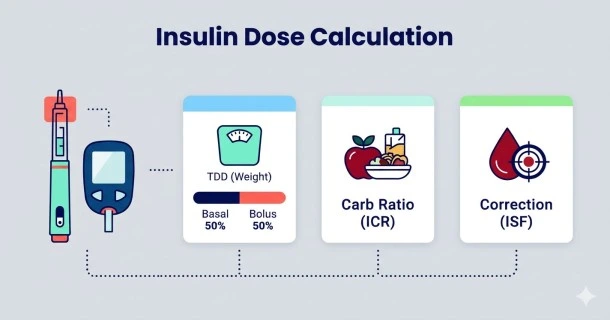
Estimate your Total Daily Dose (TDD), basal/bolus split, insulin-to-carb ratio (500 rule), and correction factor (1800 rule) for Type 1 diabetes management.
Insulin Dose Calculator: Total Daily Dose, Carb Ratio & Correction Factor
This insulin dose calculator helps people managing Type 1 diabetes (and insulin-dependent Type 2 diabetes) estimate their starting Total Daily Dose (TDD), basal-to-bolus split, Insulin-to-Carbohydrate Ratio (ICR), and Insulin Sensitivity Factor (ISF). Enter your body weight, meal carbohydrates, and blood glucose readings below to calculate your estimated mealtime bolus.
Important Medical Safety Notice
For Educational Reference Only: Weight-based insulin formulas provide initial starting estimates for metabolically stable adults. Individual insulin needs vary widely based on age, kidney function, physical activity, stress, illness, and puberty. Never start or change your insulin regimen without direct guidance from your endocrinologist or diabetes care team.
How to Use the Insulin Dosage Calculator
Follow these steps to estimate your daily and mealtime insulin requirements:
- Enter Your Body Weight: Input your current weight in kilograms (kg) or pounds (lb) to estimate your Total Daily Dose (TDD) and basal/bolus split.
- Select Your Mealtime Insulin Type: Choose between Rapid-Acting Insulin (such as lispro/Humalog, aspart/Novolog, or glulisine/Apidra) or Regular (Short-Acting) Insulin. Different insulin types use different mathematical constants.
- Input Meal Carbohydrates: Enter the total grams of carbohydrates you plan to eat to calculate your food coverage dose.
- Enter Blood Glucose Levels: Input your current pre-meal blood glucose and your target blood glucose (in mg/dL or mmol/L) to calculate any needed high blood sugar correction dose.
Formulas Used in This Insulin Calculator
Healthcare providers use standardized clinical rules of thumb to establish initial insulin dosing parameters:
1. Total Daily Dose (TDD) by Weight
For a metabolically stable adult with Type 1 diabetes, typical daily insulin requirements range from 0.4 to 1.0 units/kg/day, with 0.5 units/kg/day serving as a standard starting benchmark:
- Metric Formula: Weight (kg) × 0.5 = Total Daily Dose (TDD) in units
- Imperial Formula: Weight (lb) ÷ 4 = Total Daily Dose (TDD) in units
2. Basal vs. Bolus Insulin Split
Your Total Daily Dose is typically divided into two components to mimic natural pancreatic function:
- Basal Insulin (40% to 50% of TDD): Long-acting background insulin (such as glargine, detemir, or degludec) that keeps blood sugar steady overnight and between meals.
- Bolus Insulin (50% to 60% of TDD): Rapid-acting or short-acting insulin taken before meals to cover carbohydrates and correct elevated blood glucose.
3. Insulin-to-Carbohydrate Ratio (ICR) — The 500 & 450 Rules
Your ICR tells you how many grams of carbohydrate are covered by 1 unit of bolus insulin:
- Rapid-Acting Insulin (500 Rule): 500 ÷ TDD = Grams of carbs covered by 1 unit
- Regular Insulin (450 Rule): 450 ÷ TDD = Grams of carbs covered by 1 unit
- Meal Coverage Dose: Total Meal Carbs (g) ÷ ICR = Units needed for food
4. Insulin Sensitivity Factor (ISF) — The 1800 & 1500 Rules
Also known as your Correction Factor, your ISF estimates how much 1 unit of insulin will lower your blood glucose:
- Rapid-Acting Insulin (1800 Rule): 1800 ÷ TDD = Blood glucose drop (mg/dL) per 1 unit (For mmol/L, use 100 ÷ TDD)
- Regular Insulin (1500 Rule): 1500 ÷ TDD = Blood glucose drop (mg/dL) per 1 unit (For mmol/L, use 83 ÷ TDD)
- Correction Dose: (Current Blood Glucose − Target Blood Glucose) ÷ ISF = Units needed for correction
5. Total Mealtime Bolus Insulin
Your total pre-meal dose combines food coverage and blood sugar correction:
Total Mealtime Bolus = Meal Coverage Dose + Correction Dose
Safe Insulin Titration & Adjustment Guidelines
Weight-based calculations are only a starting point. Your doctor will help you fine-tune your doses by looking at blood glucose patterns over 2 to 3 days rather than reacting to a single reading:
- Prevent Hypoglycemia First: If your blood glucose drops below 70 mg/dL (3.9 mmol/L) without an obvious cause (like skipped meals or extra exercise), contact your healthcare provider promptly. Doctors typically reduce the corresponding insulin dose by 10% to 20% after unexplained lows.
- Avoid Insulin Stacking: Rapid-acting insulin stays active in your body for 3 to 4 hours. Giving repeated correction doses too close together ("stacking" insulin) can cause severe, delayed hypoglycemia.
- Target Specific Meal Windows: If your blood sugar is consistently high before lunch, your breakfast carb ratio may need adjustment. If bedtime glucose is consistently high, your dinner dose may need review.
Frequently Asked Questions (FAQ)
How do I calculate my insulin-to-carb ratio manually?
To estimate your starting insulin-to-carbohydrate ratio (ICR), divide 500 by your Total Daily Dose (TDD) of insulin if you use rapid-acting insulin (like Humalog or Novolog). For example, if your TDD is 50 units, 500 ÷ 50 = 10, meaning 1 unit of insulin covers approximately 10 grams of carbohydrates (a 1:10 ratio).
What is the 1800 rule for insulin correction factor?
The 1800 rule estimates your Insulin Sensitivity Factor (ISF)—how many mg/dL one unit of rapid-acting insulin lowers your blood sugar. Divide 1800 by your Total Daily Dose. If your TDD is 45 units, 1800 ÷ 45 = 40, meaning 1 unit of rapid-acting insulin lowers your blood glucose by roughly 40 mg/dL.
Can people with Type 2 diabetes use this insulin calculator?
While the 0.5 units/kg/day starting formula is designed primarily for Type 1 diabetes, people with Type 2 diabetes on basal-bolus therapy also use the 500 rule and 1800 rule. However, people with Type 2 diabetes often have higher insulin resistance and may require different starting weight multipliers prescribed by their physician.
What should I do if my calculated insulin dose is a decimal?
Standard insulin syringes and pens usually measure in whole units or half-units (0.5 units). Ask your healthcare provider whether you should round to the nearest whole unit or half-unit, or use a half-unit insulin pen for greater precision.
Why does my insulin sensitivity change throughout the day?
Hormones like cortisol and growth hormone peak in the early morning (known as the dawn phenomenon), making many people more insulin-resistant at breakfast. As a result, your endocrinologist may assign a stronger carb ratio for breakfast (e.g., 1:8) and a gentler ratio for lunch or dinner (e.g., 1:12).