
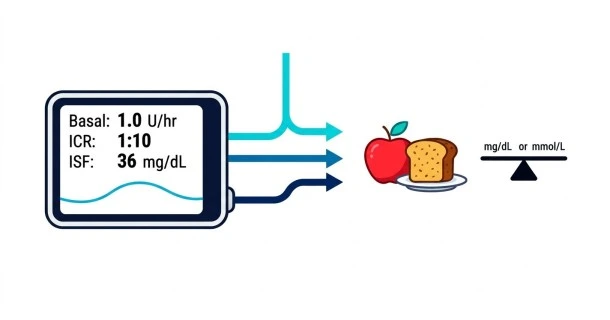
Estimate initial insulin pump settings including hourly basal rate, insulin-to-carb ratio (ICR), correction factor (ISF), and mealtime bolus doses safely.
Insulin Pump Calculator: Estimate Basal Rate, Carb Ratio & Correction Factor
Use this insulin pump calculator to estimate your initial continuous subcutaneous insulin infusion (CSII) settings, including your pump Total Daily Dose (TDD), hourly basal rate, Insulin-to-Carb Ratio (ICR), Insulin Sensitivity Factor (ISF), and mealtime bolus insulin. These clinical estimates serve as a starting baseline when transitioning from multiple daily injections (MDI) to an insulin pump and should always be reviewed with your endocrinologist or diabetes care team.
What This Insulin Pump Settings Calculator Measures
Setting up an insulin pump requires converting your daily insulin needs into automated background delivery and mealtime calculations. Based on your body weight, current injection dose, and glycemic patterns, this tool estimates:
- Pump Total Daily Dose (TDD): Your estimated 24-hour insulin requirement on pump therapy.
- Hourly Basal Rate (Units/Hour): The continuous background insulin delivered every hour to keep blood glucose steady between meals and overnight.
- Insulin-to-Carb Ratio (ICR): How many grams of carbohydrate are covered by 1 unit of rapid-acting insulin.
- Insulin Sensitivity Factor (ISF / Correction Factor): How much 1 unit of rapid-acting insulin lowers your blood sugar (in mg/dL or mmol/L).
- Mealtime & Correction Bolus: The total rapid-acting insulin required to cover meal carbohydrates and correct elevated blood glucose while accounting for active Insulin on Board (IOB).
How to Use the Insulin Pump Calculator
Follow these steps to generate your baseline pump parameters:
- Enter Your Body Weight: Input your current weight and select either Kilograms (kg) or Pounds (lb). Weight is used to estimate insulin needs if you do not know your current daily dose.
- Enter Your Current Total Daily Dose (TDD): Add up all long-acting (basal) and rapid-acting (bolus) insulin units you typically take in 24 hours via injections. If you are newly starting insulin and do not have a current TDD, enter 0 so the calculator can estimate a weight-based starting dose.
- Select Your Glycemic Profile: Indicate whether you experience frequent low blood sugar (hypoglycemia), elevated A1C / pregnancy, or stable blood sugars. This helps adjust the safety reduction factor when converting from injections to a pump.
- Enter Meal & Blood Glucose Details: Input the grams of carbohydrates in your upcoming meal, your current blood sugar reading, your target blood sugar, and your preferred unit (mg/dL or mmol/L).
- Include Insulin on Board (IOB): Enter any active bolus insulin remaining from a previous dose (displayed on your pump or CGM). Enter 0 if you have not taken rapid-acting insulin within the last 3 to 5 hours.
Clinical Formulas Used in Insulin Pump Calculations
Endocrinologists and certified diabetes care and education specialists (CDCES) rely on established clinical formulas to determine initial pump settings before fine-tuning them with Continuous Glucose Monitoring (CGM) data:
1. Pump Total Daily Dose (TDD) Adjustment
Insulin delivered continuously via a pump is absorbed more consistently than injected long-acting insulin. When switching from injections to a pump, clinicians typically reduce the pre-pump TDD by 20% to 25% (multiplying your injection TDD by 0.75 to 0.80) to prevent hypoglycemia—especially if you already experience frequent lows.
2. Basal vs. Bolus Split & Hourly Basal Rate
A standard starting regimen divides the pump TDD into 40% to 50% basal insulin and 50% to 60% bolus insulin. To find your initial flat hourly basal rate, your total daily basal units are divided by 24 hours. Over the first few weeks, your care team will adjust specific time blocks (such as increasing early morning rates for the dawn phenomenon).
3. Insulin-to-Carb Ratio (The 500 Rule)
Your starting carbohydrate ratio is estimated using the 500 Rule: dividing 500 by your pump TDD. For example, if your pump TDD is 50 units, 500 ÷ 50 = 10, giving a ratio of 1:10 (1 unit of rapid-acting insulin for every 10 grams of carbohydrates).
4. Insulin Sensitivity Factor / Correction Factor (The 1800 & 100 Rules)
For rapid-acting insulin analogs (such as lispro, aspart, or glulisine), your correction factor is estimated using the 1800 Rule (for mg/dL) or the 100 Rule (for mmol/L):
- In mg/dL: 1800 ÷ Pump TDD (e.g., 1800 ÷ 50 = 36 mg/dL drop per 1 unit).
- In mmol/L: 100 ÷ Pump TDD (e.g., 100 ÷ 50 = 2.0 mmol/L drop per 1 unit).
Important Safety Considerations for Insulin Pump Users
- Prevent Insulin Stacking: Always account for Insulin on Board (IOB) before administering a correction bolus. Rapid-acting insulin typically remains active in the body for 3 to 5 hours.
- Monitor Ketones During Unexplained Highs: Because insulin pumps use only rapid-acting insulin without a long-acting subcutaneous depot, an infusion set blockage or dislodgement can lead to diabetic ketoacidosis (DKA) within hours. Check blood or urine ketones if blood sugar stays above 250 mg/dL (13.9 mmol/L).
- Automated Insulin Delivery (AID) Systems: If you use a hybrid closed-loop system, the pump's algorithm automatically adjusts basal delivery every few minutes, though accurate manual settings for ICR, ISF, and Active Insulin Time remain essential for meal boluses.
Frequently Asked Questions (FAQ)
Why is my insulin pump Total Daily Dose lower than my injection dose?
When transitioning from multiple daily injections to an insulin pump, total insulin requirements often drop by 20% to 25%. Continuous micro-doses of rapid-acting insulin mimic natural pancreatic secretion more efficiently and eliminate the absorption variability associated with large depots of long-acting basal insulin.
How do I calculate my initial hourly basal rate for an insulin pump?
Take 40% to 50% of your adjusted pump Total Daily Dose to find your total daily basal insulin, then divide that number by 24 hours. For example, if your pump TDD is 48 units and 50% is allocated to basal insulin (24 units), your starting hourly basal rate is 1.0 unit per hour.
What is the difference between Insulin-to-Carb Ratio (ICR) and Correction Factor (ISF)?
Your Insulin-to-Carb Ratio (ICR) calculates how much insulin you need to cover the food you eat (grams of carbs per 1 unit of insulin). Your Insulin Sensitivity Factor (ISF), or correction factor, calculates how much insulin you need to bring an elevated blood sugar back down to your target range.
What is Insulin on Board (IOB) and why does it matter?
Insulin on Board (IOB), also called active insulin, is the amount of rapid-acting insulin still working in your body from a previous bolus. Subtracting IOB from a new correction dose prevents "insulin stacking," which is a common cause of severe delayed hypoglycemia.
Can I use these calculated pump settings without seeing a doctor?
No. An online insulin pump calculator provides mathematical estimates based on standard clinical formulas (such as the 500 and 1800 rules). Individual insulin sensitivity varies due to kidney function, activity levels, stress, hormones, and medications. Always have a qualified healthcare provider program and verify your pump settings.