
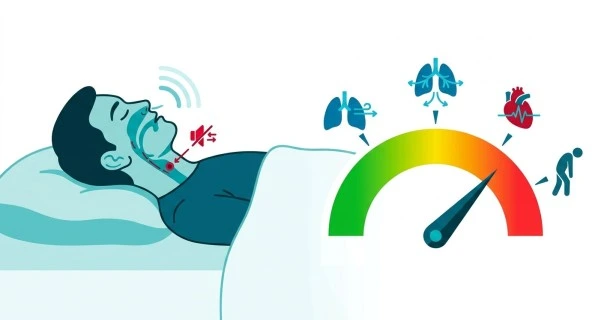
Check your risk of Obstructive Sleep Apnea (OSA) in under 1 minute using the validated MAP Index. Enter your age, BMI, and snoring symptoms for instant results.
Sleep Apnea Risk Calculator: Free Obstructive Sleep Apnea (OSA) Screening
Use this Sleep Apnea Risk Calculator to estimate your likelihood of having Obstructive Sleep Apnea (OSA) in less than one minute. Built on the clinically validated Multivariable Apnea Prediction (MAP) Index, this tool combines your age, biological sex, Body Mass Index (BMI), and nighttime breathing symptoms over the past month to calculate your sleep apnea risk score.
How to Interpret Your Sleep Apnea Risk (MAP Index) Score
The Multivariable Apnea Prediction (MAP) Index calculates a probability score ranging from 0.00 to 1.00 (0% to 100%). In clinical sleep medicine research, a score of 0.50 (50%) or higher is commonly used as the threshold indicating elevated risk for Obstructive Sleep Apnea:
| MAP Risk Score | Risk Category | Clinical Meaning & Recommended Next Steps |
|---|---|---|
| Below 0.30 (<30%) | Low Risk | Your reported symptoms and body metrics suggest a lower probability of OSA. Continue healthy sleep habits and monitor any new snoring or daytime fatigue. |
| 0.30 – 0.49 (30%–49%) | Moderate / Borderline Risk | You have some risk factors or occasional breathing disturbances. Discuss your sleep quality with a doctor, especially if you have high blood pressure or daytime tiredness. |
| 0.50 or Higher (≥50%) | High Risk | Your symptom pattern and physical profile strongly suggest possible Obstructive Sleep Apnea. Schedule an evaluation with a healthcare provider or sleep specialist for diagnostic testing. |
What Is Sleep Apnea?
Sleep apnea is a serious, common sleep-related breathing disorder in which breathing repeatedly stops and starts during sleep. Derived from the Greek word apnea (meaning "without breath"), these pauses can last from 10 seconds to over a minute and may happen 5 to 30 or more times per hour.
There are two main forms of the condition:
- Obstructive Sleep Apnea (OSA): The most common form, caused by relaxation of the throat muscles that temporarily blocks the upper airway during sleep.
- Central Sleep Apnea (CSA): Occurs when the brain temporarily fails to send proper signals to the muscles that control breathing.
Common Warning Signs and Symptoms of Sleep Apnea
Because breathing pauses happen while you are asleep, a bed partner or family member often notices the signs first. Key nighttime and daytime symptoms include:
- Loud, chronic snoring punctuated by silent pauses
- Gasping, snorting, or choking sounds as breathing resumes
- Excessive daytime sleepiness or falling asleep unintentionally while reading, watching TV, or driving
- Waking up with a dry mouth, sore throat, or morning headache
- Restless sleep, frequent nighttime urination, or difficulty concentrating during the day
Why Untreated Sleep Apnea Matters
Globally and in the United States, roughly 25% of adults are at risk for Obstructive Sleep Apnea, yet up to 80% to 90% remain undiagnosed. Each breathing pause causes blood oxygen levels to drop and triggers a surge of stress hormones, forcing the brain to briefly wake up to reopen the airway. Over time, untreated OSA increases the risk of:
- High blood pressure (hypertension) that is difficult to control with medication
- Heart rhythm disorders (such as atrial fibrillation), heart attack, and stroke
- Type 2 diabetes and insulin resistance
- Daytime fatigue-related workplace or motor vehicle accidents
How the Multivariable Apnea Prediction (MAP) Index Works
Validated in clinical sleep studies—including research published in the Journal of Clinical Sleep Medicine—the MAP Index offers a fast, zero-cost way to identify individuals who need formal sleep testing. It weighs three physical risk factors alongside three core nocturnal symptoms experienced over the last 30 days:
- Biological Sex, Age, and BMI: OSA risk rises with age, higher Body Mass Index (excess neck and upper-airway tissue), and male sex (though risk in women rises significantly after menopause).
- Loud Snoring Frequency: Rated from 0 (Never) to 4 (Always, 5–7 nights per week).
- Snorting or Gasping Frequency: Rated from 0 to 4 based on weekly occurrence.
- Choking or Struggling for Breath: Rated from 0 to 4 based on witnessed or self-reported breathing pauses.
How Sleep Apnea Is Diagnosed and Treated
A screening calculator cannot formally diagnose sleep apnea, but a positive high-risk result gives you clear evidence to share with your doctor. Today, diagnosis is much easier than in the past:
- Home Sleep Apnea Test (HSAT): For most adults with suspected uncomplicated OSA, doctors can prescribe a compact, portable monitor worn at home overnight to track airflow, breathing effort, heart rate, and blood oxygen.
- In-Lab Nocturnal Polysomnography: An overnight sleep study conducted at a sleep center that records brain waves, eye movements, muscle activity, heart rhythm, and breathing when complex sleep disorders are suspected.
Once diagnosed, effective treatments include CPAP (Continuous Positive Airway Pressure) therapy, custom oral mandibular advancement devices, positional therapy, targeted weight management, and upper-airway procedures when clinically indicated.
Frequently Asked Questions (FAQ)
What is a high-risk score on the Sleep Apnea Risk Calculator?
On the Multivariable Apnea Prediction (MAP) Index, a calculated probability of 0.50 (50%) or higher is considered high risk for Obstructive Sleep Apnea and warrants discussion with a healthcare provider. However, even if your score is below 0.50, you should still consult a doctor if you experience loud snoring paired with severe daytime sleepiness or high blood pressure.
Can thin people or women have sleep apnea?
Yes. While higher BMI and male sex increase statistical risk, people with a normal body weight can develop OSA due to jaw structure, enlarged tonsils, nasal obstruction, or airway anatomy. Women—especially during pregnancy or after menopause—also frequently experience sleep apnea, often presenting with fatigue, insomnia, or morning headaches rather than classic loud snoring.
What is the difference between the MAP Index and the STOP-Bang questionnaire?
Both are validated clinical screening tools for Obstructive Sleep Apnea. The STOP-Bang questionnaire uses 8 yes/no questions covering snoring, tiredness, observed apnea, high blood pressure, BMI, age, neck circumference, and gender. The MAP Index uses a mathematical formula combining exact age, BMI, biological sex, and the weekly frequency (0–4) of three core breathing symptoms to calculate a continuous risk percentage.
When should I see a doctor about snoring or sleep apnea?
Seek medical advice promptly if someone observes you stop breathing, choke, or gasp during sleep; if you snore loudly most nights; or if you feel excessively sleepy during the day despite spending enough hours in bed.
Medical Disclaimer: This calculator is an educational screening tool based on the Multivariable Apnea Prediction (MAP) Index and does not provide a medical diagnosis. Always consult a qualified physician or board-certified sleep specialist for evaluation and testing.