
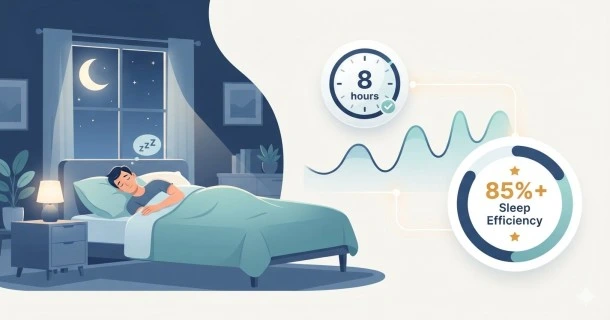
Calculate your sleep efficiency percentage and check your sleep quality based on sleep latency, nighttime awakenings, and age-specific medical guidelines.
Sleep Quality & Sleep Efficiency Calculator
Restorative sleep is vital for physical healing, cognitive function, and long-term health. True rest depends not just on time spent in bed, but on sleep continuity. This calculator measures your sleep efficiency percentage and compares it against clinical sleep guidelines.
Sleep Quality vs. Sleep Quantity: What Is the Difference?
Sleep quantity tracks total hours logged in a 24-hour cycle. Sleep quality reflects how deep and uninterrupted that rest is. Fragmented sleep or frequent nighttime awakenings can leave you fatigued despite logging a full eight hours.
How Is Sleep Quality Measured Clinically?
The National Sleep Foundation outlines four core metrics for evaluating sleep continuity:
- Sleep Onset Latency (SOL): Time required to fall asleep after turning off the lights. Normal latency ranges from 15 to 30 minutes. Under 5 minutes can indicate severe deprivation, while over 30 minutes may point to insomnia.
- Nighttime Awakenings: Episodes of waking during the night lasting over 5 minutes. Adults typically experience 0 to 1 awakening per night, or up to 2 awakenings for those aged 65 and older.
- Wake After Sleep Onset (WASO): Total minutes spent awake after initial sleep onset until final waking. Optimal WASO is 20 minutes or less.
- Sleep Efficiency (SE): The ratio of actual sleep time to total time spent in bed.
Sleep Efficiency Formula
Specialists calculate efficiency using these standard formulas:
Total Sleep Time (TST) = Total Time in Bed − Sleep Onset Latency − Wake After Sleep Onset (WASO)
Sleep Efficiency (%) = (Total Sleep Time ÷ Total Time in Bed) × 100
An efficiency of 85% or higher points to healthy sleep quality, whereas scores under 80% suggest disruption.
Recommended Sleep Duration by Age
Guidelines from the CDC and the American Academy of Sleep Medicine recommend daily totals based on age:
- Infants (4–12 months): 12 to 16 hours
- Toddlers (1–2 years): 11 to 14 hours
- Preschoolers (3–5 years): 10 to 13 hours
- School-Age Children (6–12 years): 9 to 12 hours
- Teenagers (13–18 years): 8 to 10 hours
- Adults (18–64 years): 7 to 9 hours
- Older Adults (65+ years): 7 to 8 hours
Calculate Your Sleep Quality & Efficiency
Input your sleep details below. Note: This tool is for educational screening and does not replace medical diagnosis.
Signs of Poor Sleep Quality & Common Causes
An efficiency rate under 80% or chronic difficulty falling and staying asleep points to poor sleep quality. Frequent triggers include erratic sleep schedules, late caffeine or alcohol intake, environmental light/noise, and underlying disorders like insomnia or sleep apnea.
Frequently Asked Questions (FAQ)
What is a good sleep efficiency percentage?
A score of 85% or higher indicates healthy sleep efficiency. Scores consistently below 80% often signal sleep fragmentation or insomnia.
Can your sleep efficiency be too high?
Yes. Efficiencies near 95%–100% paired with very rapid sleep onset (<5 minutes) can point to severe underlying sleep debt.
Why do I feel tired even after 8 hours of sleep?
Total time in bed does not equal restorative rest if frequent awakenings, long latency, or sleep disorders disrupt your deep and REM cycles.
How can I improve my sleep efficiency naturally?
Maintain consistent wake times, optimize bedroom temperature (60–67°F), limit screens before bed, restrict afternoon caffeine, and exit the bed if awake longer than 20–30 minutes.
When should I see a doctor about poor sleep quality?
Consult a specialist if poor efficiency, loud snoring, gasping, or insomnia symptoms persist at least three nights a week for over three months.