
Find the best time to go to bed based on your wake-up time, age, and natural sleep cycles. Wake up refreshed and avoid morning grogginess with our tool.
Sleep Time Calculator: Find Your Best Bedtime by Age & Sleep Cycles
Use this Sleep Time Calculator to find the ideal time to go to bed based on your desired wake-up time, your age, and natural 90-minute sleep cycles. Planning your bedtime around complete sleep cycles helps you wake up during light sleep rather than deep sleep, reducing morning grogginess and helping you feel refreshed.
How the Sleep Time Calculator Works
Getting a good night's rest depends on both how long you sleep and which sleep stage you wake up from. Even after eight hours in bed, waking up abruptly from deep sleep can leave you feeling heavy, disoriented, and exhausted—a temporary state known as sleep inertia.
This calculator works backward from your alarm time using two clinical benchmarks:
- 90-Minute Sleep Cycles: A typical adult sleep cycle lasts roughly 90 minutes (ranging between 70 and 120 minutes). Most adults need 5 to 6 complete cycles (7.5 to 9 hours) per night.
- Sleep Onset Latency: Healthy adults usually take about 10 to 20 minutes to fall asleep after turning off the lights (15 minutes is used as the standard default, though you can customize this above).
Recommended Sleep Duration by Age
While timing your wake-up at the end of a sleep cycle helps prevent grogginess, getting enough total sleep is the most important factor for physical recovery, memory, and heart health. According to the American Academy of Sleep Medicine (AASM), daily sleep needs change throughout life:
| Age Group | Recommended Total Sleep (per 24 Hours) | Typical Nighttime Sleep Cycles |
|---|---|---|
| Infants (4–12 months) | 12 to 16 hours (including naps) | Varies (shorter ~50–60 min cycles) |
| Toddlers (1–2 years) | 11 to 14 hours (including naps) | Varies |
| Preschoolers (3–5 years) | 10 to 13 hours (including naps) | Varies |
| School-Age Children (6–12 years) | 9 to 12 hours | 6 to 8 cycles |
| Teenagers (13–18 years) | 8 to 10 hours | 5 to 6 cycles |
| Adults (18–64 years) | 7 to 9 hours | 5 to 6 cycles |
| Older Adults (65+ years) | 7 to 8 hours | 5 cycles |
Understanding the 4 Stages of a Sleep Cycle
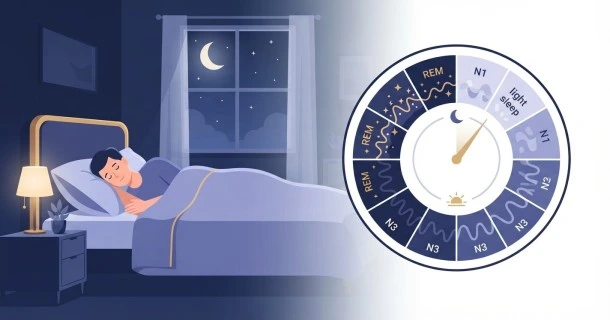
Sleep is an active, dynamic process where your brain cycles through four distinct stages several times each night:
- Stage 1 (N1 – Light Sleep): The brief transition between wakefulness and sleep, lasting 1 to 7 minutes. Your heartbeat and breathing begin to slow down.
- Stage 2 (N2 – Deeper Light Sleep): Your body temperature drops, eye movements stop, and brain waves slow down. You spend about half your total sleep time in this stage.
- Stage 3 (N3 – Deep Slow-Wave Sleep): Crucial for physical repair, immune function, and tissue growth. Waking up during Stage 3 causes severe grogginess and brain fog.
- REM Sleep (Rapid Eye Movement): First occurs about 90 minutes after falling asleep. Brain activity increases, vivid dreaming occurs, and your brain consolidates memories and regulates mood.
Tips to Fall Asleep Faster and Wake Up Refreshed
- Keep a consistent schedule: Go to bed and wake up at the same time every day—even on weekends—to anchor your internal circadian rhythm.
- Optimize your bedroom: Keep your sleeping space cool, dark, and quiet.
- Limit screens before bed: Turn off phones, TVs, and tablets 30 to 60 minutes before bedtime to prevent blue light from delaying melatonin production.
- Watch caffeine and heavy meals: Avoid caffeine at least 6 to 8 hours before bedtime, and finish large meals 2 to 3 hours before lying down.
Frequently Asked Questions (FAQ)
What time should I go to bed if I have to wake up at 6:00 AM?
Assuming it takes you 15 minutes to fall asleep, the best times to go to bed for a 6:00 AM alarm are 8:45 PM (for 9 hours / 6 cycles of sleep) or 10:15 PM (for 7.5 hours / 5 cycles of sleep). If you are short on time, 11:45 PM gives you 6 hours (4 cycles), though most adults need at least 7 hours regularly.
Is it better to sleep 6 hours or 7 hours?
For most adults, 7 hours is healthier than 6 hours. Even though 6 hours equals four neat 90-minute cycles, consistently sleeping fewer than 7 hours increases long-term risks for high blood pressure, weight gain, weakened immunity, and poor focus. Total sleep duration always outweighs exact cycle math.
Why do I still feel tired after 8 hours of sleep?
Feeling exhausted after 8 hours usually happens for one of three reasons: you woke up in the middle of a deep sleep (N3) stage, your sleep schedule shifts wildly on weekends (social jet lag), or an underlying condition—such as sleep apnea, insomnia, or iron deficiency—is fragmenting your sleep quality without you realizing it.
Are 90-minute sleep cycles exact for everyone?
No. Ninety minutes is a clinical average. In reality, your first sleep cycle of the night is often shorter (around 70 to 100 minutes), while later cycles lengthen (up to 90 to 120 minutes). Use the calculated bedtimes as a starting guide and adjust by 15 to 20 minutes based on how refreshed you feel.
How long should it take to fall asleep?
Healthy sleep latency is typically 10 to 20 minutes. Consistently falling asleep in under 5 minutes often indicates severe sleep deprivation, while regularly taking more than 30 minutes may be a sign of insomnia or poor sleep habits.
Medical Note: This calculator provides general educational guidance and does not replace professional medical advice. Consult a doctor or sleep specialist if you experience chronic insomnia, loud snoring with gasping, or persistent daytime fatigue.