
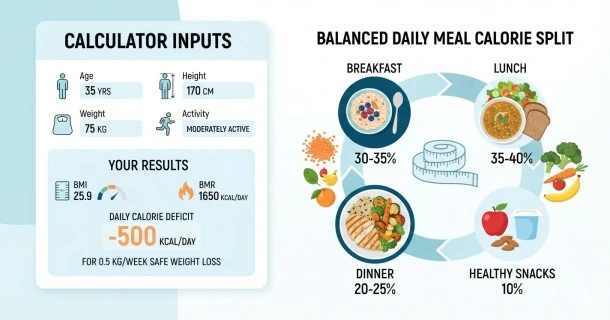
Calculate your daily calorie target for safe weight loss of 0.5 to 1 kg per week. Get your BMI, BMR, TDEE, and healthy meal calorie split instantly.
Weight Loss Calculator: Daily Calorie Deficit & Healthy Meal Plan
The Weight Loss Calculator estimates how many calories you should eat each day to reach your target weight safely. By combining your Body Mass Index (BMI), Basal Metabolic Rate (BMR), and daily activity level, this tool calculates your personalized calorie deficit and divides your daily intake across breakfast, lunch, dinner, and snacks.
Calculate Your Daily Weight Loss Calories
How to Use This Weight Loss Calculator
- Select your biological sex and enter your current age in years.
- Choose your preferred units and enter your height and current weight.
- Select your daily physical activity level from sedentary to very active.
- Choose your target weekly weight loss pace (0.5 kg / 1 lb or 1 kg / 2 lb per week) and click Calculate.
How Safe Weight Loss Calorie Deficits Work
Sustainable fat loss happens when you consistently consume fewer calories than your body burns, known as a calorie deficit. Public health organizations including the World Health Organization (WHO) and the Centers for Disease Control and Prevention (CDC) recommend losing 0.5 to 1 kg (1 to 2 pounds) per week.
| Weekly Weight Loss Goal | Weekly Calorie Deficit | Daily Calorie Reduction (from TDEE) | Best Suited For |
|---|---|---|---|
| 0.25 kg (0.5 lb) / week | ~1,750 kcal | 250 kcal / day | Lean individuals or final few kilograms |
| 0.5 kg (1 lb) / week | ~3,500 kcal | 500 kcal / day | Most adults seeking steady, sustainable fat loss |
| 1.0 kg (2 lb) / week | ~7,000 kcal | 1,000 kcal / day | Individuals with higher starting BMI under guidance |
Important Safety Minimum: Unless supervised by a physician, women should generally avoid dropping below 1,200 calories per day and men should avoid dropping below 1,500 calories per day. Severe calorie cuts accelerate muscle loss, trigger fatigue, and slow down your metabolism.
Understanding Your BMI & Healthy Weight Range
Your calculator output includes your current Body Mass Index (BMI) alongside an estimated healthy weight range. Because South Asian and Indian populations carry higher metabolic risk at lower body weights, clinical guidelines use lower thresholds than standard international charts:
| Weight Category | Standard WHO BMI (kg/m²) | Asian-Indian Consensus BMI (kg/m²) |
|---|---|---|
| Underweight | Below 18.5 | Below 18.5 |
| Normal / Healthy Weight | 18.5 – 24.9 | 18.5 – 22.9 |
| Overweight | 25.0 – 29.9 | 23.0 – 24.9 |
| Obesity | 30.0 or higher | 25.0 or higher |
Health Benefits of Losing Excess Weight
Carrying excess body fat—especially visceral fat around the abdomen—raises the risk of high blood pressure, type 2 diabetes, heart disease, stroke, fatty liver disease, osteoarthritis, sleep apnea, and several cancers. Clinical research shows that losing even 5% to 10% of your starting body weight delivers major health improvements:
- Better Blood Sugar Control: Improves insulin sensitivity and helps prevent or reverse prediabetes and early type 2 diabetes.
- Lower Blood Pressure & Cholesterol: Reduces strain on blood vessels, lowers triglycerides, and improves HDL ("good") cholesterol.
- Reduced Joint Pain & Better Sleep: Takes mechanical pressure off knees and lower back while reducing snoring and obstructive sleep apnea symptoms.
Meal Timing & Daily Calorie Distribution
How you spread your calories across the day can make sticking to a calorie deficit much easier. Traditional Indian Ayurvedic wisdom advises eating like a king at breakfast, a queen at lunch, and a pauper at dinner—a principle supported by modern circadian nutrition studies.
- Front-Load Daytime Calories: Insulin sensitivity and digestive efficiency peak earlier in the day. Eating a substantial breakfast (around 8:00 a.m.) and balanced lunch (around 1:00 p.m.) helps stabilize blood sugar and curb evening cravings.
- Keep Dinner Light & Early: Eating a smaller dinner at least 2 to 3 hours before bedtime (around 7:00 p.m.) supports overnight fat metabolism and improves sleep quality.
- Suggested Daily Calorie Split: Aim for roughly 30% to 35% at breakfast, 35% to 40% at lunch, 20% to 25% at dinner, and 10% for healthy snacks.
Evidence-Based Habits for Lasting Weight Loss
- Prioritize Protein & Fiber: Include lean protein (lentils, eggs, fish, poultry, Greek yogurt, tofu) and high-fiber vegetables or whole grains at every meal to stay full on fewer calories and protect muscle mass.
- Cut Liquid Calories & Refined Sugars: Replacing sugary sodas, sweetened teas, packaged juices, and ultra-processed snacks with water or unsweetened beverages easily removes 200 to 400 hidden calories per day.
- Combine Cardio with Strength Training: Aim for at least 150 minutes of brisk walking, cycling, or swimming per week plus 2 days of resistance exercises so the weight you lose comes from fat rather than muscle.
- Sleep 7 to 8 Hours Nightly: Poor sleep increases hunger hormones (ghrelin) and cravings for high-calorie foods.
Frequently Asked Questions (FAQ)
How many calories should I eat a day to lose weight?
To lose about 0.5 kg (1 lb) per week, subtract 500 calories from your Total Daily Energy Expenditure (TDEE). Most women lose weight safely on 1,200 to 1,600 calories per day, while most men lose weight on 1,500 to 2,000 calories per day, depending on height and activity level.
Is losing 1 kg (2 lbs) per week safe?
Losing up to 1 kg (2 lbs) per week is generally safe for adults with a higher starting weight, provided your daily intake stays above 1,200 calories (women) or 1,500 calories (men) and includes adequate protein. If you have less weight to lose, a gentler pace of 0.5 kg per week better preserves lean muscle.
Why does weight loss slow down after the first two weeks?
During the first week or two, rapid drops on the scale often include water weight as glycogen stores decrease. Afterward, true fat loss settles into a steadier pace of 0.5 to 1 kg per week. As your body gets lighter, it also burns fewer calories, so recalculating your target every 5 kg lost keeps progress moving.
Can I lose weight without exercise?
Yes, weight loss is driven primarily by a calorie deficit from food choices. However, combining diet changes with regular walking and strength training preserves muscle mass, keeps your metabolism higher, and prevents weight regain.
What is the difference between BMR and daily weight loss calories?
Your BMR (Basal Metabolic Rate) is the energy your body burns at complete rest. Your daily weight loss calorie target is calculated by multiplying your BMR by your physical activity factor (your TDEE) and then subtracting a safe deficit of 500 to 1,000 calories.