
Can acupressure help manage high cholesterol? Explore the top pressure points (like ST40, ST36, and SP6) used in complementary therapy for lipid health.
Acupressure for High Cholesterol: A Complementary Approach to Lipid Management
Managing high blood cholesterol typically involves a combination of medical supervision, dietary adjustments, and active lifestyle changes. For individuals seeking a holistic, non-invasive complementary therapy, acupressure for high cholesterol offers a way to support conventional cardiovascular treatments.
Originating in Traditional Chinese Medicine (TCM) thousands of years ago, acupressure involves applying targeted physical pressure to specific anatomical sites (acupoints) across the body. From a modern wellness perspective, stimulating these points helps modulate the autonomic nervous system, reduce systemic stress, and optimize metabolic pathways that support healthy circulation.
Note: Acupressure is an excellent supportive practice but should never replace standard medical treatments, such as cholesterol-lowering medications prescribed by your physician.
Traditional Chinese Medicine (TCM) Perspectives on High Cholesterol
While modern medicine measures cholesterol through lipid panels (HDL, LDL, and triglycerides), Traditional Chinese Medicine views elevated lipids as an accumulation of internal disharmonies. In TCM, high cholesterol is generally categorized under four distinct systemic imbalances:
- Damp-Phlegm Accumulation (Spleen & Lung Disharmony): This refers to an inability of the digestive system to properly process fluids and nutrients, leading to a turbid buildup (resembling lipids) within the circulatory pathways.
- Blood Stasis: A pattern where circulatory efficiency declines, causing sluggish blood flow through the blood vessels.
- Spleen and Stomach Qi Deficiency: A weakness in primary metabolic functions, which prevents the body from effectively converting food into clean energy, generating metabolic waste instead.
- Liver and Kidney Yin Deficiency: An imbalance that leads to internal metabolic heat, which can biochemically alter and thicken body fluids, contributing to plaque and lipid imbalances.
5 Essential Acupressure Points for Cholesterol & Metabolic Support
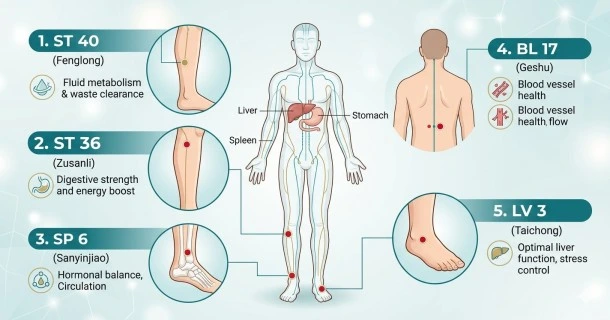
If you prefer a simplified approach without diagnosing complex TCM patterns, regular stimulation of these core metabolic pressure points can help support your overall cardiovascular profile:
1. Stomach 40 (ST 40 - Fenglong)
- Location: On the lower leg, midway between the knee crease and the outer ankle bone, about two finger-widths lateral to the shinbone.
- Why it matters: Known as the premier point in TCM for resolving hidden "phlegm" and clearing metabolic waste, ST 40 is widely used to support body fluid regulation and optimize lipid clearance.
2. Stomach 36 (ST 36 - Zusanli)
- Location: Approximately four finger-widths below the bottom of the kneecap, and one finger-width toward the outside of the shinbone.
- Why it matters: This is one of the most powerful points for reinforcing metabolic energy (Qi). Stimulating ST 36 helps strengthen digestive functions, improves nutrient absorption, and boosts cellular vitality.
3. Spleen 6 (SP 6 - Sanyinjiao)
- Location: Three finger-widths above the tip of the inner ankle bone, right behind the rear border of the shinbone.
- Why it matters: SP 6 is the intersection point of three major meridians (Spleen, Liver, and Kidney). It plays a crucial role in regulating hormonal balance, stabilizing metabolism, and smoothing blood circulation.
4. Bladder 17 (BL 17 - Geshu)
- Location: On the back, roughly two finger-widths lateral to the lower border of the spinous process of the 7th thoracic vertebra.
- Why it matters: Renowned as the influential point for blood health, BL 17 is utilized to relieve systemic stasis, support healthy blood vessels, and enhance overall circulatory efficiency.
5. Liver 3 (LV 3 - Taichong)
- Location: On the top of the foot, in the depression between the first (big) and second toes, about two finger-widths up from the webbing.
- Why it matters: The liver is the primary organ responsible for endogenous cholesterol synthesis and clearance. LV 3 helps manage stress, regulates autonomic responses, and supports optimal liver function.
How to Apply Acupressure Safely at Home
To practice self-administered acupressure effectively, follow these simple steps:
- Sit comfortably and take a few deep breaths to relax your body.
- Locate the desired acupoint. Use your thumb, index finger, or a smooth, blunt tool to apply steady, firm pressure.
- Massage the point using small, circular motions for 1 to 3 minutes. Apply enough pressure that you feel a mild, dull ache or tingling sensation, but never sharp pain.
- Breathe naturally and deeply throughout the process. Repeat the routine daily or a few times a week.
Is Acupressure Safe?
Acupressure is highly safe, non-invasive, and well-tolerated by most individuals. Because it does not rely on biochemical introductions, there are no medical side effects or pharmaceutical interactions reported.
Precautions:
- Bruising and Tenderness: Sensitive individuals or those taking blood thinners should apply gentle, moderate pressure rather than deep, vigorous pressure to prevent localized bruising.
- Pregnancy: Certain pressure points—particularly Spleen 6 (SP 6)—can stimulate uterine contractions and must be strictly avoided during pregnancy. Always consult a certified prenatal acupressure practitioner or your OB-GYN.
- Local Injuries: Never apply physical pressure directly over open wounds, active infections, severe inflammation, fresh bruises, or fractures.
Frequently Asked Questions (FAQs)
Can acupressure directly cure high cholesterol?
No. Acupressure cannot cure or instantly reverse high cholesterol on its own. It acts as a supportive lifestyle tool designed to optimize metabolic performance, reduce systemic stress, and improve blood circulation. For effective lipid control, it must be paired with physical exercise, dietary changes, and any doctor-prescribed medications.
How often should I stimulate pressure points for cholesterol health?
For optimal results, it is generally recommended to practice acupressure once daily or 3 to 4 times per week. Consistency over a period of several months is essential to experience the systemic, stress-reducing benefits of mind-body therapies.
Why is the Stomach 40 (ST 40) point highly emphasized for cholesterol?
In clinical acupuncture and acupressure settings, Stomach 40 (Fenglong) is considered the primary point for resolving "phlegm." In holistic medicine terms, this translates directly to clearing fatty accumulations, metabolic waste, and damp congestion from the circulatory pathways.
Can I practice acupressure if I am taking prescription statins?
Yes. Acupressure is non-invasive and does not involve biochemical substances, making it completely safe to practice alongside conventional pharmaceutical treatments like statins. Make sure to double-check your physical medication labels and follow up with your doctor regularly to monitor your progress.