
High cholesterol rarely presents noticeable symptoms, meaning routine screening is your primary line of defense against cardiovascular risks. Many individuals delay these essential checks because they believe they must fast for 9 to 12 hours beforehand. However, a standard baseline cholesterol screening test does not require fasting. Understanding when you can skip the fast makes maintaining your health far more accessible.
Why Baseline Cholesterol Screening Doesn't Require Fasting
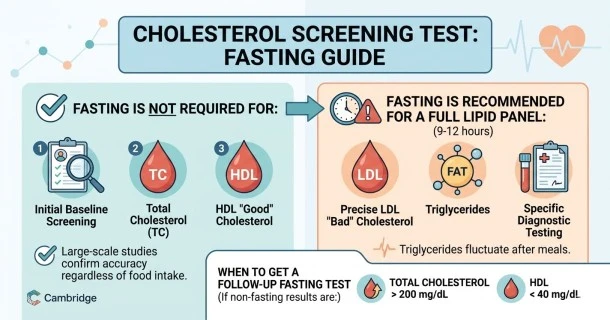
If you want a clear baseline picture of your heart health without the inconvenience of fasting, a non-fasting screening test evaluates two major lipid markers: Total Cholesterol and HDL (good) Cholesterol.
Large-scale clinical insights, including extensive data analyzed by Cambridge researchers, confirm that total cholesterol and HDL levels remain highly accurate regardless of whether you have recently eaten. While eating causes your triglycerides to fluctuate for up to 8 hours, it does not significantly alter these two foundational markers.
When Do You Need a Follow-Up Fasting Test?
A non-fasting screening acts as an initial filter. You will only be required to take a detailed, fully fasting lipoprotein profile to confirm a diagnosis if your screening numbers indicate potential risks:
- Total Cholesterol: Registers above 200 mg/dL.
- HDL Cholesterol: Drops below 40 mg/dL.
Age-Based Cholesterol Screening Guidelines
1. General Guidelines for Adults
All healthy adults over the age of 20 should receive a cholesterol screening test at least once every five years.
- Normal Results: If your numbers stay consistently optimal, your doctor may extend the time between your checks.
- Borderline Results: If your total cholesterol is borderline high or your HDL is low, you will require more frequent monitoring.
2. High-Risk Individuals (Any Age)
Routine screening intervals do not apply to individuals dealing with pre-existing metabolic or structural conditions. You must undergo consistent cholesterol testing regardless of your age if you manage:
- Diabetes mellitus.
- Coronary heart disease or history of stroke.
- Chronic high blood pressure (hypertension).
3. Pediatric Screening for Children
Early screening prevents long-term arterial damage. Children should be screened under the following criteria:
- Family Risk History: If a parent or close relative has a history of severe hypercholesterolemia or early heart attacks (under age 55 for men; under age 65 for women), children should begin screening between the ages of 2 and 10.
- Metabolic Complications: Children who are clinically obese or diagnosed with diabetes should be tested every 3 to 5 years, even if their early baseline numbers appeared normal.
Frequently Asked Questions (FAQs)
Is a non-fasting cholesterol test accurate?
Yes, a non-fasting cholesterol test is highly accurate for measuring total cholesterol and HDL (good) cholesterol levels. Large-scale clinical studies demonstrate that eating beforehand has a minimal impact on these specific markers, making it a reliable tool for initial risk screening.
Why do some doctors still recommend fasting before a lipid panel?
Fasting is recommended when your doctor needs to measure your exact triglyceride levels and calculate your low-density lipoprotein (LDL or "bad" cholesterol) precisely. Triglyceride levels fluctuate significantly for about 8 hours following a meal, which can alter the complete calculation of a full lipid profile.
What happens if my non-fasting cholesterol test results are abnormal?
If your baseline non-fasting test reveals a total cholesterol level over 200 mg/dL or an HDL level under 40 mg/dL, it serves as a clinical red flag. Your healthcare provider will then order a comprehensive, fasting lipoprotein profile test to confirm a formal diagnosis.