
Discover how insulin auto-injectors simplify daily care. Learn how hidden needles, fixed-depth mechanics, and automated delivery help manage needle phobia safely.
Insulin Auto-Injectors: Overcoming Needle Anxiety in Diabetes Care
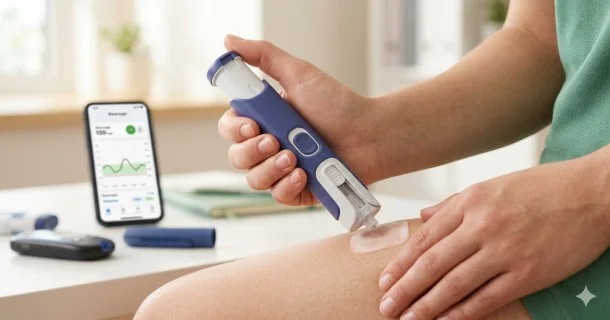
For many individuals living with diabetes, multiple daily injections can cause significant needle anxiety or physical discomfort. An insulin auto-injector is a specialized medical device designed specifically to assist individuals who find manual syringe insertion difficult. By completely concealing the needle before injection and mechanizing the fluid delivery process, these tools eliminate visual triggers and reduce physical hesitation.
Understanding how auto-injectors work allows you to evaluate alongside your healthcare professional if this device can help streamline your daily diabetes management.
What is an Insulin Auto-Injector?
An auto-injector is an ergonomic delivery housing that accommodates a standard insulin syringe or pre-filled cartridge device.
- Concealed Architecture: The integrated needle remains safely hidden inside the plastic shield tip, keeping it sterile and out of sight until the precise moment of deployment. This structure eliminates the risk of accidental needle-stick injuries.
- One-Touch Mechanics: At the push of a button or the application of pressure against the skin, an internal spring mechanism autonomously inserts the needle and injects the precise fluid dose.
- Dose Confirmation: Modern auto-injectors include clear mechanical click audio alerts or visual windows that shift color once the complete dose has left the chamber, ensuring no medication is wasted.
Critical Medical Correction: Subcutaneous vs. Intramuscular Delivery
A crucial clinical correction must be noted regarding the original text's historical instructions. The original text stated that the injector "shoots the needle into your muscles" and recommended pressing it into "muscle tissues."
This is medically incorrect for standard insulin administration. Insulin must always be delivered into the subcutaneous tissue (the fatty layer just beneath the skin), never directly into the underlying muscle layer. Injecting insulin into muscle tissue causes the medication to absorb far too rapidly, which can result in severe, sudden, and dangerous drops in blood sugar (acute hypoglycemia). Modern insulin auto-injectors feature short, fixed needle depths precisely calibrated to reach only the subcutaneous layer.
Step-by-Step Operation Guide
While activation steps vary across specific manufacturing models, standard clinical practices for loading and deploying an auto-injector include:
- Preparation: Wash your hands with warm water and soap. Wipe the targeted subcutaneous injection site (such as the abdomen or outer thigh) with an alcohol swab and let it air-dry completely.
- Safety Removal: Pull off the safety cap cap while keeping your fingers completely away from the exposed deployment tip to prevent accidental firing.
- Placement: Hold the injector firmly in your hand and place the safety guard tip perpendicular (at a 90-degree angle) flat against the skin.
- Deployment: Press the trigger button or push down firmly until the internal spring mechanism releases. Hold the device locked in place for a slow count of 5 to 10 seconds to guarantee that the fluid has completely dispersed into the subcutaneous fat tissue.
- Disposal: Withdraw the device gently and discard the single-use needle or cartridge component safely into a designated puncture-resistant biohazard sharps container.
Direct Comparison: Manual Injections vs. Auto-Injectors
| Feature | Manual Syringe / Pen Injection | Mechanized Auto-Injector |
|---|---|---|
| Long-Tail Keyword Focus | traditional manual diabetes injections | insulin delivery for needle anxiety |
| Needle Visibility | Fully exposed needle prior to skin entry | Hidden needle shielded before and after use |
| Depth Consistency | Dependent on manual hand angle and force | Mechanical fixed depth for ideal subcutaneous placement |
| Anxiety Level | High visual trigger; risk of needle hesitation | Low visual impact; automated rapid delivery |
Frequently Asked Questions (FAQ)
How does an auto-injector help someone with needle phobia?
An auto-injector completely conceals the needle inside an opaque plastic guide shield so you never see it. Additionally, it automates the puncture speed and fluid distribution at the click of a button, removing the psychological barrier of manually pushing a needle into your own skin.
Why is injecting insulin into muscle tissue dangerous?
Insulin is designed to absorb slowly and predictably from the subcutaneous fat layer. If an injection accidentally reaches muscle tissue, the high vascular blood flow causes the insulin to be absorbed much faster than intended, significantly increasing the risk of an acute, severe hypoglycemic event.
Can I reuse the needle inside an auto-injector device?
No, the needle or cartridge unit used inside an auto-injector remains strictly single-use. Reusing a needle dulls the tip, causes increased pain, and can introduce bacteria into the subcutaneous site, leading to potential localized skin infections or tissue micro-trauma.