
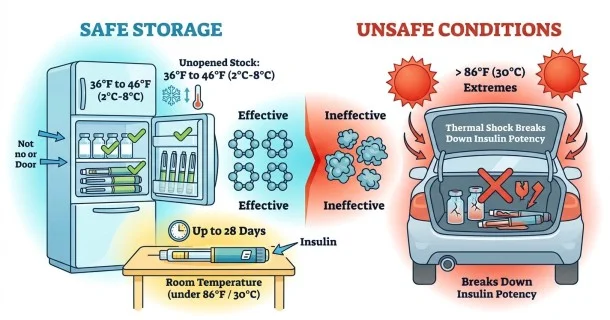
Learn how to store insulin correctly to keep it working perfectly. Compare refrigerator limits, room temperature guidelines, and visual safety checks.
Insulin Storage and Handling Guide: Temperature Rules and Safety Protocols
Proper insulin care begins with correct storage, as the hormone rapidly loses its therapeutic potency when kept for too long or exposed to extreme temperatures. Whether you use vials, disposable pens, or pump cartridges, protecting your insulin from excessive heat and freezing conditions ensures that your daily dosages remain effective and predictable.
Make sure to double-check the physical label of your insulin to verify the exact expiration date, storage requirements, and manufacturer guidelines before use.
Core Temperature Regulations for Storing Insulin
Insulin is a delicate protein hormone that breaks down easily when exposed to unfavorable environmental conditions. Follow these standard storage rules to preserve its integrity:
1. Unopened Insulin Stock
- Refrigerate immediately: Keep all unopened vials and pens inside a standard refrigerator maintained between 36°F and 46°F (2°C and 8°C).
- Never freeze: Avoid placing your stock near the cooling element or inside a freezer compartment. Freezing breaks down the molecular structure, causing the insulin to clump and render it permanently useless.
2. Open and In-Use Insulin
- Room temperature limits: The bottle or pen currently in active use can be safely kept at room temperature for up to 28 to 31 days without needing refrigeration.
- Maximum temperature threshold: Ensure your room temperature stays consistently under 86°F (30°C to 32°C). Keep in-use supplies far away from direct sunlight, hot vehicles, or appliances that emit heat.
- Comfort tip: Injecting cold insulin directly from the refrigerator can cause localized discomfort or minor pain at the injection site. Keeping your active supply at room temperature prevents this issue.
Pre-Injection Safety Inspections
Before drawing a dose or starting a new cartridge, develop a habit of inspecting your insulin carefully to rule out damage or contamination:
- Verify the Expiration: Check the printed expiration date on the box and the bottle label; if it has expired, discard it immediately.
- Confirm Visual Clarity: If you are using clear insulins—such as Regular, insulin aspart (NovoLog), insulin lispro (Humalog), insulin glargine (Lantus), insulin glulisine (Apidra), or insulin detemir (Levemir)—the liquid must look perfectly transparent and glass-clear.
- Check for Anomalies: Look closely for any floating particles, cloudiness, clumping, or distinct discoloration. If you notice any changes in appearance, do not use the product, and return it to your pharmacy for an exchange.
Frequently Asked Questions (FAQ)
What happens to the medicine if insulin gets too hot or freezes?
Insulin is a protein hormone, meaning it unfolds and permanently breaks down when exposed to thermal stress. If it gets hotter than 86°F (30°C to 32°C) or drops below freezing (32°F or 0°C), the molecular structures clump together irreversibly. Once damaged, the insulin will fail to lower your blood glucose reliably, leading to unexpected, dangerous spikes in blood sugar or state-level ketoacidosis.
Can I place my insulin in the refrigerator door shelves?
It is highly recommended to store your unopened stock on a middle shelf inside the main body of the refrigerator rather than the door shelves. The temperature inside the door fluctuates heavily every time the refrigerator is opened and closed, which can accelerate the breakdown of the medicine. Furthermore, avoid placing it too far in the back where items can accidentally freeze against the cooling coils.
How do I store intermediate-acting or pre-mixed cloudy insulins?
Unlike clear varieties, intermediate-acting (NPH) and pre-mixed insulins naturally look cloudy because they contain added crystalline proteins. While they follow the identical temperature rules as clear options, you must gently roll the vial or pen between your palms roughly 10 to 20 times before use to evenly resuspend the particles. Never shake the bottle violently, as this creates tiny air bubbles that can cause inaccurate dose measurements.
How should I handle and protect my insulin while traveling?
When traveling by car or airplane, never place your insulin inside checked luggage or a hot vehicle trunk, where extreme temperatures will instantly destroy it. Keep all supplies in your carry-on bag. If you are traveling through hot areas or locations exceeding 86°F (32°C), utilize a specialized, insulated travel cooling case or a water-activated evaporative pouch (like a Frio pouch) to keep the medication at a safe baseline temperature.