
Explore how needle-free insulin jet injectors use fluid pressure to deliver doses safely. Learn about tissue absorption differences, comfort, and device settings.
Needle-Free Insulin Jet Injectors: Features, Benefits, and Clinical Guidelines
For individuals living with diabetes who navigate profound needle phobias or deep skin anxieties, traditional syringes and pens present a significant psychological barrier to daily care. A needle-free insulin jet injector offers a highly advanced alternative that eliminates sharp metal needle tips entirely from the drug delivery process.
By utilizing precise fluid dynamics, these specialized devices deliver medication safely and effectively across the skin barrier into the target tissue matrix.
How a Needle-Free Jet Injector Works
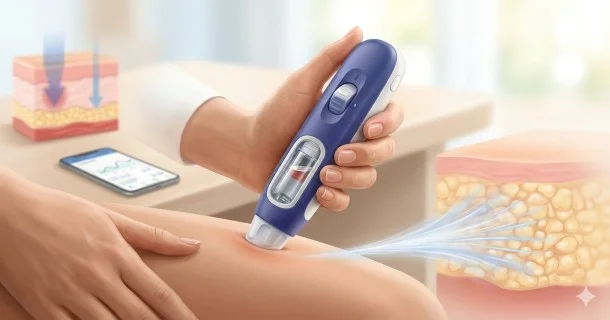
Instead of using a sharp tip to pierce the epidermis, a jet injector relies on a highly calibrated, pressurized spring or gas mechanism to compress a liquid dose of insulin.
- Microscopic Liquid Stream: The injector forces the liquid insulin through a tiny micro-orifice at extreme high pressure. This creates a microscopic, high-velocity stream that painlessly passes straight through the pores of the skin dermis without requiring a deep physical puncture.
- Subcutaneous Dispersion: Once the micro-stream crosses the outer layer of the skin, the fluid naturally fans out into a wide aerosol pattern across the subcutaneous fat layer rather than pooling in a single spot.
Critical Medical Correction: Accelerated Insulin Absorption
When transitioning to a needle-free jet injector, a critical physiological change must be carefully monitored under direct medical guidance.
Because the pressurized micro-stream disperses insulin widely throughout the tissue matrix rather than depositing it in a single manual depot pool, the medication is absorbed by the body significantly faster than a standard syringe shot.
Due to this accelerated uptake profile, individuals often need to work closely with their endocrinologist or diabetes care team to systematically adjust baseline dosages. This ensures that the rapid action does not trigger unexpected post-meal drops or sudden hypoglycemic events.
Calibrating Injection Pressure and Comfort
A common misconception is that jet injectors are completely imperceptible or pain-free for every patient. In clinical practice, physical comfort depends heavily on personal body composition and precise device configuration.
- Impact of Body Composition: Individuals with deep subcutaneous fat reserves generally find jet injectors to be virtually painless. Conversely, children or lean adults with minimal body fat or thin skin profiles may experience a sensation similar to a quick pinch or a light rubber band snap.
- Pressure Setting Calibration: Users must fine-tune the delivery force based on the specific area of the body being targeted. Configuring the device with too much pressure can cause localized skin bruising or capillary damage. Conversely, setting too little pressure results in incomplete dosing due to liquid leaking backward onto the skin surface. Comprehensive user training from the device manufacturer is crucial to achieving perfect calibration.
Evaluating the Clinical Pros and ConsClear Advantages
- Complete Elimination of Sharps: Eliminates the psychological hesitation associated with needles and removes the daily need for complex sharps disposal containers.
- Volumetric Accuracy: The internal loading chambers make drawing up a precise, micro-measured fluid dose highly reliable, even for younger patients or those with minor visual impairments.
Practical Limitations
- Upfront Initial Expense: The heavy-duty mechanical core makes the initial acquisition cost high compared to single pens, though there are fewer recurring accessory expenses over time.
- Device Maintenance: Unlike disposable options, standard jet injectors require systematic weekly sterilization routines to keep internal fluid paths clean and perfectly safe.
Direct Comparison: Needle-Free vs. Sharp-Needle Delivery
| Technical Evaluation Metric | Pressurized Jet Injectors | Standard Syringes / Pens |
|---|---|---|
| Long-Tail Search Intent | needle free insulin delivery systems | traditional manual diabetes injections |
| Skin Puncture Mechanism | Micro-velocity fluid stream pressure | Beveled stainless steel needle shaft |
| Tissue Absorption Dynamics | Accelerated (mist dispersion throughout tissue) | Standard (localized baseline depot pool) |
| Initial Upfront Device Cost | High one-time mechanical equipment cost | Low baseline investment per individual pen |
| Maintenance Requirements | Requires strict, systematic weekly sanitization | Zero tool maintenance (single-use disposables) |
Frequently Asked Questions (FAQ)
Is a needle-free jet injector completely painless?
Comfort levels vary based on your body composition. Individuals with typical subcutaneous fat layers usually report that jet injectors feel virtually painless. However, lean individuals or children with minimal tissue fat might feel a brief pinch or slight pressure drop during delivery.
Why does insulin absorb faster when delivered via a jet injector?
Traditional needles deposit insulin in a tight, concentrated pool under the skin, which takes time to absorb. Jet injectors force the liquid out as a high-speed mist that disperses widely throughout the subcutaneous tissue matrix, allowing your capillaries to absorb the insulin significantly faster.
Do insurance policies typically cover jet injector devices?
Because jet injectors require a higher initial financial investment than standard disposable needles, coverage varies greatly by provider and specific medical necessity conditions. Always check directly with your insurance representative regarding your specific plan benefits before purchasing.