
Discover what causes astigmatism, from genetic factors at birth to eye injuries and conditions that alter your vision later in life. Get the medical facts here.
What Causes Astigmatism? Underlying Reasons for Blurry Vision
Astigmatism is a very common eye condition caused by an irregular curvature of either the cornea (the clear front window of the eye) or the natural lens inside the eye. Instead of being perfectly round like a basketball, an eye with astigmatism is shaped more like an oval or a football. This uneven shape prevents light rays from focusing onto a single sharp point on your retina, resulting in distorted or blurry vision at all distances.
The Primary Causes of Astigmatism
While eye specialists do not fully understand why the shape of the eye varies so much between individuals, medical data points to a few primary causes:
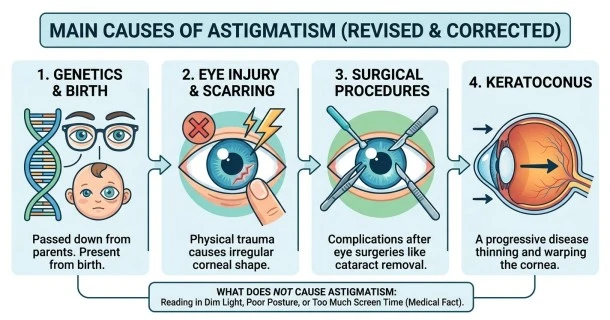
1. Genetics and Hereditary Factors
For the vast majority of people, astigmatism is inherited and present from birth. If your parents or close relatives require corrective lenses for astigmatism, you are at a significantly higher risk of developing it as your eyes grow.
2. Eye Injuries and Trauma
A physical injury to the eye can cause corneal scarring. When scar tissue forms over the cornea, it alters its natural, even curvature, resulting in acquired or irregular astigmatism later in life.
3. Ocular Surgeries
Certain surgical procedures—such as cataract removals, corneal transplants, or glaucoma surgeries—involve micro-incisions that can subtly shift the structural tension of the eye. While modern techniques aim to minimize this, postoperative astigmatism is a known possibility.
4. Advanced Corneal Health Conditions
- Keratoconus: This is a progressive condition where the cornea becomes thin and gradually bulges outward into a cone shape. It causes severe, irregular astigmatism that often cannot be fully corrected with standard eyeglasses.
- Other Corneal Issues: Less common conditions like pellucid marginal degeneration or benign growths on the eye surface (such as a pterygium) can also warp the cornea.
Corneal vs. Lenticular Astigmatism
Depending on which part of your eye structure is misshapen, astigmatism is divided into two types:
| Type of Astigmatism | Underlying Structural Cause | Key Characteristics |
| Corneal Astigmatism | The front surface (cornea) of the eye has mismatched or uneven curves. | The most common form; often caused by genetics or surface scarring. |
| Lenticular Astigmatism | The internal natural lens of the eye is irregularly shaped. | Less common; can change with age-related lens changes (like cataracts) or systemic fluctuations. |
Medically Corrected Myths: What Does Not Cause Astigmatism
There is a widespread misconception that behavioral habits ruin your eyesight. According to the Mayo Clinic and the National Eye Institute, astigmatism is NOT caused or worsened by:
- Reading in dim or poor light
- Sitting too close to the television or computer screens
- Poor posture or squinting
While these habits can lead to temporary eye strain and headaches, they do not permanently alter the physical shape of your cornea or lens.
Frequently Asked Questions (FAQs)
Can you suddenly develop astigmatism later in life?
Yes, you can develop astigmatism as an adult. While most cases are present from birth, adult-onset astigmatism is usually triggered by an eye injury, a surgical complication, age-related changes to the eye's crystalline lens, or a progressive corneal condition like keratoconus.
What causes astigmatism to worsen over time?
In children, astigmatism frequently changes as the eye physically grows. In adults, a gradual worsening is often linked to the natural aging process of the internal lens. However, a sudden or severe increase in astigmatism can be a red flag for keratoconus or an underlying eyelid mass pushing against the cornea.
Is astigmatism a disease?
No, astigmatism by itself is not an eye disease. It is a refractive error, similar to nearsightedness (myopia) and farsightedness (hyperopia). It simply means your eye does not bend light perfectly, which can be easily managed with corrective lenses or refractive surgery.ry.