
Explore the best ways to correct astigmatism. From toric contact lenses and Ortho-K to LASIK and PRK laser eye surgery, find the right treatment for your vision.
Astigmatism Correction: Modern Treatment Options for Clear Vision
Astigmatism can be highly corrected and managed using a variety of non-surgical and surgical methods designed to counterbalance the irregular curvature of your eye. Because astigmatism causes light to scatter rather than focusing cleanly on the retina, treatments work by redirecting light rays back into a single, sharp focal point. Depending on your lifestyle, age, and severity of refractive error, your optometrist or ophthalmologist will recommend the most appropriate option.
Non-Surgical Astigmatism CorrectionFor individuals seeking clear vision without undergoing a surgical procedure, several highly effective optical solutions are available:
1. Prescription Eyeglasses
Eyeglasses remain the primary and most accessible choice for correcting astigmatism.
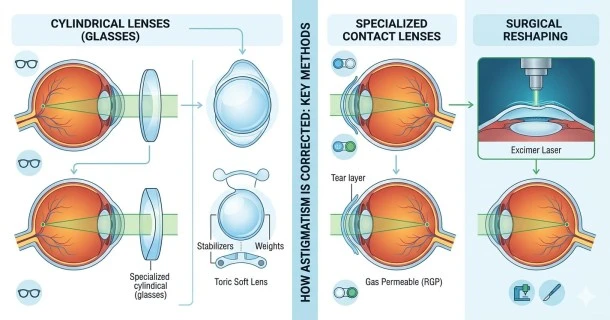
- Cylindrical Lenses: Unlike standard lenses for nearsightedness or farsightedness, astigmatism glasses use a specialized cylindrical lens that bends light in only one specific direction.
- Understanding Your Prescription: A typical prescription reads like this:
-1.00 -1.25 x 180.- The first number (
-1.00) is the Sphere, indicating nearsightedness or farsightedness. - The second number (
-1.25) is the Cylinder (CYL), indicating the severity of your astigmatism. - The third number (
180) is the Axis, indicating the exact angle (from 1 to 180 degrees) where the lens correction is positioned.
- The first number (
2. Specialized Contact Lenses
Standard spherical contact lenses do not correct astigmatism because they conform directly to the eye's irregular shape. Instead, specialized designs are required:
- Toric Soft Lenses: These lenses feature varying powers in different meridians and are weighted at the bottom to prevent the lens from rotating out of alignment when you blink.
- Rigid Gas Permeable (RGP) Lenses: These are hard lenses that maintain their firm shape on the eye. They create a smooth, spherical layer of tears over the cornea, providing exceptionally crisp vision for severe or irregular astigmatism.
3. Orthokeratology (Ortho-K)
Ortho-K uses specially designed, rigid gas-permeable contact lenses worn exclusively overnight while you sleep.
- Mechanism: The lenses gently temporarily reshape the curvature of your cornea surface.
- Result: When removed in the morning, your reshaped cornea allows you to see clearly without glasses or daytime contacts.
- Note: This effect is completely temporary. If you stop wearing the night retainer lenses, your eye will revert to its original shape within a few days.
Surgical Refractive Procedures
If you want to permanently correct astigmatism and eliminate your dependency on corrective eyewear, surgical options reshape the corneal tissue using advanced laser technology:
1. LASIK (Laser-Assisted In Situ Keratomileusis)
LASIK is the most common laser eye surgery performed today. A surgeon creates a thin, microscopic flap on the outer layer of the cornea, folds it back, and uses an excimer laser to precisely remove microscopic amounts of underlying tissue to smooth out the eye's irregular shape. The flap is then laid back down to heal naturally.
2. PRK (Photorefractive Keratectomy)
PRK is an alternative to LASIK ideal for patients with thinner corneas. Instead of creating a flap, the surgeon completely removes the thin outer surface layer (epithelium) of the cornea. The laser then reshapes the exposed corneal structure directly. The surface cells naturally regenerate and grow back within a few days.
Direct Comparison of Correction Treatments
| Treatment Type | Permanent | Best Suited For | Key Consideration |
| Eyeglasses | No | All ages and severities. | Safe, low-risk, but restricts peripheral views. |
| Toric Soft Contacts | No | Mild to moderate astigmatism. | Comfortable, but can occasionally shift or rotate. |
| RGP Hard Contacts | No | Moderate to severe or irregular shapes. | Provides the sharpest vision; requires an adaptation period. |
| Orthokeratology | Temporary | Active individuals, athletes, or children. | Completely reversible; requires nightly lens wear. |
| LASIK / PRK Surgery | Yes | Adults with stable prescriptions. | Permanent fix; carries standard minor surgical risks. |
Frequently Asked Questions (FAQs)
Can astigmatism be cured naturally with eye exercises?
No, astigmatism cannot be cured or reversed using eye exercises, dietary changes, or massage techniques. Astigmatism is a structural, physical imperfection in the shape of your cornea or internal crystalline lens. The only ways to change how light focuses on your retina are through corrective optical lenses or refractive surgical reshaping.
Why do my astigmatism glasses make me feel dizzy at first?
Because cylindrical lenses alter peripheral magnification to compensate for your eye's irregular shape, your brain requires an adjustment period to adapt to the new visual perspective. This mild dizziness or "fishbowl effect" is normal and usually resolves completely within a few days of continuous wear.
Can you have LASIK if you have astigmatism?
Yes, modern LASIK surgery is highly effective at correcting astigmatism. Advanced laser mapping systems measure the specific contours of your eye, allowing the laser to smooth out asymmetrical curvatures with extreme precision.