Learn what astigmatism is, how it affects your vision, and how it differs from other eye conditions. Discover the basics of this common corneal profile.
Understanding Astigmatism: A Comprehensive Overview
Astigmatism is a highly common and generally treatable type of refractive error—not an eye disease. It occurs when the clear front window of your eye (cornea) or the natural lens inside the eye has mismatched curves.
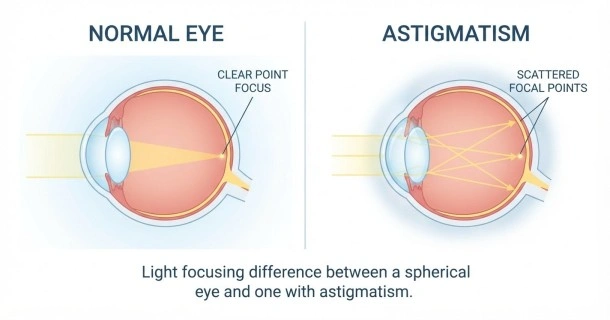
Instead of being perfectly round like a basketball, an eye with astigmatism is shaped more like an oval or a football. This irregular shape prevents incoming light rays from focusing sharply on a single point on your retina. Instead, light scatters, which may lead to distorted or blurred vision at all distances.
Normal Eye Structure:
Light Rays --------> [ Round Cornea ] --------> Focused on a Single Point (Retina) = Clear Vision
Astigmatism Eye Structure:
Light Rays --------> [ Oval/Football Cornea ] -> Scattered to Multiple Focal Points = Blurry Vision
Astigmatism regularly coexists with other refractive errors, including myopia (nearsightedness) and hyperopia (farsightedness). Together, these conditions alter how your eyes bend and focus light rays.
While mild amounts of astigmatism typically do not affect your daily vision, larger amounts can cause noticeable visual distortion, eye fatigue, and headaches.
Exploring Astigmatism
To better understand how this condition impacts your life and how it can be managed, explore our detailed sub-sections below:
- Astigmatism Symptoms: Discover the primary warning signs, including night-driving glares, frequent squinting, and how uncorrected vision can impact a child's school performance.
- Astigmatism Causes: Learn about the genetic factors behind corneal and lenticular variations, as well as the structural changes triggered by eye injuries.
- Astigmatism Test & Diagnosis: Explore what happens during a comprehensive eye exam, from reading a standard visual acuity chart to advanced corneal topography maps.
- Astigmatism Correction & Treatment: Review your clinical choices for achieving clear vision, including specialized toric contact lenses, glasses, and permanent refractive surgeries like LASIK.
Frequently Asked Questions (FAQs)
Can astigmatism go away on its own?
No, astigmatism does not resolve on its own. Because it is caused by the physical, structural shape of your eye's cornea or lens, it remains stable or changes gradually as the eye grows or ages. The only ways to actively counteract it are through prescription eyewear or refractive surgery.
Is astigmatism considered a serious eye disease?
No, astigmatism is not an eye disease, nor does it mean your eyes are unhealthy. It is simply a highly common refractive error where light does not bend evenly. While uncorrected astigmatism causes frustrating symptoms like chronic headaches and eye strain, it is fully manageable and easily corrected by eye care professionals.
Who is at risk for developing astigmatism?
Most people are born with some minor degree of astigmatism due to inherited genetic traits. It can affect adults and children alike. Beyond genetics, individuals who experience severe eye trauma, undergo specific corneal surgeries, or develop progressive thinning conditions like keratoconus may notice changes in their astigmatic profile.