
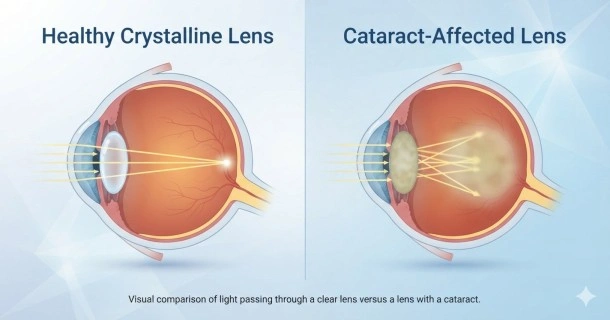
Discover how cataracts develop within the eye's natural crystalline lens. Learn about early-stage lens changes, how proteins cause cloudiness, and why it is a leading cause of reversible vision loss.
Understanding Cataracts: An Introduction to Lens Clouding
A cataract is a progressive clouding or opacification of the eye's natural, crystalline lens that interferes with clear vision by scattering and obstructing the passage of light. Situated right behind the iris and pupil, this transparent, avascular structure acts like a camera lens, focusing sharp, vivid light rays directly onto the retina at the back of your eye.
When the lens becomes clouded, images delivered to your brain turn hazy, dim, or distorted. Globally, cataracts remain the leading cause of reversible blindness and significant visual impairment. While they commonly develop in both eyes, they do not spread from one eye to another; however, one eye often experiences advanced progression much earlier than the other.
How Age-Related Cataracts Form: The Pathophysiology
The biological structure of a healthy crystalline lens is composed almost entirely of water and highly organized, precisely arranged structural proteins called crystallins. This tight, microscopic alignment is what keeps the lens perfectly clear, allowing unhindered light transmission.
As we cross into our fourth and fifth decades, the natural aging process triggers biochemical shifts within the lens tissue.
- Protein Denaturation: Over time, normal metabolic changes cause these stable structural proteins to break down, denature, and lose their transparency.
- Protein Aggregation: Instead of remaining organized, the broken-down proteins begin to clump together.
- Lens Opacification: These accumulating protein clumps create localized areas of cloudiness. As the cataract matures, the lens slowly shifts from clear to a dense, yellowish-brown shade, blocking vital light from reaching the retina.
Early-Stage Lens Changes & Vision Transitions
During the initial development of a cataract, the cloudiness may only impact a minute portion of your lens, leaving your day-to-day visual acuity relatively undisturbed. However, distinct physiological transformations begin taking place:
- The Myopic Shift ("Second Sight"): As the center of the lens (the nucleus) hardens and compresses, its refractive power temporarily increases. This can cause a paradoxical temporary improvement in near vision, sometimes allowing individuals over 55 to read without reading glasses.
- Progressive Loss of Clarity: This shift is temporary. As the opacification expands, a gradual, painless decline in vision takes over. Brighter reading lights and frequent prescription updates will eventually fail to restore visual clarity.
- Bilateral Asymmetry: Because cataracts develop independently in each eye, you may experience vastly different visual clarity between your left and right eye during these early transitions.
Frequently Asked Questions (FAQ)
Can cataracts spread from one eye to the other?
No. Cataracts are localized cellular and structural changes happening within the protein matrix of an individual eye’s lens. They do not contain infectious agents and cannot cross over or spread to the opposite eye, though aging typically causes them to develop in both eyes around the same timeframe.
Are cataracts an inevitable part of growing older?
Yes, to a large extent. The biochemical breakdown of lens proteins is a natural marker of human aging. While underlying medical conditions like diabetes, smoking, and extensive UV exposure can rapidly accelerate the process, nearly everyone will develop some degree of lens clouding if they live long enough.
Can early-stage cataracts be reversed or cured with eye drops?
No. There are currently no medically approved pharmacological treatments, medications, or specialized eye drops capable of reversing or dissolving protein aggregation once it has formed inside the lens. The only definitive, permanent cure for a visually restrictive cataract is modern cataract surgery.