
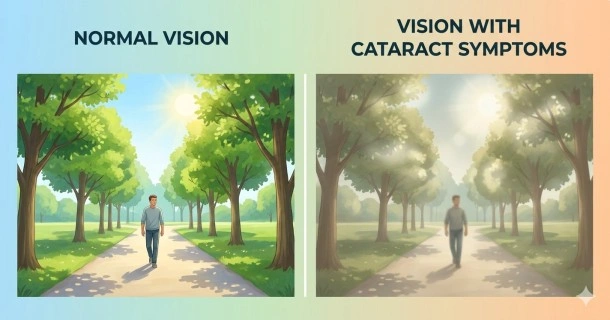
Learn to recognize the key signs and early symptoms of cataracts, including cloudy or blurry vision, night glare, halos around lights, and faded color perception.
Early Symptoms of Cataracts: Recognizing the Signs
The most prominent and defining symptom of a cataract is a gradual, painless blurring or clouding of your vision. Because cataracts grow very slowly, your eye health and sight change incrementally. You might not notice major adjustments early on, but over time, daily activities like reading, driving at night, or reading facial expressions become increasingly difficult.
Key Symptoms and Indicators of Cataracts
As the natural crystalline lens inside the eye becomes more opaque, light cannot focus cleanly onto your retina. This physical disruption creates several distinct visual disturbances:
- Painless Blurred or Hazy Vision: Your overall eyesight may feel like you are perpetually looking through a foggy window or a dirty piece of glass.
- Increased Glare and Light Sensitivity: Bright sunlight, indoor lamps, or oncoming headlights can suddenly feel overwhelming or blinding.
- Halos and Starbursts Around Lights: At night, streetlights and headlights frequently appear surrounded by glowing rings or scattered starburst patterns.
- Degraded or Poor Night Vision: You may find it difficult to navigate in low-light environments, requiring much brighter lights for reading or close-up tasks.
- Faded, Yellowed, or Dim Colors: As the lens proteins degrade and take on a yellowish-brown tint, colors lose their vividness. Whites look creamy or yellow, and blues or purples become difficult to differentiate.
- Monocular Diplopia (Double Vision in One Eye): Sometimes, the irregular density of a clearing or clouding lens causes light rays to split, projecting a double or ghost image even when you cover your unaffected eye. Paradoxically, this specific symptom can sometimes decrease or vanish entirely as the cataract expands across the rest of the lens core.
When to Consult an Eye Care Professional
Cataracts never cause physical pain, redness, or itching in the eye. If your eyesight is progressively worsening or if you experience sudden visual disruptions, scheduling a comprehensive dilated eye exam with an eye specialist is vital. Early diagnosis rules out other serious, sight-threatening ocular conditions such as glaucoma or macular degeneration.
Frequently Asked Questions (FAQ)
Do cataract symptoms include physical eye pain or headaches?
No. The development of a cataract is an entirely painless cellular process within the lens of the eye. If you experience aching eye pain, sudden headaches, eye redness, or a rapid loss of vision over a few hours, seek emergency medical care immediately, as these are signs of acute narrow-angle glaucoma or other urgent eye conditions.
Why do headlights look so bright and blurry at night if I have cataracts?
The cloudy protein clusters forming your cataract scatter the oncoming light rays as they enter your pupil instead of focusing them into a sharp point. This scattering causes the glare, starbursts, and halos that make driving at night dangerous.
Can cataract symptoms be corrected permanently with new glasses?
Only in the early stages. Updating your eyeglass prescription can temporarily compensate for the early vision changes caused by a mild cataract. However, as the structural cloudiness becomes denser, no corrective lens prescription will be able to restore sharp sight because the physical barrier inside the eye lens remains.