
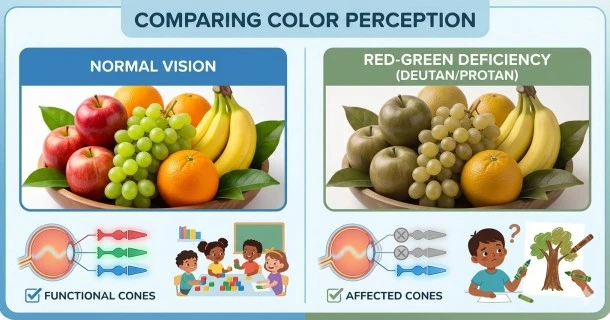
Learn to identify color blindness symptoms in children and adults. Discover the differences between mild anomalous trichromacy and severe dichromacy.
Symptoms of Color Vision Deficiency
The symptoms of color vision deficiency (CVD) vary significantly from person to person depending on the specific type of deficiency and whether the condition is mild, moderate, or severe. In fact, many individuals have such mild symptoms that they remain entirely unaware of their condition well into adulthood.
Unlike progressive ocular diseases, congenital color vision deficiency does not occur in "stages"—it is a stable, lifelong condition determined at birth.
Common Signs and Symptoms
While the exact colors that present a challenge depend on which photoreceptors (cones) are affected, general signs of color vision deficiency include:
- Difficulty Distinguishing Hues: Inability to tell the difference between specific colors, most commonly shades of red and green, or less frequently, blue and yellow.
- Shade Overlap: Trouble differentiating between similar shades, tones, or saturations of the same color (e.g., mistaking olive green for brown, or navy blue for purple).
- Altered Brightness Perception: An inability to perceive the true brightness, vividness, or intensity of colors in the same manner as an individual with standard trichromatic vision.
Classification by Severity: Mild vs. Severe Deficiencies
Medical professionals classify congenital color vision deficiencies based on the functional status of the retina's cone photoreceptors:
- Anomalous Trichromacy (Mild to Moderate): All three types of cones (red, green, and blue) are present, but one type possesses an altered spectral sensitivity. Symptoms are often subtle. Individuals can see a vast array of colors but frequently mistake overlapping intermediate hues under dim light or when looking at small color samples.
- Dichromacy (Severe): One specific type of cone photoreceptor pigment is completely absent or non-functional. This results in a pronounced inability to distinguish between red and green (Protanopia or Deuteranopia) or blue and yellow (Tritanopia).
- Achromatopsia (Total Color Blindness): This is an extremely rare condition where two or all three cone mechanisms are missing. Individuals see the world strictly in black, white, and shades of gray. Symptoms are severe and include profound light sensitivity (photophobia), involuntary eye movements (nystagmus), and significantly reduced visual acuity.
Spotting Color Blindness in Children
Because children born with color vision deficiency have never experienced standard color perception, they rarely complain about their vision. Instead, symptoms are usually noticed by parents or teachers during early childhood development.
Key signs to watch for include:
- Difficulty or frustration when learning, naming, or sorting colors.
- Using inappropriate colors when drawing or coloring (e.g., painting a tree trunk green and leaves purple).
- Relying heavily on texture, smell, or brightness rather than color to identify objects (such as identifying fruit by its shape alone).
- Complaining of eye strain or headaches when looking at red text on a green background.
Frequently Asked Questions (FAQ) Section
What are the most common color blindness symptoms in daily life?
The most common symptoms include difficulty distinguishing between reds, greens, browns, and oranges (in red-green deficiency) or blues and greens (in blue-yellow deficiency). People may also struggle to read color-coded graphs, identify whether a traffic light is red or yellow from a distance, or determine if meat is fully cooked.
Can you have mild color blindness symptoms without knowing it?
Yes. Mild cases of color vision deficiency (such as mild deuteranomaly) are frequently asymptomatic in normal environments. Because individuals see a broad spectrum of colors, they may only discover their deficiency as adults during a routine optometric exam or when failing a workplace color assessment for professions like aviation, military, or graphic design.
Do color blindness symptoms worsen over time?
Congenital (genetic) color vision deficiency is stable and does not change or worsen throughout a person's life. However, if an individual notices a sudden or progressive loss of color perception, it is a sign of an acquired condition. Acquired color vision deficits can be caused by optic nerve diseases, macular degeneration, glaucoma, cataracts, or certain systemic medications, and require immediate medical evaluation.
How do teachers and parents identify color vision deficiency in children?
Signs in children typically manifest during creative or educational tasks. Parents and teachers might notice a child struggling to match pairs of socks, failing to identify colored chalk on a blackboard, or using unexpected color palettes in school artwork. Formal screening using specialized color plates can accurately diagnose children as young as four years old.