
Discover how eye care professionals test for color blindness. Learn about the Ishihara pseudoisochromatic plate test, pediatric exams, and clinical tools.
How Do Eye Care Professionals Test for Color Blindness?
Color blindness tests are diagnostic tools used by optometrists and ophthalmologists to detect, classify, and measure the severity of a color vision deficiency (CVD). Routine vision exams using standard eye charts do not evaluate color perception. Instead, specialized tests that utilize overlapping color spectrums are required to identify exact abnormalities in the retina's cone photoreceptors.
The Ishihara Color Vision Test
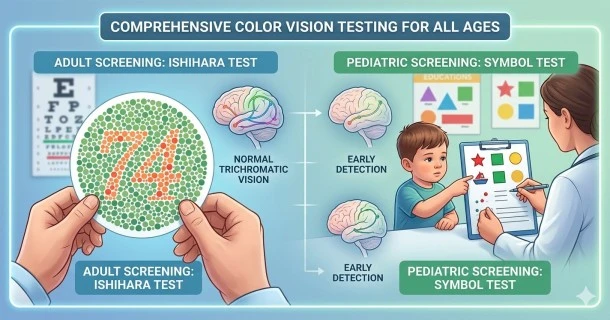
The Ishihara color vision test is the most widely recognized and universally utilized screening method for red-green color blindness. Designed in 1917 by Dr. Shinobu Ishihara, a professor at the University of Tokyo, this test consists of a specific series of circular images known as pseudoisochromatic plates.
- Composition of the Plates: Each plate is densely packed with randomized dots varying in size, brightness, and color.
- The Hidden Matrix: Within the dot pattern, a collection of dots forms a distinct numeral or path that is easily visible to an individual with standard trichromatic vision.
- The Diagnostic Contrast: An individual with a red-green deficiency will either fail to see the hidden figure entirely or see an alternative number because their brain cannot distinguish the contrasting hues.
- Comprehensive Assessment: A full, clinical Ishihara booklet typically contains 24 or 38 plates. Testing a comprehensive set allows practitioners to distinguish between total color blindness (dichromacy) and partial color weaknesses (anomalous trichromacy).
Testing Color Vision in Children
Because standard Ishihara plates rely entirely on numeral recognition, they cannot be reliably used on toddlers or young children who have not yet learned to identify numbers. To screen children early in development, specialized pediatric color vision tests have been developed. These tests replace numbers with universal geometric symbols or child-friendly illustrations—such as squares, circles, stars, or simple boat and car outlines. Identifying color vision deficits early ensures teachers and parents can modify learning materials appropriately.
Alternative and Advanced Clinical Tests
While the Ishihara test is an exceptional screening tool for congenital red-green defects, it cannot measure the exact severity of the condition, nor can it detect blue-yellow (tritan) deficiencies. To achieve a comprehensive diagnosis, clinics use advanced tests:
- Farnsworth-Munsell 100 Hue Test: This highly precise evaluation requires an individual to arrange a series of colored caps in a continuous, gradual chronological spectrum. It measures fine color discrimination and accurately diagnoses red, green, and blue-yellow defects.
- Anomaloscopes: Regarded as the gold standard for clinical research, an anomaloscope requires a patient to match a multi-colored light source to a fixed reference light by adjusting control knobs. It perfectly differentiates between a complete absence of a cone type (dichromacy) versus a shifted sensitivity (anomalous trichromacy).
Taking an Online Screening Test
While digital versions of color blind plates offer a fast, convenient way to screen your vision at home, online tests are not definitive medical diagnoses. Computer monitors, mobile screens, ambient room lighting, and device color calibrations vary wildly, which can heavily alter the appearance of the plates. If you or a family member struggle to identify figures during an informal online screening, schedule a standardized evaluation with an eye care professional to confirm your exact vision profile.
Frequently Asked Questions (FAQ) Section
What is the most accurate test for color blindness?
The Anomaloscope is clinically recognized as the gold standard for perfectly identifying and measuring the exact degree of red-green deficiencies. However, for everyday clinical screenings, the Ishihara pseudoisochromatic plate test is the most widely trusted and highly accurate tool for identifying the presence of red-green color blindness.
Can an online color blind test replace an eye doctor's exam?
No. Digital screenings provide an excellent baseline, but they cannot replace a professional diagnostic exam. Digital displays emit light differently than printed media, and factors like display brightness, blue-light filters, and screen resolution can produce inaccurate false-positive or false-negative results.
At what age can a child be tested for color vision deficiency?
Children can be screened as early as 3 to 4 years old using pediatric color vision tests. Instead of numbers, these tests utilize shapes, patterns, or symbols to assess color discrimination before a child possesses full numerical literacy.
Does the Ishihara test check for blue yellow color blindness?
No. Standard Ishihara test plates are specifically designed to diagnose red-green color deficiencies (protan and deutan defects). Testing for rare blue-yellow color vision deficiency (tritan defects) requires alternative diagnostic tools, such as the Farnsworth-Munsell 100 Hue Test or specialized HRR (Hardy-Rand-Rittler) pseudoisochromatic plates.