
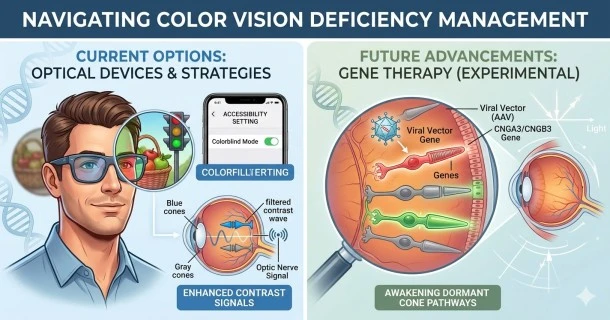
Explore current management strategies for color vision deficiency. Learn how color-correcting glasses, specialized lenses, and adaptive strategies assist.
Can Color Blindness Be Treated or Cured?
Currently, there is no structural cure or permanent medical treatment for congenital (genetic) color vision deficiency. Because inherited color blindness is caused by a missing or genetically altered cone photopigments in the retina, the condition remains stable and unchanging throughout a person's life.
However, if an individual develops acquired color blindness later in life due to an underlying disease (such as cataracts, glaucoma, diabetes, or macular degeneration) or as a pharmaceutical side effect, treating the primary medical condition or adjusting prescription medications can significantly improve or restore color perception.
Optical Solutions: Glasses and Lenses for Color Blindness
While optical devices cannot restore standard trichromatic color vision or repair non-functional retinal cones, several dynamic solutions exist to help individuals distinguish overlapping color hues:
- Color-Filtering Eyeglasses: Specially tinted glasses (such as modern optical filters) use advanced notch-filtering technology to block specific overlapping wavelengths of light between red and green spectral bands. By exaggerating the separation between these wavelengths, the user can accurately perceive enhanced contrast and differentiate colors that previously looked identical, though they do not experience true color vision.
- The X-Chrom Contact Lens: The X-Chrom lens is a red-tinted monocular contact lens worn strictly on an individual’s non-dominant eye. By creating a spectral disparity between the two eyes, it provides a specialized contrast cue that allows the brain to interpret shifting shades. While it historically assists individuals in passing specific diagnostic screenings like the Ishihara plate test, it does not correct the overall visual deficiency and can disrupt depth perception.
Adaptive Daily Strategies and Lifestyle Modification
Most individuals with color vision deficiency learn to navigate daily routines seamlessly using effective, practical adjustments:
- Location-Based Cueing: Relying on the standardized ordering of visual systems rather than the color itself—such as memorizing that the red stop light is universally positioned at the top of a traffic signal.
- Labeling and Organization: Labeling clothing, matching pairs, and school or office materials (such as pens, filing systems, or charts) with explicit descriptive words to avoid matching errors.
- Optimizing Digital Accessibility: Utilizing specialized "Colorblind Mode" accessibility profiles built directly into modern computer operating systems, smartphones, software applications, and video game engines to shift difficult palettes into highly legible contrasts.
- Enhancing Ambient Lighting: Ensuring living and working spaces are exceptionally well-lit with high-quality, full-spectrum LED illumination, as rich lighting naturally maximizes the eye’s capability to perceive contrasting saturations.
The Future of Treatment: Experimental Gene Therapy
The frontier of ocular science is actively investigating gene therapy as a path toward a functional cure. Clinical trials are successfully utilizing modified, non-pathogenic adeno-associated virus (AAV) vectors to deliver functional copies of missing photopigment genes directly beneath the retina. While current breakthroughs have primarily targeted complete color blindness (achromatopsia) caused by mutations in the CNGB3 and CNGA3 genes to awaken dormant cone pathways, ongoing research offers strong clinical hope for correcting common red-green deficits in the future.
Frequently Asked Questions (FAQ) Section
Are there any medical color blindness treatment options available today?
No medical treatment or surgical procedure can restore missing cone function for inherited color blindness. Treatment is exclusively management-focused, relying on specialized light-filtering glasses, colored contact lenses, and digital adaptations to improve contrast discrimination.
How do color blind glasses and lenses actually work?
These specialized lenses use optical filters to block specific overlapping wavelengths of light where red and green cone sensitivities bleed into one another. By filtering out these confusing frequencies, the lenses amplify the contrast between the remaining colors, making it dramatically easier for a person with CVD to tell shades apart.
Can gene therapy for color blindness cure the condition?
Gene therapy has shown profound success in clinical trials by successfully introducing healthy genetic sequences into the retina to restore functional cone activity. Currently, these cutting-edge therapies are focused on rare, complete color vision loss conditions like achromatopsia, but they represent the foundational basis for a true cure for all inherited forms of color vision deficits down the road.
Can acquired color blindness be reversed or cured?
Yes, in many instances. If your color vision deficiency is caused by a cataract, removing the clouded lens surgically will instantly restore normal light transmission and color vibrancy. Similarly, if the deficit is caused by toxic side effects from systemic medications, a physician can modify or change the treatment plan to halt or minimize further retinal degradation.