
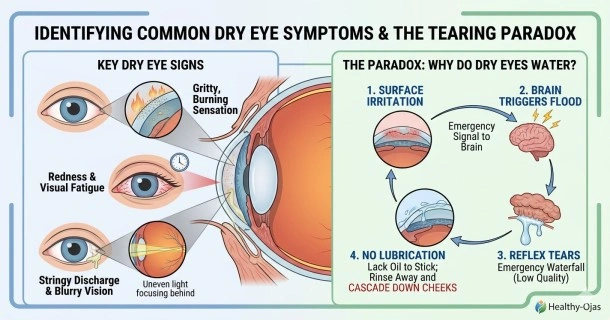
Are your eyes burning, stinging, or constantly watery? Discover the common signs of dry eye syndrome and learn why dry eyes paradoxically cause excessive tearing.
Dry Eye Symptoms: Common Signs of Ocular Discomfort
While the name dry eye is self-explanatory, this condition causes far more than a simple lack of moisture. It is a complex disorder of the tear film driven by low tear volume or poor tear quality (excessive evaporation).
When your tear film fails, it leaves the exposed outer surface of the eye—known medically as the interpalpebral ocular surface—unprotected and prone to friction damage. This constant irritation leads to widespread ocular discomfort.
Comprehensive Checklist of Dry Eye Symptoms
If you suffer from dry eye syndrome, you may experience a combination of the following clinical signs:
- Gritty Sensations: Feeling a persistent scratchy, dry, or foreign body sensation, as if sand or an eyelash is stuck in your eye.
- Pain & Irritation: Experiencing sharp stinging, burning, or itching feelings across the eye surface.
- Visual Fatigue: Noticeable eye fatigue and heavy eyelids, especially after staring at screens or reading.
- Light Sensitivity: A painful sensitivity to bright indoor lighting or outdoor sunlight (photophobia).
- Vision Shifts: Intermittent blurry vision that often clears temporarily right after a deliberate blink.
- Surface Discharges: A thick, stringy mucus discharge accumulating inside or around the edges of the eyelids.
- Physical Changes: Chronic eye redness and abnormal or frequent blinking patterns as the body attempts to self-lubricate.
The Tearing Paradox: Why Do Dry Eyes Water?
It seems completely contradictory that a condition called "dry eye" can cause your eyes to water uncontrollably. However, this hyper-tearing is a natural defense mechanism triggered by severe surface irritation.
When the eye surface becomes dangerously parched or inflamed, the nervous system sends an emergency signal to the brain. The brain responds by triggering a sudden flood of reflex tears.
Why Reflex Tears Don't Fix the Dryness
Unfortunately, these emergency tears will not make your eyes feel any better long-term. A healthy, functional tear film requires a precise combination of three distinct layers: water, oil, and mucus working in unison to stay stable.
Reflex tears are strictly thin and watery fluid. Because they completely lack the lubricating oil layer needed to anchor them down, they cannot stick to the cornea. Instead, they simply rinse over the surface and cascade down your cheeks, leaving the underlying cornea just as dry, exposed, and vulnerable to infection as it was before.
Frequently Asked Questions (FAQs)
Why does my vision get blurry when my eyes are dry?
Your tear film acts as the very first optical lens that light passes through before reaching the retina. When your eyes are dry, this fluid layer becomes uneven, rough, and full of microscopic dry spots. This structural irregularity scatters incoming light, resulting in fluctuating blurry vision. Blinking temporarily spreads a fresh layer of moisture, which is why vision often sharpens momentarily right after a blink.
What is the "foreign body sensation" in dry eyes?
Foreign body sensation is the medical phrase used to describe the feeling of having an object—like a speck of dirt, sand, or fluff—trapped underneath your eyelid when nothing is actually there. This happens because the microscopic nerve endings on your cornea are exposed to friction from your eyelid due to a lack of lubricating tear fluid.
How can I tell if my eye redness is from allergies or dry eyes?
While both conditions cause red, irritated eyes, eye allergies are primarily distinguished by intense, unrelenting itching alongside swollen eyelids. Dry eye syndrome, on the other hand, is characterized more heavily by a burning, sandy, or gritty texture that typically worsens as the day goes on or after long periods of computer screen use.ect it from infection.