
Explore the traditional Chinese eye exercises like candle gazing and eye tromboning. Discover the medical facts behind vision training and safety rules.
Chinese Eye Exercises: 5 Traditional Techniques and Medical Realities
Chinese eye exercises and traditional Eastern vision practices are frequently sought after by individuals looking to enhance their visual focus, reduce eye fatigue, and explore holistic wellness. While these historical techniques are excellent for improving focus flexibility and relieving the daily strain caused by digital screens, modern vision science reveals that they cannot structurally alter the anatomy of the eye to cure conditions like nearsightedness or age-related vision changes.
Important Medical Clarification: Traditional text claims that these exercises can physically restore lost elasticity to the eye, eliminate advanced myopia, or metabolically heal the physical liver through the color green. Medically, refractive errors like myopia (nearsightedness) are caused by the structural physical length of the eyeball, which exercises cannot change. However, these techniques are highly valuable as orthoptic tools that improve eye muscle coordination, flexibility, and focus stamina.
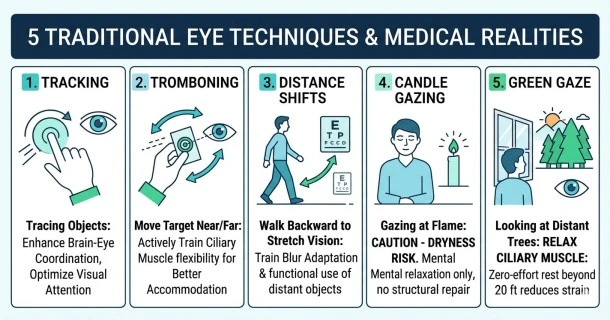
1. Traditional Tracking and Edging
This method involves using your eyes to slowly trace the outer contours of distant objects, such as a picture frame, a table, or large outdoor signs.
- How it helps: This exercise strengthens the brain-eye coordination path by training saccadic movements and smooth pursuit tracking.
- Medical Reality: It trains your visual attention and allows you to optimize your existing visual acuity, though it does not alter the physical macula or retinal structure.
2. Accommodative Tromboning and Focus "Whipping"
This practice involves holding a small target card with text at arm's length, slowly or rapidly moving it closer to one or both eyes, and then extending it out again while maintaining sharp focus.
- How it helps: Shifting focus between near and far points forces the internal ciliary muscle to actively contract and relax.
- Medical Reality: This acts as a legitimate accommodative facility exercise to reduce focusing lag. However, it cannot prevent or reverse presbyopia (the inevitable, age-related structural hardening of the eye's internal lens).
3. "Stretch the Vision" Distance Shifts
A traditional technique where an individual stands before a vision chart, focuses on a single character, and takes slow steps backward while swaying gently to maintain clarity as long as possible.
- How it helps: This exercise serves as a form of blur adaptation training, teaching the brain to better interpret slightly unfocused images.
- Medical Reality: While it helps maximize your functional visual utility, it cannot shorten an elongated myopic eyeball or lower a prescription glass requirement.
4. Candle Gazing (Yang Eye Technique)
An ancient meditative practice where an individual sits at arm's length from a lit candle at eye level, staring steadily at the flame.
- How it helps: It promotes deep mental relaxation, steady posture, and focused neurological concentration.
- Medical Reality: Use extreme caution. Staring at an open flame without blinking rapidly dries out the tear film, causing intense corneal irritation and reflex tearing. Never perform this for extended periods, and ensure the flame is faint to prevent photic damage to the retina.
5. Green Color Visualization
Rooted in traditional philosophy linking the wood element and the color green to the liver and pathways of the eye, this practice involves spending time gazing at green trees, plants, or fields.
- How it helps: Gazing at natural outdoor landscapes relaxes the ciliary muscles entirely because looking at objects beyond 20 feet allows the eye's focusing system to rest at a zero-effort baseline.
- Medical Reality: While looking at distant greenery relieves digital eye strain and sunlight exposure supports retinal health, visualizing colors has no metabolic impact on clinical liver health or structural eye pathology.
Vital Safety Rules for Traditional Eye Routines
To safely integrate traditional vision training into a modern lifestyle, follow these foundational parameters:
- Never Avoid Blinking: Many traditional text instructions recommend avoiding blinking until tears run down the cheeks. This causes severe dryness and can micro-scratch the cornea. Blink naturally during all exercises.
- Avoid Direct Eye Pressure: When practicing recovery techniques like "palming," cup your hands carefully over the bony orbital ridges. Never place direct compression or pressure onto the soft tissue of the eyeballs.
- Screen for Underlying Issues: If your blurred vision is accompanied by sudden flashes, floating dark spots, eye pain, or rapid progression, skip exercises entirely and schedule an emergency exam with an eye care specialist.
Frequently Asked Questions (FAQ)
Can Chinese eye exercises cure middle-age blurred vision (presbyopia)?
No. Presbyopia is not caused by weak external eye muscles. It is caused by a natural aging process where the internal crystalline lens of the eye loses its flexibility and hardens. While exercises like tromboning keep the ciliary muscles moving, they cannot restore youth or flexibility to a physically hardening lens.
Why do my eyes water during candle gazing, and is it a sign of healing?
No, watering eyes during candle gazing is a basic physiological defense mechanism, not a sign of toxic clearing or healing. When you stare at a flame without blinking, your tear film evaporates rapidly, exposing the delicate cornea to air. The brain recognizes this dangerous dryness and triggers reflex crying to save the eye from irritation.
How often should I practice tracking and accommodation exercises for digital strain?
For basic strain relief, practicing tracking or focus shifting for 5 to 10 minutes, three times a week, is highly beneficial. However, for immediate relief during heavy computer use, the clinical 20-20-20 rule remains the easiest and most practical daily exercise to implement.