
Explore traditional Egyptian eye exercises like the lazy eight and black dot tracking. Discover the medical facts behind muscle training and strain relief.
Egyptian Eye Exercises: 3 Vision Tracking Techniques and Medical Realities
Egyptian eye exercises and historical geometric vision tracking routines are widely sought after by individuals looking to enhance their visual focus, reduce eye fatigue, and improve eye-muscle coordination. While these traditional tracking systems serve as excellent orthoptic tools to ease the physical strain caused by prolonged computer work, it is important to separate historical mythology from modern ophthalmic science.
Important Medical Clarification: Historical alternative vision texts often claim that moving targets at extreme angles can physically "reshape the eyeball" to eliminate severe refractive errors like myopia (nearsightedness) or hyperopia (farsightedness). Medically, refractive errors are determined by the structural, genetic length of the eyeball, which cannot be modified by eye movements. However, these exercises are highly effective for training binocular convergence (how well the eyes work together) and stretching the six extraocular muscles that control eye movement.
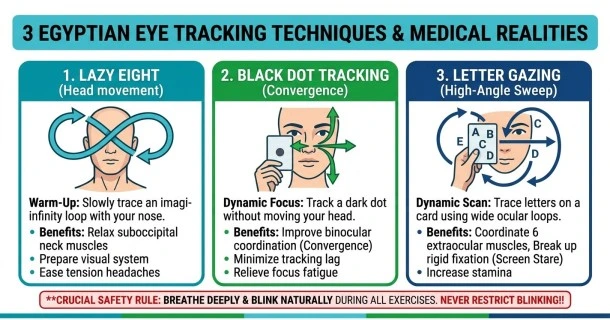
1. The "Lazy Eight" Visual Warm-Up
This initial step involves moving your head slowly to trace an imaginary infinity symbol (∞) or horizontal figure-eight in the air with the tip of your nose.
- How it helps: This exercise functions primarily as a gentle mobility warm-up for the suboccipital neck muscles.
- Medical Reality: Relaxing tight cervical and neck muscles helps ease tension headaches associated with severe screen strain and improves full-range cervical mobility. It prepares the visual tracking system for targeted eye movements.
2. The Egyptian Black Dot Tracking Method
This technique utilizes a small card featuring a dark, button-sized black circle centered on a white background. Without moving your head, you move the card inward toward the tip of the nose, upward toward the brow, or out toward the shoulders, holding focus on the dot for 30 seconds at each point.
- How it helps: This is a classic binocular coordination drill. Moving the dot close to the nose forces the medial rectus muscles to contract evenly, training convergence.
- Medical Reality: Ensuring you see only one distinct dot confirms that both eyes are tracking together properly without suppression. While highly effective for minimizing convergence insufficiency and tracking fatigue, it does not reshape the structural layers of the eyeball.
3. High-Angle Graphic Letter Gazing
This exercise involves gluing printed characters onto a small index card and moving the card in large vertical, horizontal, diagonal, and circular patterns at arm's length while tracking the letters strictly with your eyes.
- How it helps: It stretches and coordinates the four rectus and two oblique extraocular muscles through their full anatomical ranges of motion.
- Medical Reality: Moving targets dynamically across the visual field helps break up the rigid, locked fixation pattern caused by staring at smartphones or computer monitors for hours (commonly called "screen stare"). It improves saccadic accuracy and focus stamina.
Vital Safety Rules for Ocular Training
To safely practice tracking routines without causing accidental fatigue or damage, follow these clinical parameters:
- Blink Frequently and Naturally: Traditional text variations sometimes instruct users to avoid blinking during visual focus. This is medically unsafe. Failing to blink dries out the protective tear film layer over the cornea, causing instant irritation, redness, and blurred vision. Always blink naturally.
- Manage Ocular Fatigue Responsibly: If your eye muscles feel tired or slightly strained after a session, it indicates ciliary or extraocular muscle fatigue from heavy tracking—not the "awakening of dormant muscles". Treat eye training like any muscle workout: stop immediately if you experience dizziness, structural headaches, or double vision, and allow 48 hours of rest between intense sessions.
- Never Wear Corrective Lenses During Workouts: If practicing tracking movements, remove your glasses or contact lenses to let your eye muscles adjust naturally, provided you can safely see the targets without intense squinting.
Frequently Asked Questions (FAQ)
Can the Egyptian black dot technique cure severe nearsightedness (myopia)?
No. The black dot technique is a muscle tracking exercise. Myopia is a structural condition where the physical eyeball is too long from front to back, causing light to focus in front of the retina. No amount of tracking a dot toward your nose or shoulders can physically shorten the structural shape of a mature human eyeball.
Why do my eyes feel sore or tired the day after doing these tracking exercises?
Just like the skeletal muscles in your arms or legs, the six extraocular muscles that control the movements of your eye can experience fatigue when forced into extreme angles or repetitive patterns for long periods. This mild soreness is a sign of temporary muscular fatigue from the intense focusing effort, not a structural cure for vision loss.
Is the "Lazy Eight" neck exercise safe for individuals with cervical spine issues?
If you have a history of neck injuries, chronic cervical spine arthritis, or severe vertigo, you should modify the lazy eight exercise. Keep the figure-eight movements incredibly small and gentle, or skip the head movements entirely, tracing the shape strictly with your eyes while keeping your neck perfectly still to avoid triggering dizziness.