
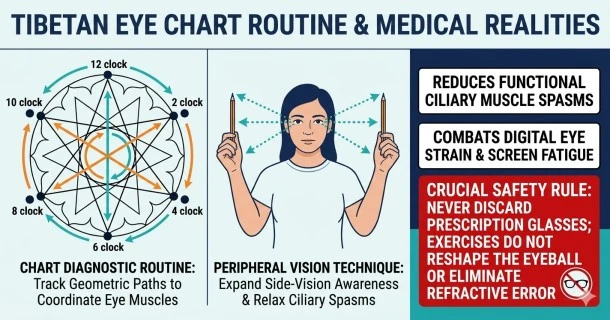
Can the Tibetan eye chart restore your vision? Discover the medical facts behind traditional Tibetan peripheral vision training and safe strain relief.
Tibetan Eye Exercises: Chart Routine and Medical Realities
Tibetan eye exercises and traditional geometric chart routines are highly popular holistic methods designed to train peripheral awareness, loosen rigid screen fixation patterns, and improve the coordinate stamina of the extraocular muscles. While these techniques are excellent orthoptic training tools to relieve digital eye fatigue, it is important to evaluate them through the lens of modern vision science.
Important Medical Clarification: Historical text copies often claim that tracing geometric paths can structurally eliminate refractive defects like myopia (nearsightedness) or hyperopia (farsightedness), eventually making prescription glasses or contact lenses unnecessary. Medically, lenses are not "crutches"—they adjust how light enters an anatomically misshapen eyeball. No tracking routine can physically alter your eyeball's axial length or flatten your cornea. However, these exercises are highly effective for reducing functional ciliary spasms and training the brain to process side-vision inputs more efficiently.
The Tibetan Peripheral Vision Technique
Modern screen habits lock the eyes into a strict, forward-facing narrow focus, which leaves the extraocular muscles rigid and fatigues the visual processing center. This technique uses two targets (like pencils or your thumbs) to actively expand your field of awareness.
Step-by-Step Training Protocol
- The Baseline Setup: Sit comfortably with a straight spine. Hold a pencil in each hand exactly twelve inches directly in front of your eyes.
- The Distance Gaze: Do not look directly at the pencils. Instead, look straight past them into the far distance. Allow your focus to soften so that you perceive the pencils entirely using your peripheral (side) vision.
- Horizontal Expansion: Keeping your eyes fixed straight ahead, slowly move both pencils outward to the sides of each eye, pushing them as far as your peripheral vision can safely track them. Bring them back to the center. Repeat 10 times.
- Vertical Expansion: Return to the center line. Keeping your eyes forward, move your right hand slowly upward and your left hand slowly downward. Repeat 10 times.
- Diagonal and Circular Paths: Move the pencils along opposing diagonal paths (top-right to bottom-left, and top-left to bottom-right) 10 times each. Finish by tracing broad, slow circles outward to the edges of your vision.
Medical Reality Check: While this expands your conscious recognition of side-vision signals, it will not prevent or cure pathological "tunnel vision," which is a severe medical symptom caused by high intraocular pressure in glaucoma or retinal diseases.
Eye Training Using the Tibetan Eye Chart
The traditional Tibetan eye chart features a centralized geometric pattern radiating outward to distinct dots and lines, usually shaped like a multi-pointed star or mandala.
       [12 o'clock]
    10      .      2
      \     .     /
        \   .   /
  9 . . . . O . . . . 3
        /   .   \
      /     .     \
    8       .       4
        [6 o'clock]
The Diagnostic Routine
Perform this routine entirely without glasses or contact lenses, sitting with a straight spine. Move your eyes only, keeping your head perfectly stationary.
- Ocular Palming Warm-up: Gently cup your clean palms over your closed eyes for 30 seconds to block out all light stimulation and relax the ciliary muscles.
- Outer Circle Tracking: Open your eyes and slowly trace the outermost perimeter of the chart dots in a clockwise direction for 30 seconds. Reverse and trace counterclockwise for 30 seconds.
- The 2 and 8 Line Sweep: Move your eyes in a straight diagonal line back and forth between the dots at the 2 o'clock and 8 o'clock positions for 30 seconds.
- The 4 and 10 Line Sweep: Shift your tracking diagonally between the dots at the 4 o'clock and 10 o'clock positions for 30 seconds.
- Blink and Rest: Blink rapidly and naturally for a few seconds to lubricate the cornea, and finish the session with another round of soothing palming.
Essential Safety Parameters
- Never Discard Prescription Lenses: Attempting to force your eyes to function without prescribed corrective lenses during complex daily tasks (like driving or reading small text) will not "force the eye to fix itself." Instead, it induces severe accommodative strain, headaches, and increases safety risks.
- Blink Frequently: Do not keep your eyes excessively wide or fight the urge to blink while tracking the chart. Blinking redistributes the tear film layer, keeping your eyes healthy and free from corneal irritation.
- Stop if Disorientation Occurs: Shifting focus across rapid diagonal axes can sometimes induce mild dizziness or inner-ear disorientation in sensitive individuals. If you feel lightheaded, stop the exercise immediately and close your eyes.
Frequently Asked Questions (FAQ)
Can the Tibetan eye chart exercises restore 20/20 vision and eliminate astigmatism?
No. Astigmatism is an anatomical irregularity where the cornea or internal lens has an asymmetrical curvature (like a football instead of a basketball). Tracing the lines on a Tibetan chart trains the external muscles to guide the eye smoothly, but it cannot alter the physical, structural curvature of your cornea or flatten the eye tissue to eliminate astigmatism.
Is it safe to practice the peripheral vision technique if I feel standard eye strain?
Yes. The peripheral technique is exceptionally beneficial for screen-induced strain. When you look "past" the objects into the distance to activate peripheral vision, the internal ciliary muscle fully relaxes from its tight, near-focus screen contraction. This instantly breaks up accommodation spasms.
Why did older texts claim that glasses make your eyes weaker?
This historical misconception stems from a misunderstanding of how the eye adapts. When an individual takes off their prescription glasses, the blurred world forces the brain to perform heavy guess-work, and putting the glasses back on makes the blur feel more intense by comparison. Glasses simply correct the path of light; they do not physically change your baseline eyeball structure or make it weaker.