
Explore traditional yogic eye exercises like palming, accommodation drills, and sinus massage. Learn the true medical facts and vital safety parameters.
Yogic Eye Exercises: 5 Supportive Routines and Medical Facts
Yogic eye exercises and traditional Ayurvedic vision training methods are widely sought after by individuals looking to ease modern digital eye fatigue, enhance concentration, and promote ocular relaxation. While these ancient stress-relief techniques are excellent for soothing the nervous system and conditioning the muscles around the eyes, it is important to separate historical folklore from modern ophthalmic science.
Important Medical Clarification: Historical alternative texts often claim that these exercises can permanently reverse refractive errors like myopia (nearsightedness) or completely halt presbyopia (age-related loss of near vision). Medically, refractive errors are dictated by the physical, genetic shape of the eyeball and the aging elasticity of the internal crystalline lens, neither of which can be structurally altered by muscle movement. However, yogic eye drills are highly effective for breaking up ciliary muscle spasms, relieving digital eye strain, and optimizing your functional visual comfort.
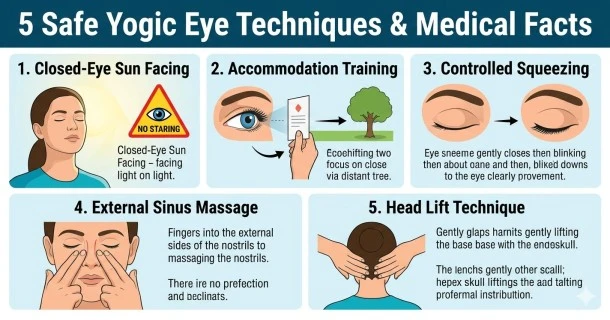
1. Medically Safe "Sun Facing" (Not Sun Gazing)
- The Traditional Approach: Ancient practices often involved staring directly at the rising or setting sun. Modern ophthalmology strictly warns against this. Staring at the sun can permanently burn your retinal tissue (solar retinopathy), causing irreversible blind spots.
- The Safe Modification: Sit outside during early morning sunrise with your eyes completely closed. Turn your face toward the sun, allowing the warm, ambient light to filter through your closed eyelids while taking deep, relaxing breaths. Finish by rubbing your hands together and gently cupping your warm palms over your closed eyes (Palming) to give the optic nerve a deep neurological rest.
2. Yogic Eye Accommodation Training
This drill exercises the internal focusing system by actively shifting focus between near and distant focal planes.
- Part 1 (Near-to-Far Focus): Hold a small card with printed letters at arm's length at eye level. Focus clearly on a letter. Next, look past the card at a distant object 20 feet away (like a tree or building) until it becomes sharp. Shift your gaze back and forth 3 times. Slowly move the card an inch closer and repeat, training the ciliary muscles to flex dynamically.
- Part 2 (Distance Tracking): Look at the card at standard reading distance (14–16 inches), then look at an object 20 feet away, and finally focus on an object even further away (50+ feet).
- Medical Reality: This functions as an accommodative facility exercise. It helps relieve the rigid "accommodation spasm" caused by staring at a flat computer monitor for hours, though it will not stop the natural aging of the internal lens.
3. Controlled Eye Squeezing and Wide Blinking
- How to Do It: Inhale slowly and gently squeeze your eyelids tightly shut for 10 seconds. As you exhale, open your eyes wide and blink naturally. Repeat 3 to 6 times.
- Medical Reality: This simple physical movement compresses the meibomian and lacrimal glands embedded in your eyelids. This action safely expresses necessary natural lipids and oils into your tear film, lubricating the cornea, preventing dry eye syndrome, and clearing away foreign dust particles.
4. External Paranasal Sinus Massage
- Correction Note: The original text dangerously suggested inserting a finger coated in essential oils deep inside the nasal passages. This introduces infection risks and irritates mucous membranes.
- The Safe Modification: Apply a tiny drop of pure sesame oil to the tips of your index fingers. Gently massage the external sides of your nostrils and the bony ridges along the bridge of your nose in small circular patterns.
- Medical Reality: While it does not cure eye anatomy or "purify the liver," external sinus massage helps stimulate local lymphatic drainage, relieves congestion in the nasal passages, and eases the facial pressure that exacerbates eye strain.
5. Suboccipital Head Lift Technique
- How to Do It: Interlace your fingers and place your palms at the very base of your skull (the mastoid processes). Apply a gentle, upward lifting pressure to elongation the neck while slowly turning your head from right to left.
- Medical Reality: Chronic screen time causes "forward head posture," which pinches the suboccipital nerves and tightens the upper trapezius muscles. This gentle stretch unblocks cervical tension, relieving the tension headaches and referred upper-orbital pain commonly confused with worsening eyesight.
Vital Safety Guidelines for Ocular Yoga
- Blink Frequently: Never force your eyes to stay wide open without blinking during any exercise. Blinking is the eye's natural defense mechanism to keep the corneal surface moist and healthy.
- Remove Lenses for Drills: Remove your eyeglasses or contacts when practicing these focus-shifting movements to allow your extraocular muscles to stretch through their natural range, provided you can do so safely without intense squinting.
- Never Push on the Eyeball: During palming or massage, always rest your weight on the hard, bony orbital sockets surrounding your eyes. Never apply direct physical pressure down onto the soft eyeball tissue itself.
Frequently Asked Questions (FAQ)
Can yogic eye exercises cure age-related reading problems (presbyopia)?
No. Presbyopia is not caused by weak eye muscles. It is caused by a natural aging process where the eye's internal lens loses its elasticity and hardens, making it difficult to bend light for close-up viewing. While accommodation exercises help keep the ciliary muscles agile, they cannot reverse the structural hardening of the lens tissue.
Why is looking directly at the sun dangerous, even during sunrise?
Even during sunrise or sunset, the sun emits high levels of ultraviolet (UV) radiation and intense blue light. The eye’s natural lens acts like a magnifying glass, focusing these rays directly onto the macula (the center of your retina). This can cause immediate photic damage or "solar retinopathy," which destroys photoreceptors and can leave a permanent blind spot in your central vision.
How does eye squeezing help with watery or dry eyes?
It sounds counterintuitive, but watery eyes are often a symptom of dry eye syndrome. When your eyes lack a proper oil layer, your tears evaporate too fast, causing the brain to flood the eye with watery, low-quality reflex tears. Squeezing the eyes stimulates the meibomian glands to release the necessary oils, stabilizing your tear film naturally.