
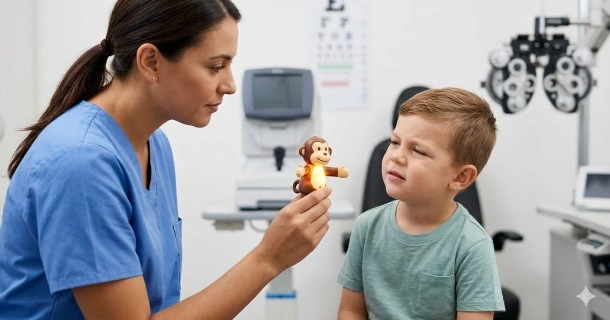
Learn how to spot hidden vision problems in children. Explore physical, behavioral, and verbal warning signs of pediatric eye conditions and refractive errors.
Warning Signs of Vision Problems in Children: Behavioral, Physical, and Verbal Symptoms
Children rarely complain about vision difficulties because they assume everyone sees the world exactly as they do. As a parent, identifying the warning signs of pediatric eye problems is critical to preventing long-term developmental delays or permanent vision loss.
Clinical research from the American Academy of Ophthalmology (AAO) and the American Optometric Association (AOA) categorizes pediatric eye symptoms into three distinct areas: physical appearance changes, behavioral shifts, and symptoms directly expressed by the child.
1. Physical Structural and Appearance Symptoms
Physical changes in the eye structure are often the easiest signs for parents to spot. These changes generally point to active infections, inflammation, or structural misalignment:
- Strabismus (Crossed Eyes): The eyes do not coordinate or align with each other. One eye may turn inward, outward, upward, or downward.
- Blepharitis or Conjunctivitis: Eyelids appear red-rimmed, inflamed, crusty, or swollen. The white part of the eye (sclera) may display significant redness.
- Epiphora (Excessive Tearing): Constantly watery eyes, even when the child is not crying, which can indicate blocked tear ducts or severe corneal sensitivity.
- Leukocoria (White Pupil): A white or cloudy reflection in the pupil instead of a normal dark center. This is a critical medical warning sign requiring immediate specialist evaluation.
2. Behavioral Eye Symptoms (Hidden Signs)
Children often adapt their behavior to compensate for underlying refractive errors (such as myopia, hyperopia, or astigmatism) or binocular vision disorders:
- Frequent Eye Rubbing: Indicative of chronic eye strain, asthenopia, or allergic conjunctivitis.
- Ocular Suppression (Closing One Eye): Closing or covering one eye while reading or watching television to block out double vision caused by misalignment.
- Abnormal Head Tilts: Tilting the head or thrusting the chin forward to find a "null point" where their eyes can focus more clearly or align together.
- Proximity Compensation: Holding books, tablets, or toys unusually close to the face, or sitting directly in front of the television.
- Frequent Squinting: Partially closing the eyelids to create a pinhole effect, which temporarily sharpens blurry vision caused by uncorrected refractive errors.
- Avoidance of Near Work: Avoiding reading, coloring, or schoolwork due to rapid fatigue, or showing behavioral frustration during close-up tasks.
3. Eye Symptoms Directly Expressed by the Child
When children do vocalize visual discomfort, their descriptions often combine sensory complaints with physical symptoms caused by overworked eye muscles:
- Asthenopia (Eye Strain): Complaining that their eyes feel itchy, burning, scratchy, heavy, or tired.
- Asthenopic Headaches or Nausea: Experiencing dizziness, frontal headaches, or slight nausea specifically after doing near-focal work like reading or homework.
- Diplopia (Double Vision): Reporting that words on a page or objects are splitting into two separate images.
- Transient Blurry Vision: Mentioning that words or distant objects occasionally go out of focus.
Direct Parental Guidelines
A child can still suffer from a significant vision issue even if they show no obvious symptoms and pass a basic school vision screening. Comprehensive pediatric eye examinations are the only clinical method to measure refractive errors, check internal ocular health, and evaluate binocular alignment.
Frequently Asked Questions (FAQ)
Why does my child get a headache after doing schoolwork or reading?
Headaches after near-focus tasks are a classic symptom of eye strain (asthenopia). This is often caused by uncorrected hyperopia (farsightedness) or convergence insufficiency, a condition where the eye muscles struggle to turn inward together while reading.
My child's eyes only cross when they are tired. Is this normal?
While intermittent misalignments can happen in newborns, any eye turning (strabismus) in children older than 4 months is abnormal. Even if it only happens when they are tired or stressed, it requires a comprehensive professional evaluation to prevent lazy eye (amblyopia).
Can eye rubbing cause permanent damage to a child's eyes?
Yes. While rubbing is usually a response to allergies or strain, chronic, forceful eye rubbing can mechanically weaken the cornea over time. In rare cases, this can contribute to a progressive thinning condition called keratoconus.
What should I do if I notice a white reflection in my child's pupil in photos?
A white reflection in the pupil (leukocoria) instead of the normal red-eye reflex is a medical emergency. It can indicate a congenital cataract or a rare retinal tumor called retinoblastoma. Schedule an evaluation with a pediatric ophthalmologist immediately.