
Discover what causes high eye pressure and optic nerve damage. Learn the primary risk factors, hereditary links, and secondary triggers of glaucoma.
Glaucoma Causes and Risk Factors: What Triggers Eye Pressure?
While the precise biological triggers of glaucoma can vary, the disease is primarily caused by damage to the optic nerve, most commonly driven by an accumulation of fluid pressure inside the eye. The optic nerve transmits visual information from your retina to your brain. When its fragile nerve fibers are compressed or deprived of blood, they permanently degrade, causing irreversible vision loss.
Understanding how fluid dynamics work inside the eye—and knowing your personal risk factors—is essential to preventing the "silent thief of sight" from damaging your vision.
The Mechanics: What Causes High Eye Pressure?
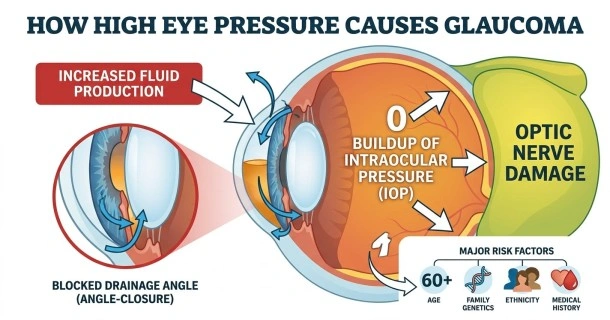
Your eye continuously produces a clear fluid called aqueous humor to nourish its internal structures. This fluid is supposed to drain out at the exact same rate it is produced through a complex drainage system called the trabecular meshwork, located at the angle where the iris and cornea meet.
Glaucoma typically develops due to a mechanical imbalance in this system:
- Overproduction or Blockage: If the drainage angle becomes inefficient, restricted, or physically blocked, the fluid cannot exit properly.
- Pressure Accumulation: Because the eye is a rigid structure, this trapped fluid builds up intraocular pressure (IOP).
- Nerve Compression: The elevated pressure directly presses against the optic nerve at the back of the eye, cutting off microscopic blood flow and starving the nerve cells.
Root Causes by Glaucoma
1. Primary Open-Angle Glaucoma (POAG)
In this most common form, the physical drainage angle between the iris and cornea looks completely open and normal. However, the microscopic channels within the trabecular meshwork become slowly clogged or inefficient over time. Fluid backs up gradually, causing a slow, painless rise in eye pressure that silently destroys the optic nerve. Poor localized blood circulation to the nerve can also accelerate this damage.
2. Angle-Closure Glaucoma (Acute & Chronic)
This occurs when the iris physically bulges forward and pinches shut the drainage angle, completely sealing off the trabecular meshwork.
- The Cause: Most affected individuals are born with naturally narrow drainage angles. As we age, the eye's natural lens grows larger, pushing the iris forward.
- Acute Attack: If the angle closes suddenly (often triggered when pupils dilate in dark rooms or due to certain medications), eye pressure spikes violently within minutes. This is a severe medical emergency.
- Chronic Closure: The angle narrows gradually over months or years, scarring the drainage pathways without causing sudden pain.
3. Normal-Tension Glaucoma
Intriguingly, some individuals experience classic glaucoma optic nerve damage even though their eye pressure constantly tests within the normal range (10 to 21 mm Hg). The underlying causes are believed to be:
- An abnormally fragile optic nerve that cannot withstand even everyday baseline pressures.
- Systemic vascular problems, such as poor blood flow to the optic nerve caused by atherosclerosis (hardening of the arteries), low blood pressure (hypotension), or vasospasms.
4. Secondary Glaucoma
Secondary glaucoma is explicitly caused by an identifiable underlying medical condition, medication, or physical trauma that interferes with eye drainage. Common causes include:
- Eye Injuries: Blunt force trauma that alters or scars the eye's internal drainage system.
- Medical Conditions: Advanced diabetes or high blood pressure leading to neovascular glaucoma (abnormal blood vessels growing over the drainage area).
- Medications: Prolonged or high-dose use of corticosteroids (steroid eye drops, pills, or inhalers).
- Eye Abnormalities: Advanced cataracts, severe internal eye inflammation (uveitis), or pigment particles shedding and clogging the drain (pigmentary glaucoma).
Who is At Risk? Primary Glaucoma Risk Factors
While anyone can develop glaucoma, certain genetic, demographic, and medical factors drastically increase your vulnerability:
- Age: Risk rises significantly after age 40 and accelerates dramatically after age 60.
- Family History: Glaucoma has a strong hereditary link. Having a parent or sibling with open-angle glaucoma increases your risk up to four to nine times.
- Ethnicity: African-Americans, Latinos, and Afro-Caribbeans have a much higher statistical prevalence of open-angle glaucoma. Individuals of Asian descent have a heightened risk of developing angle-closure and normal-tension variants.
- Medical Conditions: Diabetes, systemic hypertension (high blood pressure), severe hypotension (low blood pressure), heart disease, and sickle cell anemia increase vulnerability.
- Eye Anatomy: Being highly nearsighted (high myopia) increases open-angle risk, while being highly farsighted (high hyperopia) increases angle-closure risk due to a naturally crowded front eye chamber.
Frequently Asked Questions
Can stress cause high eye pressure and glaucoma?
While emotional stress does not directly cause chronic glaucoma, severe stress or anxiety can temporarily cause minor spikes in blood pressure and pupil dilation. If you have naturally narrow angles, severe pupil dilation can potentially contribute to triggering an acute angle-closure attack.
Is normal tension glaucoma hereditary?
Yes, normal-tension glaucoma has a strong genetic component. If you have a first-degree relative diagnosed with any form of glaucoma—even if their eye pressure was normal—you should inform your eye care professional and undergo regular comprehensive optical assessments.
Can using steroid eye drops cause glaucoma?
Yes. Corticosteroids (whether administered as eye drops, creams, inhalers, or oral pills) can decrease the efficiency of the eye's trabecular meshwork, causing fluid buildup. This is known as steroid-induced secondary glaucoma, which is why long-term steroid users require frequent eye pressure monitoring.