
Learn the crucial differences between open-angle and acute angle-closure glaucoma symptoms. Discover early warning signs and when to seek emergency eye care.
Glaucoma Symptoms: Early Signs, Types, and Warning Signals
Glaucoma is a group of progressive eye diseases that cause permanent damage to the optic nerve, typically driven by elevated intraocular pressure (IOP). Because it frequently presents without noticeable warning signs until permanent vision loss has occurred, it is widely referred to as the "silent thief of sight."
The nature of your symptoms depends entirely on the specific type of glaucoma you have. Understanding the difference between open-angle and closed-angle variants can help you protect your vision and recognize a true ophthalmologic emergency.
Primary Open-Angle Glaucoma Symptoms
Primary open-angle glaucoma (POAG) is the most common form of the disease, accounting for roughly 90% of all cases.
- Early Stages: There are absolutely no early symptoms or pain. The drainage angle of the eye remains structurally open, but the microscopic drainage channels (trabecular meshwork) become slowly clogged over time. Fluid pressure builds up gradually, quietly destroying nerve fibers.
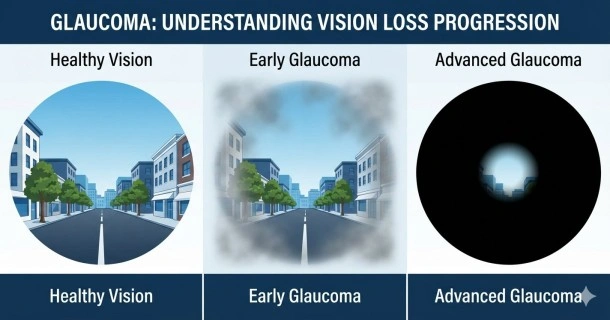
- Advanced Stages: As the disease progresses, patchy blind spots develop in your peripheral (side) vision. Because these blind spots develop gradually and often affect the outer fields of both eyes differently, your brain compensates for them initially. You may only notice the issue when you begin experiencing "tunnel vision" or start frequently bumping into objects or tripping. Without intervention, central vision is eventually lost, resulting in complete blindness.
Acute Angle-Closure Glaucoma Symptoms
Acute angle-closure glaucoma occurs when the iris physically bulges forward, completely blocking the eye's drainage angle. This creates a rapid, dramatic spike in intraocular pressure that requires immediate emergency medical care to prevent blindness within hours.
An acute attack presents with severe, sudden symptoms, including:
- Severe eye pain or a radiating brow headache
- Nausea and vomiting triggered by the intense eye pressure
- Sudden blurred, hazy, or rapidly declining vision
- Rainbow-colored halos or rings around bright lights
- Extreme eye redness accompanied by a cloudy-looking cornea
Note: Some individuals experience brief, mild episodes known as intermittent angle-closure attacks. These cause temporary blurred vision, mild brow aches, or halos that resolve on their own, but they are a warning sign of a looming acute attack.
Normal-Tension and Chronic Closed-Angle Glaucoma
- Normal-Tension Glaucoma: In this variation, optic nerve damage and visual field defects occur even though your measured eye pressure falls within the statistically normal range (10 to 21 mm Hg). Like POAG, it is entirely asymptomatic in its early stages and is usually caught only during detailed optic nerve scans.
- Chronic Angle-Closure Glaucoma: This form progresses slowly as the drainage angle narrows and scars over time. It does not cause a sudden painful crisis. Instead, it quietly damages the optic nerve without explicit symptoms until advanced peripheral vision loss occurs.
When to Screen: Don't Wait for Symptoms
Because the most prevalent forms of glaucoma give no early warnings, you cannot rely on changes in your vision to alert you. Comprehensive comprehensive eye exams are the only reliable way to catch glaucoma early.
An ophthalmologist or optometrist will perform a suite of tests, including tonometry to measure eye pressure, gonioscopy to examine the drainage angle, visual field testing to map peripheral vision, and OCT imaging to inspect the structural integrity of the optic nerve.
| Glaucoma Type | Symptom Onset | Pain Level | Medical Urgency |
| Primary Open-Angle | Gradual (Years) | None | Chronic Management |
| Acute Angle-Closure | Sudden (Hours) | Severe | Ophthalmologic Emergency |
| Normal-Tension | Gradual (Years) | None | Chronic Management |
| Chronic Angle-Closure | Gradual (Months/Years) | None to Mild | Progressive Management |
Frequently Asked Questions
What are the very first signs of glaucoma?
For the most common type (open-angle glaucoma), there are no first signs or early symptoms. For acute angle-closure glaucoma, the earliest signs of a developing attack can include mild headaches, a dull brow ache, slightly blurred vision, or seeing faint halos around lights.
Can you have glaucoma with normal eye pressure?
Yes. This condition is called normal-tension glaucoma. Optic nerve damage and peripheral vision loss can still progress even if your intraocular pressure falls within the standard normal range.
Is the vision loss from glaucoma reversible?
No, vision loss caused by glaucoma is permanent and irreversible. Because dead optic nerve fibers cannot be restored, the primary goal of all glaucoma treatments—such as prescription eye drops, lasers, or surgery—is to lower eye pressure to stabilize the eye and prevent further vision loss.