
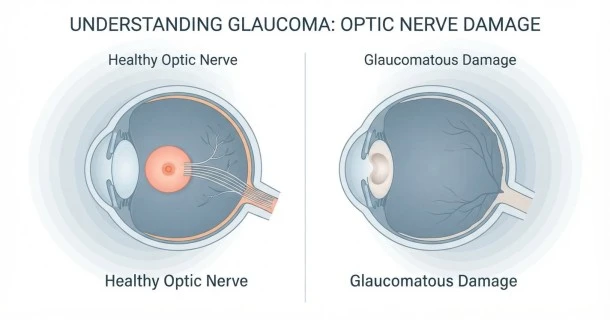
What is glaucoma? Learn how the "silent thief of sight" causes irreversible optic nerve damage. Explore primary open-angle, normal-tension, and emergency angle-closure glaucoma.
Understanding Glaucoma: The 'Silent Thief of Sight'
Glaucoma is a group of progressive eye diseases characterized by characteristic damage to the optic nerve, leading to irreversible vision loss. Often dubbed the "silent thief of sight," it is the second-leading cause of blindness worldwide. The disease typically compromises your peripheral (side) vision first, gradually creeping inward toward your central vision. Because early structural changes happen without pain or obvious visual warning signs, nearly half of the individuals living with glaucoma do not know they have it.
The Role of Intraocular Pressure (IOP)
Many people mistakenly believe that having glaucoma always means your eye pressure is too high. In a healthy eye, a clear fluid called aqueous humor is constantly produced and drained through a meshwork of tissue at the front of the eye. If this drainage mechanism slows down or gets blocked, fluid builds up, raising the intraocular pressure (IOP).
However, glaucoma is an optic neuropathy, meaning the ultimate issue is how well your specific optic nerve can tolerate pressure.
- Ocular Hypertension: Some individuals have high eye pressure but suffer no damage to their optic nerve.
- Normal-Tension Glaucoma: Conversely, up to half of all glaucoma cases occur in individuals whose eye pressure falls within the standard normal range of 10 to 21 mm Hg.
Primary Forms of Glaucoma
While there are many variants of this disease—including secondary forms caused by injuries, steroid use, or advanced diabetes—the two most prevalent types are primary open-angle and angle-closure glaucoma.
+---------------------------+-----------------------------------+-----------------------------------+
| Feature | Primary Open-Angle Glaucoma | Acute Angle-Closure Glaucoma |
+---------------------------+-----------------------------------+-----------------------------------+
| Prevalence | Most common form (~90% of cases) | Less common, highly severe |
| Drainage Angle Status | Structurally open, but clogged | Physically blocked by the iris |
| Progression Speed | Slow, painless, and gradual | Sudden, rapid pressure spike |
| Early Symptoms | None ("silent" progression) | Severe pain, halos, red eye, nausea|
| Medical Urgency | Chronic management needed | Immediate ocular emergency |
+---------------------------+-----------------------------------+-----------------------------------+
1. Primary Open-Angle Glaucoma (POAG)
In primary open-angle glaucoma, the drainage angle where the cornea and iris meet remains structurally open, but the underlying microscopic drainage channels (the trabecular meshwork) become restricted over time. This causes fluid to exit the eye too slowly, leading to a slow, painless buildup of pressure. Because visual field defects start at the outer edges of your vision, significant, permanent nerve damage usually occurs before you ever notice a change in your sight.
2. Acute Angle-Closure Glaucoma (ACG)
Acute angle-closure glaucoma happens when the iris physically shifts forward and completely seals off the drainage angle, behaving like a stopper over a drain. This triggers an abrupt, severe spike in eye pressure. Unlike open-angle glaucoma, an acute attack is a clear medical emergency. Symptoms hit suddenly and include intense eye pain, severe headaches, blurry vision, seeing rainbow-colored halos around bright lights, eye redness, and nausea or vomiting. Immediate medical intervention is required to prevent absolute blindness within days.
Protecting Your Vision: Early Detection
Vision already lost to glaucomatous damage is permanently gone and cannot be restored. However, if the condition is diagnosed early, modern medical therapies—including daily prescription eye drops, selective laser trabeculoplasty (SLT), and advanced surgical drainage devices—can effectively control eye pressure and halt further progression.
Because you cannot feel your eye pressure or notice early optic nerve cupping on your own, a comprehensive, dilated eye examination is your only true line of defense. Routine vision screenings that only look at a single eye pressure reading are not enough to rule out the disease. Eye care professionals recommend annual comprehensive exams for anyone over the age of 60, individuals with a family history of the disease, and populations at higher risk, including Black and Hispanic individuals.
- Learn More About Glaucoma:
Frequently Asked Questions (FAQ)
Can you have glaucoma with normal eye pressure?
Yes. This condition is known as normal-tension glaucoma. Your eye pressure readings may fall cleanly within the normal statistical range (10 to 21 mm Hg), yet your optic nerve still experiences progressive damage and visual field loss. This highlights why measuring eye pressure alone is insufficient for a diagnosis.
Is vision loss from glaucoma reversible?
No. Damage to the delicate fibers of the optic nerve is permanent. Current medical treatments, laser therapies, and surgeries cannot restore lost sight; instead, they focus exclusively on lowering intraocular pressure to protect and stabilize the remaining vision you have.
Why is glaucoma called the silent thief of sight?
It earns this name because the most common form, primary open-angle glaucoma, develops slowly and entirely without pain, irritation, or early symptoms. The brain naturally compensates for early, patchy blind spots in your peripheral vision, meaning you may lose up to 40% of your eyesight before realizing a problem exists.
What is the main difference between open-angle and closed-angle glaucoma?
The difference lies in the eye's drainage structure. In open-angle glaucoma, the physical angle remains open but the microscopic mesh filter becomes clogged over time, causing a slow pressure increase. In closed-angle glaucoma, the iris physically shifts and blocks the drain all at once, creating a sudden, painful, and dangerous pressure spike.