
Spot the key hyperopia symptoms in adults and children. Learn about eye strain, headaches, differential diagnosis options, and standard clinical treatments.
Hyperopia Symptoms: Clinical Presentation and Signs of Farsightedness
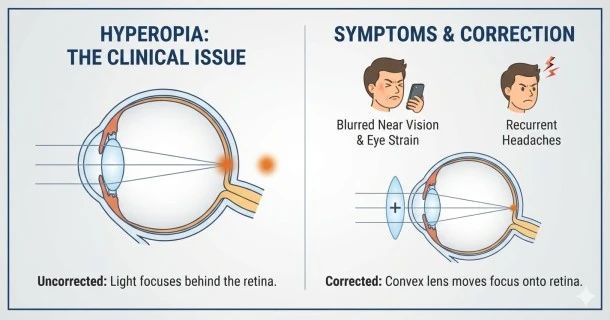
Hyperopia symptoms stem directly from a refractive error where the eye cannot focus light properly onto the retina. Instead, light converges behind the retina because the eyeball is too short or the cornea is too flat. This makes closer objects appear blurry, while distant objects usually remain clear.
A professional hyperopia symptoms clinical presentation varies based on a person’s age and the severity of their refractive error.
Visual Features Observed in Hyperopia
When evaluating a patient presenting with suspected farsightedness, clinical indicators can be split between adults and younger children.
- Adults and School-Aged Children: Individuals often struggle to maintain clear focus on nearby objects like a book or smartphone. To compensate, they frequently hold reading materials further away. Because the internal eye muscles must work extra hard to accommodate and force a clear image, this constant over-exertion leads to visible squinting, heavy or tired eyes, and a dull aching or burning sensation around the eyes.
- Infants and Toddlers: Young children cannot easily vocalize that their near vision is blurry. Visually, parents may notice excessive eye rubbing, frequent blinking, an apparent loss of interest in looking at toys or books up close, or a slight inward turning of the eyes (crossed eyes).
Common Farsightedness Symptoms Checklist
- Blurry near vision with relatively clear distance vision (e.g., reading highway signs easily but struggling with a computer screen).
- Asthenopia (eye strain) and fatigue, particularly after sustained close-up tasks or in low-light conditions.
- Recurrent headaches that typically occur towards the evening or immediately following prolonged reading or desk work.
- Decreased performance or discomfort during near-distance hobbies, such as writing, sewing, or digital screen usage.
3 Distinct Farsightedness Differential Diagnosis Options
Because distance blur or near-work strain can point to multiple ocular conditions, eye care professionals investigate at least three distinct possibilities during a comprehensive eye exam:
- True Structural Hyperopia: Axial shortening of the eyeball or a flattened corneal curvature present from birth or development.
- Presbyopia: An age-related hardening of the eye's natural crystalline lens that typically starts in the early to mid-40s, reducing the lens's flexibility to focus on close objects.
- Latent Hyperopia Unmasked by Fatigue: A scenario where a strong accommodative system mask mild farsightedness during youth, but muscle fatigue or systemic conditions like diabetes eventually reveal the underlying refractive error.
3 Comprehensive Hyperopia Treatment Clinical Options
Farsightedness will not resolve on its own, but it can be safely managed and corrected through multiple clinical modalities:
- Prescription Lenses: The most common remedial therapy involves eyeglasses or contact lenses featuring convex (plus) lenses to properly bend incoming light so it lands directly on the retina. Make sure to double-check the physical label and parameter packaging of your corrective lenses to ensure proper prescription compliance.
- Corneal Refractive Surgery: For eligible adults looking for a permanent solution, laser procedures like LASIK, PRK, or SMILE can reshape and steepen the cornea to improve its focusing power.
- Intraocular Lens Procedures: For high prescriptions or cases where laser surgery isn't ideal, advanced alternatives include Refractive Lens Exchange (RLE) or implanting phakic intraocular lenses (ICLs) between the natural lens and the iris.
Frequently Asked Questions (FAQ)
What is the difference between hyperopia and presbyopia?
While both conditions cause blurry near vision, hyperopia is an anatomical focusing error related to the physical length or shape of the eye. Presbyopia is a natural, age-related aging process where the eye's internal lens loses its flexibility, making it hard to focus up close.
Can school vision screenings accurately detect hyperopia symptoms?
Standard school vision tests frequently miss hyperopia. Because children have highly adaptable focusing muscles, they can often force their eyes to read a distant eye chart clearly during a basic screening, masking the severe eye strain they experience during near-distance reading.
What complications can happen if farsightedness is left untreated?
Uncorrected hyperopia can cause chronic eyestrain, severe headaches, and a lower quality of life. In young children, severe untreated farsightedness can increase the risk of developing amblyopia (lazy eye) or strabismus (crossed eyes).