
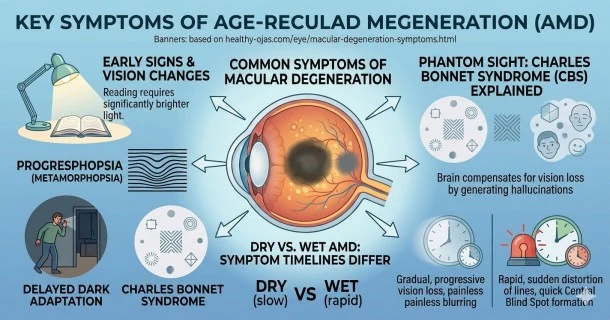
Are you experiencing blurry text or distorted lines? Discover the primary symptoms of dry and wet macular degeneration, and learn about Charles Bonnet hallucinations.
Recognizing Macular Degeneration Symptoms: Early Signs & Vision Changes
Age-related macular degeneration (AMD) symptoms typically develop silently and painlessly in their earliest stages, making early recognition critical. Because this condition selectively deteriorates the macula—the highly sensitive central portion of the retina—the initial warning signs manifest during activities requiring sharp, direct focus, such as reading, driving, or recognizing faces.
If AMD affects only one eye, the brain's visual cortex naturally adapts, allowing the stronger eye to compensate for the weaker one. Consequently, early vision loss frequently goes unnoticed until both eyes become compromised or an eye doctor performs a monocular test.
Common Symptoms of Macular Degeneration
As the light-sensitive photoreceptor cells within the macula experience metabolic stress or fluid disruption, patients will typically notice several definitive changes in their daily visual function:
- Increased Requirement for Direct Illumination: An early, subtle sign is needing significantly brighter light than usual when reading fine print, sewing, or executing close-up tasks.
- Delayed Dark Adaptation: Finding it increasingly difficult to adjust to low light levels, such as experiencing a prolonged period of blindness when walking into a dimly lit room from a bright outdoor environment.
- Progressive Central Blurring: Text printed in books, newspapers, or digital screens looks increasingly hazy, washed out, or indistinct.
- Diminished Color Perception: A noticeable drop in the overall intensity, vibrancy, or brightness of colors, causing warm tones to look faded or muted.
- Metamorphopsia (Wavy Vision): A hallmark symptom where straight lines—such as door frames, window blinds, or sentences on a page—appear bent, distorted, or strangely wavy.
- Central Blind Spots (Scotomas): The development of a persistent blurry zone or an empty, dark blind spot right in the very center of your straight-ahead field of vision.
Phantom Sight: Charles Bonnet Syndrome (CBS) Explained
As macular degeneration reaches advanced stages and central vision drop becomes severe, some individuals begin to experience complex visual hallucinations. Patients may see vivid geometric patterns, repeating textures, landscapes, animals, or even phantom human faces that are not actually there.
This clinical phenomenon is known as Charles Bonnet Syndrome (CBS). It is a neurological reaction rather than a sign of psychiatric illness. When the brain stops receiving rich visual input from the damaged macula, the visual cortex spontaneously compensates by manufacturing its own imagery.
Many individuals conceal these phantom images from family members or physicians out of fear that it indicates mental decline. However, medical specialists recognize CBS as a common, completely normal physiological response to profound eye tissue loss.
Dry vs. Wet AMD: How Symptom Timelines Differ
The speed at which your vision alters depends directly on the underlying clinical variation of the disease:
| Symptom Characteristic | Dry Macular Degeneration | Wet Macular Degeneration |
|---|---|---|
| Onset and Speed | Develops very slowly and progressively over several years. | Develops abruptly and rapidly, sometimes altering vision over days. |
| Primary Visual Indicator | Gradual dimming of print; mild blurring; slow reduction in facial clarity. | Sudden, dramatic warping of straight lines; rapid emergence of a dark central blind spot. |
| Medical Urgency | Requires routine tracking and monitoring by an optometrist or ophthalmologist. | Ocular Emergency. Requires an immediate evaluation by a retina specialist. |
To understand what causes these tissue changes or to explore current options for managing the disease, read our specialized entries on Macular Degeneration Causes, Advanced AMD Treatments, and Retinal Diagnostic Tests Explained.
Frequently Asked Questions (FAQ)
What does vision look like to someone with advanced macular degeneration?
Someone with advanced AMD retains fully functional peripheral (side) vision but loses their central vision. When looking directly at an object or a person's face, the center of their field of view appears as a dark, blurry smudge or a blank gray void, while the background around the edges remains visible.
What is the single best way to test for macular degeneration symptoms at home?
The most effective home monitoring tool is an Amsler Grid—a simple grid pattern composed of straight horizontal and vertical lines with a black dot in the center. By covering one eye at a time and focusing on the central dot, patients can instantly check if any surrounding lines appear wavy, broken, blurred, or missing, which serves as a prompt to call their eye doctor.
Can eye fatigue or dry eyes cause symptoms that look like macular degeneration?
Severe dry eye syndrome or digital eye strain can cause temporary blurriness, light sensitivity, and difficulty reading print. However, these symptoms fluctuate with blinking or artificial tear use. True macular degeneration symptoms cause a persistent, non-fluctuating loss of detail and physical line distortions (wavy vision) that eye drops cannot correct.