
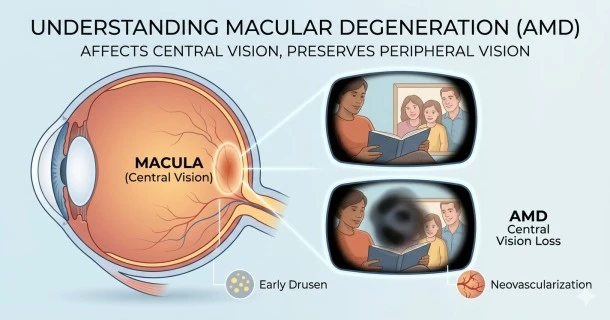
Curious about central vision loss? Learn what age-related macular degeneration (AMD) is, how the macula functions, and the key differences between dry and wet types.
Understanding Age-Related Macular Degeneration (AMD)
Age-related macular degeneration (AMD) is a progressive eye disease that breaks down the center of the retina, standing as the leading cause of permanent vision loss in adults over 50 years old. This disorder specifically deteriorates the macula, which is the specialized, light-sensitive area responsible for sharp, clear central vision. While it preserves your side (peripheral) vision, advanced AMD destroys the visual focus required to read text, drive safely, or recognize faces.
The Role of the Macula in Your Vision
The retina lines the back of your eye, capturing light to build visual signals for the brain. At the dead center of this tissue sits the macula. The macula packs millions of specialized photoreceptor cells together to process fine visual details. When these cells undergo gradual cellular death or experience fluid stress, your straight-ahead vision transforms from sharp clarity into a blurred, dark, or empty void.
The Two Main Forms of Macular Degeneration
Macular degeneration advances differently based on its clinical type. While this page serves as an initial overview, the condition is categorized into two distinct pathways:
- Dry AMD (Atrophic): This form accounts for approximately 85% to 90% of all diagnosed cases. It occurs when light-sensitive cells in the macula slowly break down and thin out over time, usually marked by small yellow metabolic deposits called drusen. The resulting vision loss is typically slow, gradual, and painless.
- Wet AMD (Neovascular): Though less common, affecting only 10% to 15% of patients, wet AMD is responsible for the vast majority of severe, rapid vision loss. It triggers the growth of fragile, abnormal blood vessels beneath the retina. These weak vessels leak blood and fluid, lifting the macula and causing rapid structural damage.
Why Proactive Eye Health Inspections Matter
In its earliest phases, sub-clinical or early AMD frequently develops without warning signs or noticeable distortions. Many individuals remain completely unaware that tissue degradation has begun inside their eyes.
Because damaged macular tissue cannot be restored once lost, receiving a regular, comprehensive eye exam is your strongest defense. Dilated pupil exams allow specialists to catch microscopic indicators—such as early drusen clusters—well before functional vision loss alters your independence.
To learn more about tracking changes, identifying risk factors, or exploring therapeutic options, please explore our dedicated resources on Macular Degeneration Symptoms, Causes and Risk Factors, Diagnostic Eye Tests, and Advanced AMD Treatment Options.
Frequently Asked Questions (FAQ)
Does macular degeneration cause complete blindness?
No, macular degeneration does not cause total blindness. The disease only damages your straight-ahead central vision. Your peripheral (side) vision remains intact, allowing you to see shapes, navigate walking pathways, and maintain basic environmental awareness.
At what age does macular degeneration typically begin to appear?
Age-related macular degeneration primarily impacts older adults, with risk factors climbing significantly after age 50. According to clinical statistics, prevalence increases progressively with each decade of life.
Can lost vision be restored if macular degeneration is treated early?
No, current medical treatments cannot restore central vision that has already been destroyed by macular tissue death. However, timely clinical interventions—such as specialized vitamin regimens for dry AMD or anti-VEGF injections for wet AMD—are highly effective at slowing down or halting further progression.