
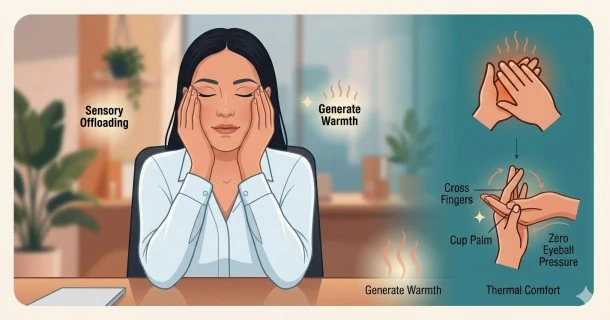
Discover how the eye palming technique provides immediate relief from digital eye strain and mental stress by providing thermal warmth and sensory offloading.
Eye Palming for Mental Stress and Eye Strain Relaxation
Prolonged screen exposure, intense focusing, and cognitive overload frequently leave our eyes feeling fatigued and our minds overstimulated. While eye palming cannot alter refractive errors or reverse organic eye diseases, it is an exceptionally effective physical wellness practice for sensory offloading, easing digital eye strain, and promoting deep mental relaxation.
By creating a barrier against all incoming light and utilizing the natural warmth of your hands, palming helps quiet the nervous system and breaks the cycle of continuous visual accommodation.
The Science-Backed Benefits of Eye Palming
Integrating a few minutes of eye palming into your daily workflow offers several physiological benefits:
- Mitigates Ocular Sensory Overload: Complete darkness temporarily stops photoreceptor activation, allowing the visual cortex in the brain to rest.
- Promotes Ciliary Muscle Relaxation: Removing visual targets breaks continuous accommodation, alleviating fatigue in the eyes' internal focusing muscles.
- Eases Facial Muscle Tension: The resting position helps relax the orbicularis oculi and brow muscles that contract during unconscious squinting.
- Provides Soothing Thermal Therapy: The gentle, passive heat transferred from your warm palms helps stimulate local blood flow and supports tear-film stability.
Step-by-Step Eye Palming Techniques
Important Safety Warning: Never apply physical pressure directly to your eyelids or eyeballs while palming, as doing so can dangerously spike intraocular pressure or cause corneal irritation. Always wash your hands thoroughly before touching your face.
1. Standard Desktop Palming
This is the most practical method to utilize during brief work or study breaks to reset your focus.
- Setup: Sit comfortably at a desk or table with your spine and neck straight. Place your elbows firmly on the surface (using a small cushion or rolled towel under your elbows can reduce shoulder strain).
- The Technique: Rub your palms together vigorously for 10 to 15 seconds until they generate noticeable friction and warmth. Close your eyes gently. Cup your hands and place them over your eyes, crossing your fingers over your forehead.
- Execution: Ensure the heel of each palm rests on your cheekbones so no direct weight touches your eyeballs. Breathe deeply and rest in this darkness for 3 to 5 minutes.
2. Supported Relaxation Palming
An alternative option for when you want a deeper somatic full-body relaxation baseline.
- The Technique: Sit back in a supportive recliner or lie flat on your back with a pillow under your knees to offload lower back tension.
- Execution: Warm your hands, place your cupped palms over your closed eyes, and focus your mind on steady, slow diaphragmatic breathing.
Frequently Asked Questions (FAQ)
Can eye palming improve or correct blurry vision?
No. Structural visual impairments—such as nearsightedness, farsightedness, or astigmatism—depend on the physical dimensions of your eyeball and the curvature of your cornea. Palming deeply relaxes tired facial muscles and nerves, but it cannot structurally alter the eye or eliminate the need for corrective lenses.
Why do I see floating colors or gray patches instead of total blackness when I close my eyes?
Seeing residual visual artifacts, light bursts, or gray fields immediately after covering your eyes is entirely normal. It represents the delayed settling of overstimulated photoreceptors and hyperactive neural activity from screen glare. As you remain in darkness and relax your mind, these visual phantoms will gradually fade into a resting dark state.
How often should I practice eye palming during work hours?
For optimal computer strain management, it is safe and highly beneficial to practice palming for 1 to 2 minutes every hour, or whenever you notice yourself squinting or losing concentration. Consistency is far more effective than long, isolated sessions.
Is it safe to perform eye palming if I wear contact lenses or have glaucoma?
If you wear contact lenses, ensure your hands are completely clean or remove the lenses first to prevent accidental shifting or contamination. If you have been diagnosed with glaucoma or a history of retinal issues, check with your ophthalmologist first—and remember to ensure that your palms apply zero physical pressure to your eyeballs.