
Can you improve eyesight naturally? Discover the medical facts about natural eye care, vision therapy, lifestyle changes, and the safety of eye herbs.
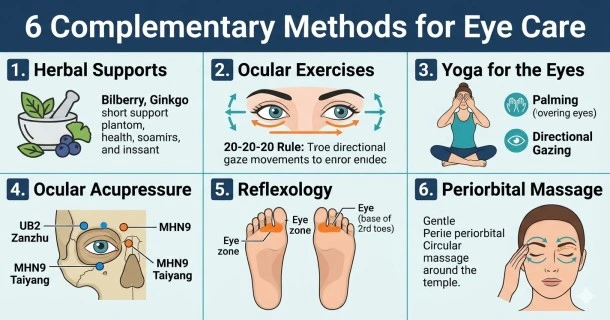
Natural Eye Care and Vision Support: 6 Complementary Methods
Natural eye care and complementary therapies are widely sought after by individuals looking to ease digital eye fatigue, improve local blood circulation, and protect long-term macular health. However, alternative therapies cannot change the physical length of the eyeball or reshape the cornea to permanently reverse structural refractive errors like myopia (nearsightedness), hyperopia (farsightedness), or astigmatism.
Important Medical Clarification: Contrary to traditional folklore, modern vision science proves that common refractive errors are not caused by "liver problems," "digestive disorders," or "mental anguish." Vision problems are primarily rooted in genetics, aging, and structural ocular anatomy. While alternative modalities cannot eliminate the need for prescription corrective lenses, they can serve as excellent supportive tools to relieve digital eye strain (asthenopia) and promote functional relaxation of the eye muscles.
6 Complementary Approaches to Eye Health
Integrating these six supportive practices can help enhance local circulation, relieve muscle tension, and combat chronic fatigue from prolonged screen time.
1. Herbal Supports
Certain herbs are traditionally utilized to deliver rich antioxidant payloads or encourage microvascular circulation to the retina.
- Bilberry Extract: Packed with anthocyanins, which protect retinal cells against oxidative stress and help support night vision adaptation.
- Goji Berries (Lycium): Rich in zeaxanthin, a powerful carotenoid that filters harmful blue light waves and helps safeguard the macula.
- Ginkgo Biloba: Promotes microvascular blood flow, which has been studied for supportive value in defending optic nerve health.
- Eyebright (Euphrasia): Used historically in folk medicine, though it lacks robust clinical data proving it can actively change or correct visual acuity.
2. Ocular Exercises
Targeted eye movements are highly effective for training muscle coordination but will not eliminate an anatomical need for glasses.
- The 20-20-20 Rule: Every 20 minutes, focus on an object at least 20 feet away for 20 seconds to allow the internal ciliary muscles to fully relax.
- Focus Switching: Alternating focus between a close object (like a finger held near the face) and a distant object trains the eyes' accommodation system and reduces stiffness.
3. Yoga for the Eyes
Yogic eye techniques focus on deliberate, uncorrected movements designed to restore mobility and counter the rigid "screen stare."
- Directional Gazing: Slowly shifting the gaze up, down, left, right, and diagonally without moving the head helps stretch and relax the six extraocular muscles.
- Palming: Rubbing the palms together to generate soothing warmth, then gently cupping them over closed eyes without applying direct pressure. This eliminates light stimulation and provides a deep neurological rest.
4. Ocular Acupressure
Acupressure involves stimulating specific anatomical points around the eye orbits to promote localized blood circulation and reduce tension.
- UB 2 (Zanzhu): Located at the inner end of the eyebrow, massaged gently to relieve frontal headaches and eye strain.
- MHN 9 (Taiyang): Located in the tender depression of the temple, targeted to ease fatigue and blurred vision from computer work.
- Safety Note: Never press directly on the eyeball itself. All pressure must be applied firmly but gently to the bony orbital ridge surrounding the eye.
5. Foot and Hand Reflexology
Reflexology maps specific zones on the extremities that correspond to different bodily systems to induce overall systemic relaxation.
- The Eye Zones: In traditional reflexology charts, the reflex zones corresponding to the eyes are located on the base and pads of the second and third toes (and the corresponding fingers). Massaging these target zones is used as a low-risk, deeply relaxing technique to alleviate physical tension and reduce the body's overall stress response.
6. Periorbital Massage
A gentle manual massage around the forehead and temples relaxes the muscle groups that involuntarily contract when you squint or strain to read.
- How to Perform: Using the soft pads of the fingers, make light, circular sweeping motions along the brow line, out toward the temples, and along the upper cheekbone. This helps stimulate local lymphatic drainage and relieves the physical tension that builds up over hours of focused desk work.
Vital Safety Guidelines for Alternative Eye Care
The eyes are incredibly delicate organs, and incorrect self-treatment can lead to irreversible damage.
- Never Apply Non-Sterile Substances to the Eye: Homemade herbal washes, teas, or unsterilized botanical extracts should never be dropped directly into the eye. This can introduce severe, blinding bacterial or fungal infections. Use only sterile, medically approved over-the-counter or prescription eye drops.
- Do Not Delay Clinical Treatment: Progressive vision loss, sudden onset of flashes or floaters, severe eye pain, or redness are medical emergencies. Attempting to treat conditions like glaucoma, cataracts, or retinal detachment with alternative therapies instead of seeing an ophthalmologist can lead to permanent blindness.
Frequently Asked Questions (FAQ)
Q: Can eye exercises permanently correct myopia or astigmatism?
A: No. Eye exercises can improve ocular muscle coordination and treat specific focusing disorders (like convergence insufficiency), but they cannot change the physical length of your eyeball or the curvature of your cornea. Therefore, they cannot eliminate the need for glasses or contact lenses if you have a refractive error.
Q: Are herbal supplements safe and effective for restoring 20/20 vision?
A: No herbal supplement can reverse structural vision loss or restore 20/20 vision. Supplements like bilberry and goji berry are highly beneficial for providing antioxidant protection to the retina, but they should be viewed as proactive nutrition rather than a corrective treatment.
Q: What is the most effective natural way to reduce digital eye strain?
A: The most effective natural remedy is strict habit modification. Consistently practicing the 20-20-20 rule, maintaining proper distance from screens (about 25 inches), using artificial tears to combat dryness, and adjusting screen glare are clinically proven to relieve strain instantly.