
Explore modern retinitis pigmentosa treatment options. Learn about FDA-approved gene therapies, optogenetics, low-vision rehabilitation, and the clinical consensus on vitamins.
Retinitis pigmentosa Treatments
Retinitis pigmentosa treatment options have experienced a profound paradigm shift, transitioning from historical supportive care to cutting-edge molecular therapies. While there is currently no universal cure to reverse advanced photoreceptor loss, modern treatments are highly successful at slowing disease progression, preserving existing visual fields, and restoring basic light sensitivity in specific genotypes. [1, 2, 3, 4]
The primary goal of modern management is to match your exact genetic mutation with targeted therapies while maximizing your independence using low-vision rehabilitation. [1, 2]
Targeted Gene Replacement Therapy
The most significant clinical breakthrough in treating inherited rod-cone dystrophies is the development of mutation-specific gene replacement therapies. [1, 2]
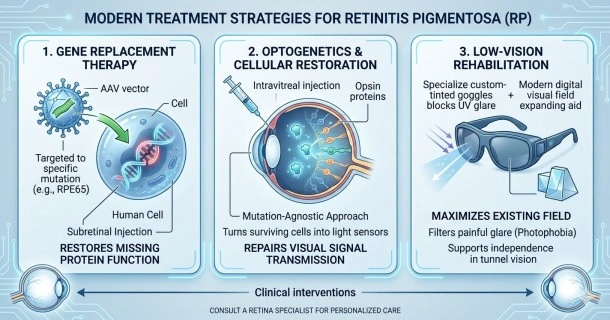
- Biallelic RPE65-Mediated RP: For patients with mutations in both copies of the RPE65 gene, the U.S. Food and Drug Administration (FDA) has approved voretigene neparvovec (Luxturna). This specialized treatment uses a modified adeno-associated virus (AAV) vector delivered via subretinal injection to introduce a fully functional copy of the healthy gene directly into the surviving retinal cells. [1, 2, 3]
- Clinical Success: This targeted approach successfully restores the visual cycle, allowing patients to achieve measurable improvements in functional night vision, contrast sensitivity, and spatial navigation under low-light conditions. [1]
- Emerging Pipelines: Clinical programs in Phase 3 trials, such as modifier gene therapies (like OCU400), are expanding this scope by treating multiple distinct RP genotypes with a single, mutation-agnostic injection designed to stabilize overall retinal cell survival. [1, 2]
Optogenetics & Advanced Cellular Restoration
For individuals who have experienced extensive degeneration where the original rod and cone photoreceptors have completely broken down, traditional gene replacement is no longer viable. In these advanced scenarios, mutation-agnostic cellular restoration techniques offer critical alternatives. [1, 2, 3]
- Optogenetic Therapy: This approach delivers light-sensitive bacterial proteins (opsins) into the eye's surviving inner retinal cells, such as ganglion or bipolar cells, effectively turning them into brand-new light sensors. [1, 2]
- Clinical Efficacy Data: Long-term clinical data from late-stage optogenetic platforms (such as the Nanoscope Therapeutics REMAIN trial) confirms that a single intravitreal injection can successfully provide sustained improvements in visual acuity for up to three years. Patients previously limited to bare light perception gained the functional ability to identify objects and read larger letters on vision charts. [1, 2]
- Stem Cell Therapeutics: Investigational stem cell therapies are focused on slow-release neuroprotection. By transplanting supportive cells into the subretinal space, these treatments aim to secrete continuous growth factors that rescue remaining retinal cells from undergoing apoptosis (cell death). [1, 2]
The Clinical Truth About Vitamin A & Nutritional Supplements
Historically, nutritional supplementation was a primary recommendation for managing retinitis pigmentosa. However, the modern clinical consensus demands extreme caution and precise patient screening. [1, 2, 3]
- The Traditional Protocol: Early long-term clinical trials suggested that taking 15,000 IU of oral vitamin A palmitate daily could slow the annual rate of decline in cone electroretinogram (ERG) amplitudes by roughly 20% in specific adults with common forms of RP.
- Crucial Medical Caveats: High-dose Vitamin A therapy does not result in immediate visual improvement and requires strict annual metabolic monitoring, including fasting serum vitamin A levels and liver function tests, to protect against long-term hepatic toxicity. It is completely contraindicated during pregnancy due to severe birth defect risks, in post-menopausal women due to increased hip fracture risks, and in patients who have undergone renal transplants.
- Strict Genetic Exclusions: Vitamin A supplements must be completely avoided in patients with specific mutations, such as ABCA4-related retinal dystrophies or Stargardt disease, because excessive vitamin A accelerates the toxic accumulation of lipofuscin, destroying central vision.
- Vitamins to Avoid: Studies confirm that taking high doses of Vitamin E (400 IU/day) actually accelerates the progression of retinitis pigmentosa and should be entirely eliminated from a patient's supplement routine. [1, 2, 3]
Low-Vision Aids & Assistive Technologies
Maximizing your existing functional visual field is a mandatory pillar of comprehensive retinitis pigmentosa management. Even while undergoing advanced medical treatments, low-vision rehabilitation specialists provide critical support systems. [1, 2]
- Optical Enhancements: Specialized magnifying systems, custom prisms, and high-contrast filters help widen or relocate the remaining visual field to combat severe tunnel vision.
- Digital Glare Mitigation: Because photoreceptor degeneration causes intense glare sensitivity (photophobia), custom-tinted lenses block specific wavelengths of light to stabilize vision outdoors.
- Artificial Retinal Prosthetics: For individuals with absolute blindness, bionic retinal implants (like the Argus II system) can be surgically positioned over the retina to transmit external camera images directly to the optic nerve, providing basic shape and motion recognition. [1, 2, 3]
Frequently Asked Questions (FAQ)
Can lifestyle changes slow down the progression of retinitis pigmentosa?
Yes. Adopting structured lifestyle habits plays a highly supportive role in preserving retinal health. Patients are strongly advised to wear UV-blocking sunglasses to protect fragile cells from ambient light damage, completely avoid smoking (which worsens oxidative stress in the retina), maintain a diet rich in leafy greens and omega-3 fatty acids, and engage in regular cardiovascular exercise.
What is the difference between gene therapy and optogenetics for RP?
Gene therapy introduces a healthy copy of a gene into the eye to replace a specific broken mutation, requiring surviving photoreceptor cells to function properly. Optogenetics is completely mutation-agnostic; it turns non-visual cells inside the eye into light-sensitive receptors, making it highly effective for individuals who have already lost their native rods and cones.
Is there a treatment that can restore completely lost peripheral vision in RP?
Currently, approved treatments like Luxturna focus on preserving remaining vision and improving function in existing visual fields rather than regenerating entirely dead tissue. However, emerging optogenetic injections and retinal prosthetics are successful at restoring basic light and motion detection in areas of absolute blindness.