Explore the 4 primary treatment options for strabismus (crossed eyes). Learn how eyeglasses, prism lenses, vision therapy, and muscle surgery align misaligned eyes.
Effective Strabismus Treatment Options for Children and Adults
People diagnosed with strabismus (crossed eyes) have several highly effective treatment options available to restore proper eye alignment, improve depth perception, and enhance binocular coordination.
Depending on the cause, direction, and frequency of the eye turn, treatment may involve non-invasive optical devices, specialized neuro-rehab training, or surgical adjustment of the eye muscles. The four main therapeutic strategies include:
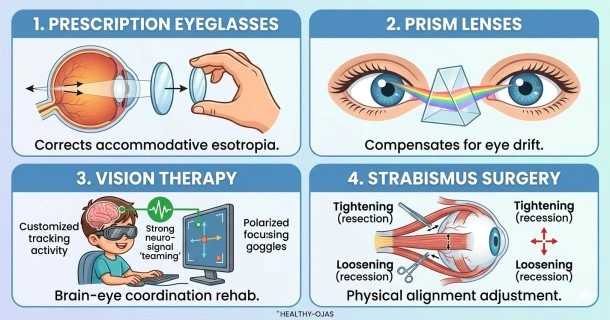
1. Prescription Eyeglasses or Contact Lenses
For individuals whose strabismus is driven by an uncorrected refractive error, standard prescription lenses are often the first line of defense.
- How it Works: This approach is particularly successful for accommodative esotropia (inward eye turning caused by severe farsightedness). By fully correcting the underlying farsightedness, the lenses eliminate the severe over-focusing effort previously required to keep images clear.
- The Outcome: Once the physical straining stops, the eyes naturally relax and remain properly aligned straight ahead without any further intervention.
2. Prism Lenses
Prisms are specialized optical lenses that incorporate a specific directional prescription to bend incoming light waves.
- How it Works: Instead of physically moving the eye, a prism changes the angle at which light strikes the retina. This reduces the extreme turning angle that the misaligned eye must perform to lock onto an object.
- The Outcome: Prisms help the brain trick itself into fusing two separate images into a single, cohesive 3D picture. This minimizes or completely compensates for intermittent eye drift and relieves double vision.
3. Vision Therapy (Neuro-Optometric Rehabilitation)
Vision therapy is a personalized, highly structured program of clinical visual activities designed to retrain the brain and eyes to communicate effectively.
- How it Works: Rather than simply strengthening the physical eye muscles, vision therapy strengthens the neural pathways connecting the brain's visual cortex to those muscles. It combines office-based clinical exercises with customized home-based training protocols.
- The Outcome: These clinical routines fix functional deficiencies in tracking, focusing speed, and eye teaming (binocularity), fundamentally reinforcing healthy eye-brain coordination.
4. Strabismus Surgery (Eye Muscle Surgery)
When optical corrections and neuro-rehabilitation are not enough to align the eyes, surgical correction becomes necessary.
- How it Works: An ophthalmic surgeon alters the relative length, tension, or attachment position of one or more of the six delicate muscles surrounding the eye shell. By loosening or tightening these focal anchor points, the eye is mechanically re-centered to point straight forward.
- The Crucial Next Step: Physical straightening does not automatically teach the brain how to use both eyes together. Consequently, a targeted course of post-surgical vision therapy is almost always required to cultivate robust tracking skills and prevent the eyes from slowly reverting back into a misaligned state.
Frequently Asked Questions (FAQs)
Can strabismus be completely corrected without undergoing surgery?
Yes. Many forms of strabismus, especially accommodative esotropia, can be entirely resolved using non-surgical options like prescription eyeglasses, contact lenses, or targeted vision therapy protocols. Surgery is typically reserved for instances where a structural alignment imbalance remains even after glasses and therapy have been optimized.
Is strabismus surgery permanent, or can the eye cross again?
While eye muscle surgery structurally realigns the physical position of the eyes, it is not always permanently stable on its own. Because strabismus is fundamentally a neurological control problem rather than a muscle issue, the brain can gradually pull the eyes back out of alignment if it hasn't learned to use them as a team. This is why integrating post-operative vision therapy is vital for long-term success.
What are the main differences between eye exercises and clinical vision therapy?
Simple internet-sourced eye exercises usually focus entirely on basic muscle strength, which rarely cures strabismus. Clinical vision therapy, however, is a medically supervised neuro-developmental program. It utilizes specialized prism lenses, polarized filters, computer tracking software, and balance boards to address how the brain processes depth and controls eye coordination.