Discover safe exercises for orthostatic hypotension. Learn clinical physical therapy techniques, lower-body conditioning, and counter-maneuvers to prevent low BP dizziness.
Safe Exercises for Orthostatic Hypotension: Clinical Conditioning and Physical Therapy
Implementing safe exercises for orthostatic hypotension is a cornerstone of non-pharmacological physical therapy designed to improve muscle pump efficiency and limit blood pressure fluctuations. While general exercise is widely recommended for metabolic health, individuals with orthostatic intolerance or autonomic failure require specific physical therapy adjustments. These programs focus on lower-body conditioning and avoiding rapid vertical position changes to prevent syncope (fainting) and orthostatic dizziness.
The Physiological Benefit: Strengthening the Skeletal Muscle Pump
When standing, gravity causes blood to naturally pool in the veins of the lower extremities and abdomen. In healthy individuals, the nervous system automatically constricts blood vessels to maintain adequate cerebral perfusion. For individuals with hypotension, this reflex is impaired.
Targeted physical therapy counteracts this pooling by strengthening the skeletal muscle pump—specifically the calves, thighs, and gluteal muscles. When these muscles contract during movement, they mechanically compress embedded veins, forcing pooled blood back upward toward the heart and brain, stabilizing systemic arterial pressure.
The Clinical Framework: How to Exercise with Hypotension Safely
To safely build cardiovascular tolerance without triggering sudden blood pressure drops, the choice of exercise position and transition speed is vital.
1. Prioritize Recumbent and Horizontal Exercises
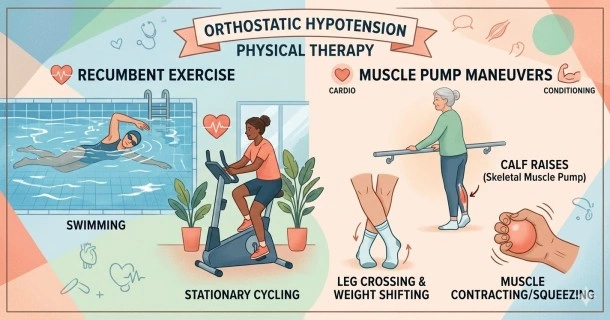
For individuals experiencing severe orthostatic symptoms, traditional standing aerobics can be dangerous. Clinical physical therapy protocols emphasize recumbent exercises where the body remains close to the ground, eliminating gravitational stress on blood vessels:
- Recumbent Stationary Bicycling: Provides excellent cardiovascular conditioning while seated in a reclined position, ensuring stable blood flow.
- Rowing Machines: Engages the entire body in a seated, horizontal motion that promotes venous return without causing dizziness.
- Swimming and Water Aerobics: The hydrostatic pressure of water naturally compresses surface blood vessels in the legs, mechanically supporting blood pressure during movement.
2. Lower-Body and Core Strength Conditioning
Building structural muscle mass in the lower body provides a natural compression garment effect. Perform these exercises slowly, ensuring smooth, steady breathing to avoid a sudden blood pressure drop:
- Modified Chair Squats: Stand in front of a sturdy chair with feet shoulder-width apart. Slowly lower your torso as if to sit, briefly graze the seat, and push back up through your heels. This builds critical quadricep and gluteal strength.
- Wall Push-Ups: Standard floor push-ups require horizontal-to-vertical transitions that can induce dizziness. Performing push-ups facing a wall maintains a safer torso angle while building upper body and core stability.
- Supported Floor Crunches: Lie flat on your back with your feet elevated on a bench or chair at a 90-degree angle. Gently contract your abdomen to raise your shoulders slightly off the mat. This positions your legs above your heart, encouraging immediate blood flow back to the central organs.
3. Incorporating Physical Counter-Maneuvers
If you must perform standing exercises like walking, always master acute physical counter-maneuvers. If a wave of lightheadedness strikes during a walk, immediately cross your legs tightly in a scissors fashion, clench your thigh and gluteal muscles, or elevate one foot onto a curb and lean forward. These maneuvers acutely elevate blood pressure, serving as a functional rescue tool.
Frequently Asked Questions (FAQ)
What are the safest exercises for orthostatic hypotension?
The safest options are recumbent or horizontal exercises, such as riding a recumbent stationary bike, using a rowing machine, or swimming. These positions minimize gravity's impact on your circulation, keeping blood from pooling in your lower limbs and preventing exercise-induced dizziness.
How does building leg muscle help with low blood pressure?
Your leg and buttock muscles act as a natural "skeletal muscle pump." When these muscles are strong and well-conditioned, their contractions mechanically squeeze your deep veins, pushing pooled blood back up to your heart and brain to prevent postural drops.
Why do I feel dizzy immediately after finishing an exercise session?
This occurs due to a rapid pooling of blood in your active muscles once movement ceases, combined with expanded blood vessels from body heat. To prevent post-exercise hypotension, never stop moving abruptly; always include a gradual, slow-paced cool-down period and hydrate with electrolytes.
Can I do traditional floor push-ups and lunges with hypotension?
Traditional floor push-ups and lunges are acceptable if your hypotension is mild. However, because they require rapid shifts in head and torso height, they can trigger dizziness in moderate-to-severe cases. Transitioning to wall push-ups and supported chair squats offers a safer alternative.