
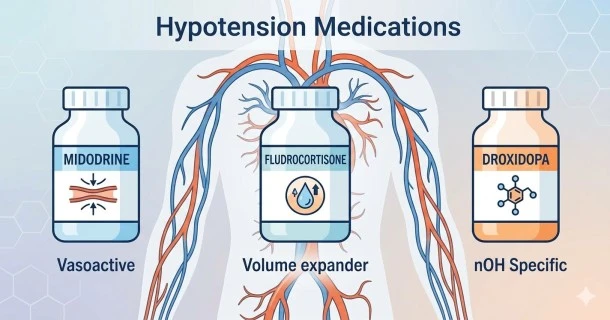
Explore FDA-approved and clinical medications for severe low blood pressure and neurogenic orthostatic hypotension, including Midodrine, Fludrocortisone, and Droxidopa.
Prescription Medications for Low Blood Pressure (Hypotension) Management
Asymptomatic low blood pressure—clinically defined as a reading below 90/60 mm Hg—typically requires no medical intervention in healthy individuals. However, when a sudden drop in blood pressure results in regular bouts of dizziness, blurred vision, or fainting (syncope), it can impair vital blood perfusion to the brain and organs.
If first-line lifestyle treatments (such as strategic hydration and increased dietary sodium) fail to control severe symptoms, physicians turn to targeted pharmacological therapies. Rather than artificial "cures," medical management focuses entirely on correcting the distinct physiological cause of your systemic drop.
The 3 First-Line Medications for Orthostatic Hypotension
Orthostatic hypotension (OH) occurs when your autonomic nervous system fails to constrict blood vessels appropriately when you stand up, leading to severe pooling of blood in your lower limbs. For severe or neurogenic orthostatic hypotension (nOH), three primary medications are clinically prioritized:
1. Midodrine (Alpha-1 Adrenoceptor Agonist)
- How it Works: Midodrine is an oral prodrug that directly stimulates alpha-1 adrenergic receptors on your blood vessels. This action triggers targeted vasoconstriction (narrowing of the blood vessels), increasing peripheral vascular resistance and elevating standing blood pressure.
- Clinical Protocol: Typically prescribed in doses of 2.5 mg to 10 mg up to three times daily. To minimize the risk of severe supine hypertension (dangerously high blood pressure while lying flat), the final daily dose must be taken at least 4 hours before bedtime, and patients must avoid lying flat during the daytime while the drug is active.
- Common Side Effects: Goosebumps (piloerection), scalp itching (pruritus), tingling sensations, and urinary urgency.
2. Fludrocortisone (Mineralocorticoid)
- How it Works: Fludrocortisone is a synthetic corticosteroid displaying powerful mineralocorticoid properties. It prompts your kidneys to actively reabsorb sodium and water back into the bloodstream. This temporary plasma volume expansion elevates your total circulating blood volume, providing a higher baseline pressure.
- Clinical Protocol: Routinely initiated at low oral doses between 0.05 mg and 0.1 mg once daily. Because it alters how your body processes electrolytes, regular lab monitoring is required.
- Common Side Effects: Hypokalemia (dangerous potassium depletion), hypomagnesemia, peripheral fluid retention (edema), and headaches. It is completely contraindicated in patients with underlying congestive heart failure.
3. Droxidopa (Norepinephrine Precursor)
- How it Works: Droxidopa is an orally administered prodrug that your body directly converts into norepinephrine—the exact chemical transmitter your sympathetic nerves require to contract blood vessels. It is primarily FDA-approved for neurogenic orthostatic hypotension (nOH) secondary to conditions like Parkinson's disease or pure autonomic failure.
- Clinical Protocol: Dosed incrementally from 100 mg up to 600 mg three times daily. Like midodrine, its primary risk factor is supine hypertension.
Secondary Medications for Specialized Hypotension Causes
When low blood pressure stems from secondary systemic issues, medications are chosen to correct that distinct underlying disorder:
- Pyridostigmine (Cholinesterase Inhibitor): This agent blocks the breakdown of acetylcholine to improve signaling through autonomic pathways. It is selectively used off-label to improve standing blood pressure without worsening supine hypertension, and is highly effective in treating hypotension stemming from severe neurodegenerative diseases or structural neuromuscular disorders.
- Erythropoietin (Anemia-Induced Hypotension): If severe low blood pressure is rooted in chronic kidney disease or severe non-bleeding anemia, synthetic erythropoietin injections stimulate bone marrow to generate fresh red blood cells. This increases overall oxygen transport capacity and total blood viscosity.
- Vasopressors (Septic & Cardiogenic Shock): Life-threatening hypotension resulting from an overwhelming infection (septic shock) or critical heart failure requires emergency intensive care. Intravenous continuous infusions of active vasopressors—such as Norepinephrine, Dopamine, or Ephedrine—are continuously administered to manually sustain coronary and cerebral perfusion.
Frequently Asked Questions (FAQs)
Why are NSAIDs not considered standard low blood pressure medications?
While older medical text snippets occasionally noted that nonsteroidal anti-inflammatory drugs (NSAIDs) can cause mild fluid retention as an unintended side effect, NSAIDs are not clinically approved or recommended for the treatment of hypotension. Relying on NSAIDs to manage blood pressure carries high clinical risks of inducing gastrointestinal bleeding, stomach ulcers, and severe kidney damage.
Can I take Midodrine or Fludrocortisone right before going to bed?
No. You must never take peripheral pressor medications within 4 hours of going to sleep. When you lie flat, gravity no longer pools your blood downward. Taking Midodrine or Fludrocortisone right before sleeping can precipitate severe, dangerous supine hypertension, significantly increasing the clinical risk of experiencing an overnight stroke or cardiovascular event.
What should I do if my low blood pressure is caused by a medication side effect?
A vast array of common drugs—such as diuretics, alpha-blockers for prostate health, tricyclic antidepressants, and standard heart medications—can cause secondary hypotension. Never stop or alter your medication dose independently. Schedule a consult with your prescribing physician to evaluate an adjustment to your dosing schedule (such as moving the medication to bedtime) or transitioning to an alternative drug class.