What numbers indicate low blood pressure? Learn how to read systolic and diastolic parameters, identify a dangerously low reading, and manage a sudden drop.
How to Read Your Blood Pressure Numbers
When you measure your blood pressure, your monitor displays two distinct numbers, usually written one over the other (e.g., 120/80 mm Hg). Both numbers are measured in millimeters of mercury (mm Hg):
- Systolic Pressure (Top Number): Measures the maximum force your blood exerts against your arterial walls while your heart actively contracts and beats.
- Diastolic Pressure (Bottom Number): Measures the residual pressure remaining in your arteries when your heart muscle rests between beats.
Your blood pressure is highly dynamic. It changes from one heartbeat to the next depending on your sleep patterns, stress levels, hydration status, digestion, and body positioning.
Defining Low Blood Pressure Ranges (Hypotension Chart)
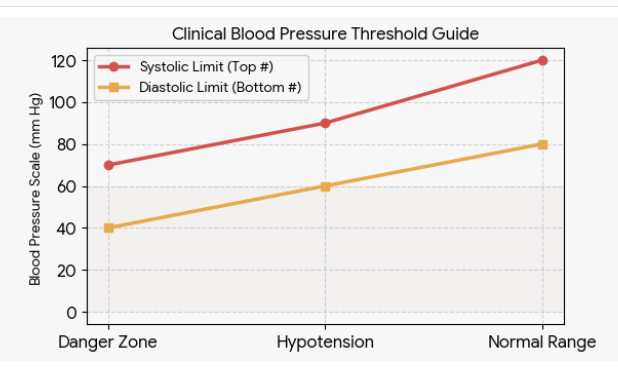
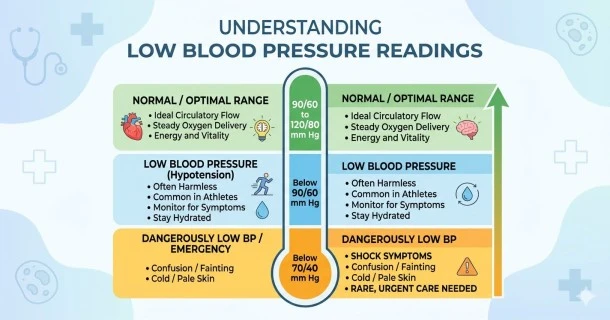
In clinical medicine, low blood pressure is not categorized by a single universal number. Instead, healthcare organizations evaluate readings across three primary zones.
Note: If either your systolic OR your diastolic number falls into a lower zone, your overall reading is categorized in that lower range.
| Category | Systolic Pressure (Top #) | Diastolic Pressure (Bottom #) | Clinical Guidance |
|---|---|---|---|
| Normal / Optimal | 90 to 120 mm Hg | 60 to 80 mm Hg | Ideal cardiovascular circulatory baseline. |
| Low Blood Pressure (Hypotension) | Below 90 mm Hg | OR Below 60 mm Hg | Often harmless if you have no symptoms; common in athletes. |
| Dangerously Low Blood Pressure | Below 70 mm Hg | OR Below 40 mm Hg | Requires urgent medical care if accompanied by shock symptoms. |
When Does Low Blood Pressure Become Dangerous?
A reading of 90/60 mm Hg or lower is considered low. However, the absolute numbers are often less critical than the speed of the drop and the presence of physical symptoms.
The Danger of a Sudden Drop
An abrupt drop in your numbers is much more hazardous than a chronically low baseline. For instance, if your systolic pressure rapidly plunges by 20 mm Hg (dropping from a normal 130 mm Hg down to 110 mm Hg), you will likely experience sudden dizziness, blurred vision, or fainting. This happens because your body cannot adjust fast enough to maintain steady blood flow to your brain.
Critical Symptoms of Emergency Hypotension
A low numerical reading becomes an immediate medical emergency if it triggers signs of cardiovascular shock or systemic tissue oxygen starvation (hypoperfusion):
- Severe confusion, disorientation, or sudden fainting (syncope)
- Cold, clammy, pale, or bluish skin tones
- A rapid, weak, and thready pulse
- Rapid, shallow breathing or shortness of breath
Frequently Asked Questions (FAQ)
What is considered a dangerously low blood pressure reading?
A reading drops into a dangerous zone when your systolic pressure falls below 70 mm Hg or your diastolic pressure drops below 40 mm Hg, especially if accompanied by symptoms like confusion, fainting, cold skin, or a weak, rapid pulse. This requires immediate emergency medical evaluation.
Is a blood pressure reading of 90 over 60 considered low?
Yes, 90/60 mm Hg is the official medical threshold where low blood pressure (hypotension) begins. However, if you are physically fit and feel entirely fine, doctors often view this reading as a normal sign of excellent cardiovascular health rather than a disease.
Can only one number be low for it to be called hypotension?
Yes. If your systolic reading is a perfectly healthy 120 mm Hg, but your diastolic reading drops down to 50 mm Hg, the reading is still classified as isolated diastolic hypotension. Either number dropping below the threshold qualifies as low blood pressure.
Why does my blood pressure drop lower at night?
Your blood pressure naturally follows a daily circadian rhythm. It drops by 10% to 20% while you sleep because your body is at rest and your nervous system reduces its alert state. Your numbers then experience a sharp upward spike right as you wake up.
Visualizing Blood Pressure Ranges
The chart below illustrates where healthy metrics end and where low parameters begin, helping patients cross-reference their numbers at a glance.