What is the Stage 1 Hypertension range? Learn about the updated 130/80 mmHg threshold, cardiovascular risks, and how to reverse it naturally.
Stage 1 Hypertension: New Ranges, Risks, and Treatment Guidelines
If you have recently been diagnosed with Stage 1 Hypertension, you might be wondering what this means for your long-term health. Is it still considered mild? Do you need to start taking prescription medication right away?
The medical community's approach to early high blood pressure has changed dramatically. What was once brushed off as a borderline issue is now recognized as a critical window of opportunity to protect your heart and blood vessels before permanent damage occurs.
The New Stage 1 Hypertension Ranges: What the Numbers Mean
In the past, high blood pressure wasn't diagnosed until a patient reached 140/90 mmHg. However, clinical data proved that cardiovascular risks double well before hitting that mark.
According to current guidelines from the American College of Cardiology (ACC) and the American Heart Association (AHA), the blood pressure categories are structured as follows:
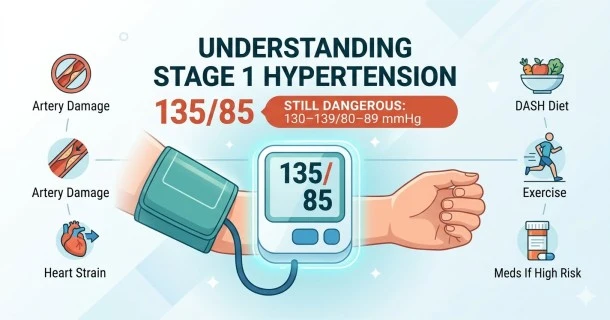
- Stage 1 Hypertension: Systolic (top number) between 130–139 mmHg OR diastolic (bottom number) between 80–89 mmHg.
- Stage 2 Hypertension: Systolic of 140 mmHg or higher OR diastolic of 90 mmHg or higher.
| Blood Pressure Category | Systolic (Top Number) | Diastolic (Bottom Number) | |
|---|---|---|---|
| Normal | Less than 120 mmHg | and | Less than 80 mmHg |
| Elevated | 120 – 129 mmHg | and | Less than 80 mmHg |
| Stage 1 Hypertension | 130 – 139 mmHg | or | 80 – 89 mmHg |
| Stage 2 Hypertension | 140 mmHg or higher | or | 90 mmHg or higher |
Why Stage 1 Hypertension is a "Silent" Warning Sign
The primary danger of Stage 1 Hypertension is its complete lack of physical symptoms. You cannot "feel" your blood pressure rising to 134/84 mmHg. Because there are no headaches, dizziness, or warning signs, millions of people live with early high blood pressure completely unaware that the constant, excessive force is subtly damaging the delicate inner linings of their arteries.
Left unmanaged, this arterial strain accelerates atherosclerosis (hardening of the arteries), which significantly elevates your risk for:
- Strokes and Transient Ischemic Attacks (TIAs)
- Heart attacks and coronary artery disease
- Chronic Kidney Disease (CKD)
- Vision loss from retinal vessel damage
First-Line Treatment: Lifestyle Modifications
For many adults newly diagnosed with uncomplicated Stage 1 Hypertension, clinical guidelines recommend a 3 to 6-month trial of therapeutic lifestyle changes before initiating prescription medication. These non-pharmacological interventions are highly effective and can frequently lower numbers back into the normal range:
- Adopt the DASH Eating Plan: Prioritize the Dietary Approaches to Stop Hypertension (DASH Diet). Eat a diet rich in fruits, vegetables, whole grains, and low-fat dairy while cutting out saturated fats and refined sugars.
- Aggressively Restrict Sodium: Reduce your salt intake to under 1,500 mg per day. Slashing sodium directly minimizes fluid retention and decreases vascular volume pressure.
- Commit to Regular Exercise: Aim for 150 minutes per week of moderate-intensity aerobic physical activity (such as 30 minutes of brisk walking, 5 days a week). Regular exercise makes your heart stronger and more efficient at pumping blood.
- Manage Body Weight: Aim to keep your Body Mass Index (BMI) within the healthy 18.5–24.9 kg/m² range. Losing just 1 kg (2.2 lbs) of body weight can drop your systolic pressure by roughly 1 mmHg.
- Limit Alcohol and Quit Smoking: Restrict alcohol to no more than 1 standard drink per day for women, or 2 for men. If you use tobacco, quitting is the single most impactful action you can take to immediately relieve acute arterial stress.
When Does Stage 1 Hypertension Require Medication?
While lifestyle changes are always the foundation of therapy, lifestyle modifications alone are not always enough. Whether or not a doctor prescribes blood pressure-lowering medication during Stage 1 Hypertension depends entirely on your overall cardiovascular risk profile.
Physicians utilize risk calculators (like the PREVENT equations) to estimate your 10-year risk of having a heart attack or stroke. Treatment pathways generally follow these rules:
- Low Risk (<10% 10-year risk): Managed primarily with structured lifestyle modifications for 3–6 months, followed by re-evaluation.
- High Risk (≥10% 10-year risk) or Co-morbidities: Immediate initiation of a single blood pressure medication alongside lifestyle changes is strongly recommended.
High-Risk Compelling Indications for Early Medication:
- Diabetes Mellitus
- Chronic Kidney Disease (CKD)
- Established Cardiovascular Disease (prior heart attack, stroke, or heart failure)
Preferred First-Line Medications
If monotherapy (a single drug) is required, modern medical consensus relies on four primary classes of antihypertensive medications:
- Thiazide Diuretics (e.g., Chlorthalidone, Hydrochlorothiazide)
- ACE Inhibitors (ACEIs) (e.g., Lisinopril, Enalapril)
- Angiotensin Receptor Blockers (ARBs) (e.g., Losartan, Valsartan)
- Calcium Channel Blockers (CCBs) (e.g., Amlodipine)
Note: Contrary to older practices, beta-blockers are no longer recommended as a primary first-line treatment for uncomplicated hypertension due to a higher incidence of side effects and lower efficacy in stroke prevention compared to newer agents.
What is Your Ultimate Target Blood Pressure?
The overarching goal of high blood pressure management has been simplified to optimize patient outcomes. Across almost all patient populations—including older adults, individuals with diabetes, and those with kidney disease—the modern clinical target is to safely lower blood pressure to less than 130/80 mmHg.
Frequently Asked Questions (FAQ)
Is Stage 1 Hypertension considered dangerous?
While Stage 1 Hypertension is the earliest formal stage of high blood pressure, it should not be ignored. It acts as a silent warning sign. Living with blood pressure in this range over several years causes progressive, cumulative damage to your blood vessels, significantly increasing your long-term risk of a future heart attack, stroke, or kidney damage.
Can Stage 1 Hypertension be reversed without medication?
Yes, absolutely. If your overall 10-year cardiovascular risk score is low, Stage 1 Hypertension can frequently be fully reversed back to normal levels through rigorous lifestyle changes. Committing to a low-sodium DASH diet, losing excess weight, and getting regular aerobic exercise are often powerful enough to avoid prescription drugs entirely.
How long does it take for lifestyle changes to lower Stage 1 Hypertension?
Most individuals who consistently implement dietary modifications (like cutting out processed foods and lowering sodium) and begin regular physical exercise will see a measurable drop in their home blood pressure monitor readings within 3 to 6 weeks. Max effects are typically evaluated by a physician at the 3-to-6-month mark.
Why are beta-blockers no longer the first choice for Stage 1 Hypertension?
Large clinical trials have shown that beta-blockers are less effective at preventing strokes and protecting against certain cardiovascular events compared to preferred first-line choices like ACE inhibitors, ARBs, or calcium channel blockers. Additionally, older beta-blockers carry a higher risk of side effects, such as fatigue and an increased risk of developing new-onset type 2 diabetes. They are now primarily reserved for patients with specific heart conditions, like a recent heart attack or heart failure.