What is the Stage 2 Hypertension range? Learn about the updated 140/90 mmHg threshold, why doctors use two medications, and how to lower it.
Stage 2 Hypertension: Guidelines, Health Risks, and Treatment Options
Discovering that you have Stage 2 Hypertension can be alarming, but understanding your numbers is the first step toward safeguarding your health. At this stage, your blood pressure is high enough to demand immediate medical attention and structured treatment to prevent serious vascular complications.
What is Stage 2 Hypertension? New Diagnostic Ranges
In the past, a doctor would not diagnose Stage 2 high blood pressure until your readings surpassed 160/100 mmHg. However, extensive clinical trials proved that damage to vital organs accelerates much earlier than previously thought.
To protect patients sooner, the ACC and AHA updated the clinical categories:
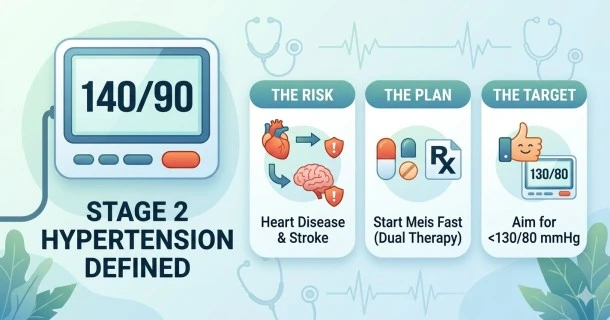
- Stage 2 Hypertension Range: A systolic (top number) reading of 140 mmHg or higher, OR a diastolic (bottom number) reading of 90 mmHg or higher.
- Hypertensive Crisis: Readings that spike over 180 mmHg systolic and/or 120 mmHg diastolic require urgent medical care.
| Blood Pressure Category | Systolic (Top Number) | Diastolic (Bottom Number) | |
|---|---|---|---|
| Normal | Less than 120 mmHg | and | Less than 80 mmHg |
| Elevated | 120 – 129 mmHg | and | Less than 80 mmHg |
| Stage 1 Hypertension | 130 – 139 mmHg | or | 80 – 89 mmHg |
| Stage 2 Hypertension | 140 mmHg or higher | or | 90 mmHg or higher |
The Severe Risks of Uncontrolled Stage 2 High Blood Pressure
Like lower stages, Stage 2 Hypertension is typically a "silent killer" that presents no physical symptoms. You cannot feel the excess force pounding against your arterial walls. However, leaving Stage 2 readings unmanaged drastically elevates your risk for irreversible target-organ damage:
- Heart Failure & Heart Attacks: High pressures force your heart to pump harder, causing the left ventricle to thicken (Left Ventricular Hypertrophy), which eventually leads to heart failure.
- Ischemic or Hemorrhagic Stroke: Excessive pressure can weaken, burst, or block the blood vessels supplying oxygen to your brain.
- Chronic Kidney Disease (CKD): Stiffened, damaged renal blood vessels lose their ability to properly filter waste from the blood.
- Vascular Dementia: Reduced, unstable blood supply to the brain accelerates cognitive decline, memory impairment, and dementia.
Medical Treatment Guidelines: The Power of Dual-Medication Therapy
If you are diagnosed with Stage 2 Hypertension, your physician will initiate immediate prescription medication alongside therapeutic lifestyle interventions.
Why Two Medications are Preferred
Clinical consensus strongly recommends starting treatment with two different first-line antihypertensive drug classes, ideally combined into a single-pill, fixed-dose combination (SPC). Taking a single pill containing two active therapies yields several major benefits:
- Faster Control: It targets different physiological pathways simultaneously to bring your numbers down safely and quickly.
- Better Adherence: Managing a single daily pill is far easier than tracking multiple prescriptions, reducing the risk of missed doses.
- Fewer Side Effects: Lower doses of two separate drugs often cause fewer adverse side effects than maximizing the dosage of a single medication.
The Four First-Line Medication Classes
Modern clinical protocols utilize four primary families of drugs to construct a custom dual-therapy treatment plan:
- Thiazide-Type Diuretics: (e.g., Chlorthalidone, Hydrochlorothiazide) Help flush excess water and sodium out of your bloodstream.
- Calcium Channel Blockers (CCBs): (e.g., Amlodipine) Directly relax and dilate the smooth muscles of your blood vessels.
- ACE Inhibitors (ACEIs): (e.g., Lisinopril) Block the chemical pathways that cause blood vessels to constrict.
- Angiotensin II Receptor Blockers (ARBs): (e.g., Losartan) Prevent hormones from narrowing your vascular pathways.
Note on Beta-Blockers: Outdated regimens frequently paired beta-blockers with diuretics. Modern guidelines no longer consider beta-blockers a primary first-line choice for uncomplicated high blood pressure due to their lower efficacy in stroke prevention and a higher risk of triggering new-onset diabetes.
5 Essential Lifestyle Habits to Support Recovery
While medication is mandatory at this stage, healthy lifestyle adaptations are vital to help your prescriptions work efficiently and eventually allow your doctor to lower your drug dosages:
- Adopt a Low-Sodium DASH Diet: Base your eating habits around the Dietary Approaches to Stop Hypertension (DASH Diet). Prioritize fruits, vegetables, and lean proteins while restricting sodium to under 1,500 mg per day.
- Engage in Cardiovascular Exercise: Commit to 30 to 60 minutes of moderate-intensity aerobic exercise (such as brisk walking, swimming, or cycling) at least 5 days a week.
- Eliminate All Tobacco Products: Smoking causes an immediate, dangerous spike in blood pressure and accelerates the structural stiffening of your arteries.
- Achieve a Moderate Body Weight: Keep your Body Mass Index (BMI) within a healthy range (18.5 to 24.9 kg/m²). For every kilogram of weight lost, your systolic pressure can drop by approximately 1 mmHg.
- Optimize Sleep & Stress: Aim for 7 to 9 hours of quality sleep nightly and leverage mindfulness, yoga, or breathing exercises to minimize stress hormone production.
What is the Ultimate Target Blood Pressure Goal?
For almost all adults navigating a Stage 2 Hypertension diagnosis—including older individuals, those with diabetes, and patients with chronic kidney disease—the universal clinical target is to lower your blood pressure to less than 130/80 mmHg.
Frequently Asked Questions (FAQ)
What is the difference between Stage 1 and Stage 2 Hypertension?
The main difference is the severity of the readings and the required medical response. Stage 1 Hypertension spans 130–139 mmHg systolic or 80–89 mmHg diastolic and can often be initially managed with lifestyle changes alone. Stage 2 Hypertension starts at 140/90 mmHg or higher and requires the immediate initiation of prescription medication—typically two distinct drug classes—alongside lifestyle edits.
Why do I need to take two different blood pressure pills for Stage 2?
Clinical evidence shows that single medications are rarely powerful enough to bring Stage 2 pressures down into a safe, normal range. Starting with two first-line drugs from different classes (ideally combined into a single daily pill) lowers your blood pressure much faster and more reliably by attacking the problem through two separate biological mechanisms.
Can I stop taking Stage 2 blood pressure medications if my numbers drop?
No, you should never alter or stop your medication regimen without explicit instruction from your physician. If your numbers look normal, it means the medication is working successfully to protect your heart. If your blood pressure remains perfectly controlled for over a year alongside strict lifestyle modifications, your doctor may slowly and systematically step down your dosage under close monitoring.
What should I do if my blood pressure reads higher than 180/120 mmHg?
A reading this high indicates a Hypertensive Crisis. Rest quietly for 5 minutes and check your blood pressure a second time. If it is still over 180/120 mmHg and you are experiencing symptoms like chest pain, shortness of breath, blurry vision, or a severe headache, seek immediate emergency medical care (contact emergency services).