
- Are wrist blood pressure monitors accurate? Learn the exact medical steps, correct heart-level positioning, and vital tips to avoid false readings at home.
Maximizing Accuracy with a Wrist Blood Pressure Monitor: A Comprehensive Guide
- While upper arm monitors remain the clinical gold standard, a digital wrist blood pressure monitor offers a highly portable, convenient, and lightweight alternative for tracking your cardiovascular health. These all-in-one devices integrate the cuff and display unit directly, slipping onto your wrist as easily as a wristwatch.
- Wrist monitors are especially valuable for individuals with exceptionally large upper arms where traditional cuffs cause discomfort, or for people who need to track their vitals frequently while traveling. They are also incredibly helpful in identifying white-coat hypertension—a temporary spike in blood pressure caused by the anxiety of being in a doctor's office or clinical environment.
Why Wrist Monitors Require Precise Technique
- Though convenient, wrist blood pressure monitors are highly sensitive to body positioning. Because the radial and ulnar arteries in your wrist are narrower and closer to the skin surface than the brachial artery in your upper arm, your technique must be flawless. If your wrist is positioned even slightly above or below your heart during the inflation cycle, the device will generate highly unreliable, incorrect data.
Step-by-Step Instructions: How to Use a Wrist Blood Pressure Monitor
- Follow these clinical guidelines precisely to ensure you obtain the most accurate readings possible:
- Expose the Wrist: Remove any watches, jewelry, or restrictive clothing sleeves from your tracking arm. Measurements must be taken directly against bare skin.
- Orient the Device: Turn your hand so your palm is facing upward. Place the wrist cuff around your wrist with the digital display screen facing toward you.
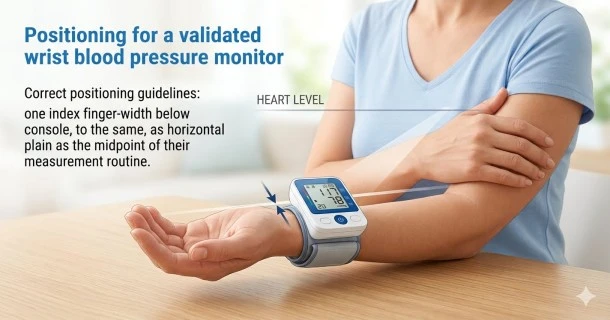
- Leave Proper Clearance: Position the top edge of the cuff roughly one index finger-width below the bottom line of your palm. Do not place the cuff directly over the bony protrusions of your wrist joint.
- Secure the Fit: Pull the fabric strap firmly and fasten the hook-and-loop closure closely around your wrist. A loose cuff cannot adequately register arterial pulse waves and will result in error codes.
- Relax and Breathe: Sit comfortably upright in a supportive chair with both feet flat on the floor. Take five or six slow, deep breaths to stabilize your baseline heart rate before pressing start.
- Find Heart Level (Crucial Step): Bring your arm up across your chest, resting it softly against your body so the monitor sits exactly at heart level (in line with your mid-chest or nipple line). Many modern devices feature internal positioning sensors that flash a specific indicator light when your arm has reached the perfect horizontal plain.
- Keep Fingers Relaxed: Do not clench your fist tightly, as tensing the tendons in your forearm will distort the arterial pressure reading. Keep your fingers loose and comfortable, and remain completely still and silent until the cuff fully deflates.
- Most digital monitors will automatically save your systolic, diastolic, and pulse metrics to their internal memory log. Medical professionals recommend taking a second reading one minute later to verify consistency.
Frequently Asked Questions (FAQs)
- Are wrist blood pressure monitors as accurate as arm monitors?
- Wrist monitors can be highly accurate, but they are far more prone to user error than upper arm monitors. Because they must be held perfectly level with your heart during the test, even a slight variation in arm height will change the hydro-static pressure and skew the numbers. Medical guidelines generally recommend upper arm devices unless physical constraints make an arm cuff impossible to wear.
- What is the correct arm position for a wrist blood pressure check?
- Your arm should be crossed over your chest, bringing the wrist monitor directly to mid-chest level (the exact horizontal plain of your heart). Do not let your arm hang down, and do not hold your arm rigidly in the air without support, as muscle tension will artificially drive up your blood pressure reading. Rest your elbow or forearm on a table or pillow if needed to stay stable.
- Which wrist should I use to measure my blood pressure?
You can use either wrist, but most operational manuals and clinical studies suggest using the left wrist as standard practice since it aligns more closely with the heart's major arterial outflows. No matter which side you choose, consistency is key—always use the exact same wrist for your daily tracking to accurately observe data trends over time.