
Can pressing specific points on your body improve your sleep? Discover the clinically backed acupressure points for insomnia, precise locations, and safety guidelines.
Acupressure for Insomnia: Natural Sleep Healing Through Acupoints
Many individuals experiencing persistent sleep disorders look to complementary methods like acupressure points for insomnia to calm an overstimulated nervous system, reduce bedtime anxiety, and encourage deep, restorative sleep.
In Traditional Chinese Medicine (TCM), sleep disturbances are viewed as an imbalance where active energy (Yang) fails to transition smoothly into resting energy (Yin). Modern clinical studies support this ancient practice, showing that self-administered natural sleep healing acupressure can significantly improve overall sleep quality and quantity without the side effects or dependency risks associated with pharmacological sleep aids.
How Does Acupressure Promote Sleep?
Acupressure involves applying targeted physical pressure to specific neurological and vascular junctions on the skin, known as acupoints. Clinical research suggests that stimulating these points influences the body in several key ways:
- Neurological Relaxation: It helps downregulate the sympathetic nervous system (the "fight-or-flight" response) and elevates parasympathetic tone (the "rest-and-digest" response).
- Neurotransmitter Regulation: Stimulating sleep acupoints can promote the systemic release of endorphins, serotonin, and melatonin, which naturally soothe the brain.
- Stress Reduction: Targeted pressure reduces muscular tension and lowers circulating cortisol levels, removing physical and mental barriers to falling asleep.
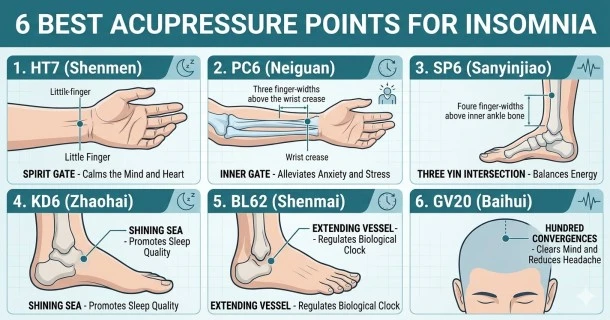
Step-by-Step Guide: 6 Best Acupressure Points for Insomnia
For maximum sleep induction, practice these techniques in a quiet, dark environment roughly 15 to 30 minutes before bed. Apply firm, steady pressure using your thumb or index finger in a small circular motion for 1 to 2 minutes per point, while taking slow, deep diaphragmatic breaths.
1. Heart 7 (HT7 / Shenmen) – The Spirit Gate
HT7 is widely recognized in integrative medicine as one of the most effective acupoints for managing sleep issues stemming from physical agitation, overexcitement, or an anxious, racing mind.
- Location: Found on the inner wrist crease, in the small depression directly aligned with the base of the little finger.
- Clinical Benefit: Regulates heart rate variability, alleviates palpitations, and provides a powerful sedative function to quiet mental chatter before sleep.
2. Pericardium 6 (PC6 / Neiguan) – The Inner Gate
PC6 is highly effective at relieving emotional distress, internal tension, and stress-related sleep blockages.
- Location: Situated on the inner forearm, exactly three finger-breadths up from the wrist crease, directly between the two prominent central tendons.
- Clinical Benefit: Relieves chest congestion, counteracts insomnia driven by anxiety or sadness, and simultaneously alleviates nighttime acid reflux or pregnancy-induced nausea.
3. Spleen 6 (SP6 / Sanyinjiao) – Three Yin Intersection
Because SP6 marks the intersection of the Spleen, Liver, and Kidney meridians, it is a highly versatile point for systemic relaxation and physical restoration.
- Location: Located on the inner lower leg, exactly four finger-breadths above the highest peak of the internal ankle bone, right behind the shin bone (tibia).
- Clinical Benefit: Relieves abdominal bloating, balances chronic fatigue, and addresses severe restlessness in individuals who feel physically exhausted but mentally wired.
4. Kidney 6 (KD6 / Zhaohai) – Shining Sea
KD6 is a primary point used to anchor restless, upward-surging mental energy down into a state of calm.
- Location: Found on the inner side of the foot, in the distinct narrow depression directly below the lower tip of the inside ankle bone.
- Clinical Benefit: Nourishes resting fluids, clears throat dryness, reduces chronic nightmares, and promotes uninterrupted sleep duration.
5. Bladder 62 (BL62 / Shenmai) – Extending Vessel
When paired with KD6, BL62 helps coordinate the body’s internal biological clock and transition the mind away from daytime hyperarousal.
- Location: Positioned on the outer side of the foot, in the small hollow space directly beneath the lower tip of the external ankle bone.
- Clinical Benefit: Soothes acute neurological nervousness, calms the mind, and relieves severe tension headaches or neck rigidity that disrupts sleep posture.
6. Governor Vessel 20 (GV20 / Baihui) – Hundred Convergences
GV20 is an excellent point for clearing out intense mental overthinking, severe worry, and stress.
- Location: Located at the exact crown of the head, at the midpoint of an imaginary line connecting the apex of both ears.
- Clinical Benefit: Grounding excessive mental energy, easing headaches, clearing cerebral fatigue, and gently steering the brain into early stage sleep.
Acupressure Safety, Risks, and Contraindications
Self-administered acupressure is exceptionally safe when applied with appropriate technique, but specific medical precautions must be followed:
- Pregnancy Warning: Spleen 6 (SP6) must be strictly avoided during pregnancy, as stimulating this point can induce uterine contractions or stimulate labor. Pregnant individuals should stick to safe alternatives like PC6 or HT7.
- Skin Integrity: Never apply direct pressure over open wounds, active skin infections, bruises, fractures, or areas with severe varicose veins.
- Pressure Calibration: Use firm but comfortable pressure. Avoid pushing hard enough to cause bruising or sharp, intense pain. The sensation should feel heavy, dull, or slightly aching, but never sharply painful.
Frequently Asked Questions (FAQs)
Can acupressure completely cure chronic insomnia?
No. Acupressure is a supportive, non-pharmacological complementary tool, not an absolute medical cure. While it helps reduce the daily stress and hyperarousal causing sleeplessness, severe chronic insomnia should always undergo an evaluation by a certified physician or sleep specialist to rule out underlying clinical issues like sleep apnea.
How long does it take for sleep acupressure to work?
Many individuals experience an immediate easing of muscular tension and a drop in acute situational anxiety within 5 to 10 minutes of stimulating these points. For long-term chronic sleep improvement, the routine should be performed consistently every night for at least two to three weeks.
What is the difference between acupressure and acupuncture for sleep?
Both systems utilize identical physiological mapping points across the nervous system pathways. However, acupuncture utilizes specialized sterile needles to stimulate points deeply and must be performed by a licensed professional. Acupressure utilizes manual thumb or finger pressure, making it an ideal, cost-effective method for self-care at home.