
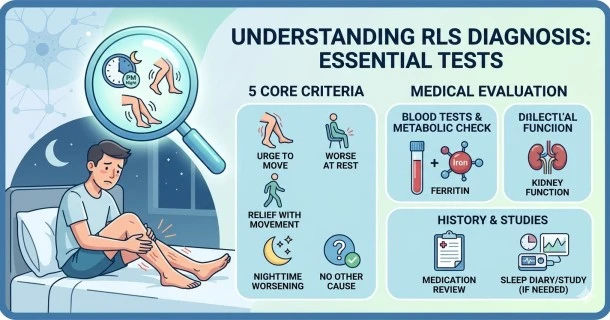
How is restless legs syndrome diagnosed? Learn about the essential diagnostic criteria, blood tests for ferritin levels, sleep studies, and what to expect during a medical evaluation.
Restless Legs Syndrome Diagnosis: Essential Clinical Criteria & Tests
While many individuals experience an overwhelming urge to move their limbs at night, securing an accurate Restless Legs Syndrome (RLS) diagnosis is essential to ruling out lookalike conditions and establishing an effective treatment plan. There is no single, standalone restless legs syndrome test like a scan or biopsy; instead, clinical diagnosis relies on a comprehensive medical evaluation, specific diagnostic criteria, and targeted laboratory testing to uncover underlying causes.
Primary care physicians can frequently diagnose and manage RLS, though complex or treatment-resistant cases may be referred to a neurologist or a sleep medicine specialist.
The Essential Clinical Criteria for RLS Diagnosis
To receive an official diagnosis of Restless Legs Syndrome (also known as Willis-Ekbom Disease), an individual must meet all five core clinical criteria established by the International Restless Legs Syndrome Study Group (IRLSSG):
- An irresistible urge to move the legs: This sensation is typically, but not always, accompanied by uncomfortable or unusual feelings deep within the limbs (often described as crawling, pulling, tingling, or aching).
- Symptoms worsen during rest or inactivity: The urge to move or uncomfortable sensations begin or intensify during periods of sitting, resting, or lying down.
- Temporary relief with movement: The uncomfortable sensations are partially or totally relieved by performing activities such as walking, stretching, or shaking the legs, for as long as the movement continues.
- Nighttime worsening: Symptoms are significantly more severe in the evening or at night than they are during the daytime, or they may occur exclusively at night.
- No other primary cause: The symptoms cannot be solely accounted for by another medical or behavioral condition, such as leg cramps, venous insufficiency, positional discomfort, or arthritis.
What to Expect During a Medical Evaluation
To validate these criteria and rule out secondary causes, your healthcare provider will perform a multi-step evaluation:
1. Detailed Medical and Family History
Your physician will review your personal health history and explore your family background, as primary RLS heavily trends across hereditary lines. They will ask about:
- Ongoing Medications: Certain prescription and over-the-counter drugs—including sedating antihistamines, specific anti-nausea medications, and some antidepressants—can trigger or severely worsen RLS symptoms.
- Co-occurring Conditions: RLS frequently presents alongside other chronic conditions, including Type 2 diabetes, chronic kidney disease (uremia), peripheral neuropathy, and rheumatoid arthritis. It is also common during the third trimester of pregnancy.
2. Targeted Laboratory Blood Tests
While blood work cannot directly confirm RLS, a blood test for restless legs is critical to detecting metabolic deficiencies:
- Serum Ferritin and Total Iron Binding Capacity (TIBC): Clinicians evaluate overall iron stores. Localized iron insufficiency in the central nervous system can disrupt dopamine regulation, even if a standard blood count does not show systemic anemia.
- Kidney Function Tests: Blood urea nitrogen (BUN) and creatinine levels are checked to rule out renal failure, a known trigger for secondary RLS.
- Blood Glucose Monitoring: Evaluates for underlying metabolic conditions or poorly controlled diabetes that could indicate peripheral nerve irritation.
3. Physical and Neurological Examination
A thorough physical exam focuses on your vascular system and neurological function. This step helps differentiate RLS from lookalike conditions, such as peripheral neuropathy (nerve damage) or poor blood circulation in the lower extremities.
Tracking Sleep and Daytime Impacts
Because RLS primarily disrupts sleep architecture, your doctor will want to understand the systemic impact of your symptoms:
- Sleep Quality and Quantity: Assessing how long it takes you to fall asleep and how often limb movements wake you up.
- Daytime Alertness: Evaluating how daytime fatigue, exhaustion, or cognitive sluggishness impacts your daily obligations.
The Value of a Sleep Diary
To maximize the efficiency of your clinical consultation, keep a sleep diary for 1 to 2 weeks prior to your appointment. Document the time you go to bed, your perceived sleep quality, the approximate frequency of nighttime arousals, and your subjective daytime alertness levels.
Do I Need a Sleep Study for RLS?
In the vast majority of cases, an in-lab sleep study (polysomnography) is not required to diagnose Restless Legs Syndrome. RLS is diagnosed purely through clinical history and meeting the five core criteria.
However, a specialist may recommend a sleep study if:
- The clinical presentation is ambiguous, and the physician needs to rule out other sleep disorders, such as obstructive sleep apnea.
- They suspect co-occurring Periodic Limb Movement Disorder (PLMD)—a closely related condition where a person experiences involuntary, repetitive leg twitching or kicking movements every 20 to 40 seconds during sleep.
Frequently Asked Questions (FAQs)
What specific test diagnoses Restless Legs Syndrome?
There is no definitive imaging scan, genetic panel, or single test that can diagnose Restless Legs Syndrome. Diagnosis is achieved clinically by a physician verifying that you meet the five core diagnostic criteria, combined with an evaluation of your medical history and specific blood work to check for iron deficiencies.
Why does a doctor order blood work if there is no RLS blood test?
Doctors order blood tests primarily to check your serum ferritin levels (stored iron) and kidney function. Low iron storage levels in the body can impair how the brain utilizes dopamine, leading directly to RLS symptoms. Identifying a clear iron deficiency allows for targeted treatment that may resolve or greatly minimize the condition.
Can a neurological exam rule out RLS?
A normal neurological exam does not rule out primary Restless Legs Syndrome. Because RLS symptoms are subjective and typically occur when resting at night, a physical exam during the day is expected to be normal. The primary purpose of a neurological exam is to identify or rule out other separate issues, like peripheral nerve damage, that could be causing similar leg sensations.sis of RLS.