
High Cholesterol Symptoms: What Are the Real Warning Signs?
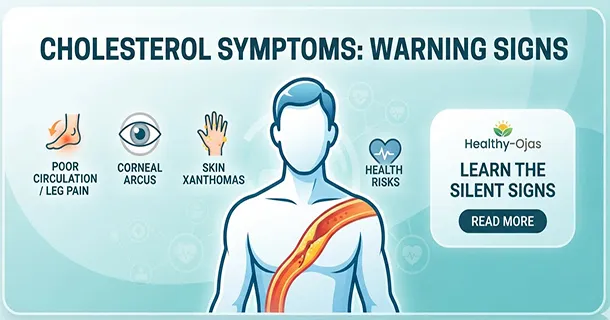
Does High Cholesterol Have Symptoms? No, high cholesterol is a 'silent' condition. The only way to know your levels is through a lipid profile blood test.
High cholesterol is often called a "silent condition" for a simple reason: it rarely gives you a warning before causing serious damage. Unlike a cold or a broken bone, elevated cholesterol quietly builds up in your blood vessels without causing pain, fever, or obvious day-to-day discomfort. By the time noticeable symptoms do appear—such as leg pain while walking, chest tightness, or unusual skin deposits—cholesterol plaque has usually been narrowing your arteries for years.
However, over time, unmanaged high cholesterol causes fatty deposits (plaque) to build up in your blood vessels—a process called atherosclerosis. When this plaque restricts blood flow or causes blockages, physical symptoms finally begin to appear.
According to conventional medical guidelines from bodies like the American Heart Association (AHA), the true warning signs are actually symptoms of the cardiovascular complications caused by this arterial blockage.
What are the Secondary warning signs of high cholesterol (hidden complications)?
When long-standing cholesterol plaque limits circulatory flow, the body begins signaling distress through specific clinical complications:
1. Coronary Artery Disease (CAD) & Angina
Cholesterol buildup within the coronary arteries narrows the pathways supplying blood to the heart muscle.
- Chest Tightness (Angina): A pressing, constricting pain or fullness in the chest that often amplifies during exercise or stress.
- Referred Pain: Discomfort that can radiate into the jaw, neck, throat, back, or down the left arm.
- Shortness of Breath: Sudden respiratory difficulty or fatigue caused by compromised cardiac efficiency.
2. Peripheral Artery Disease (PAD)
Atherosclerosis can compromise the peripheral blood vessels, most frequently affecting the lower extremities.
- Intermittent Claudication: Reproducible cramping, aching, or numbness in the calves, thighs, or buttocks while walking.
- Circulatory Changes: Poorly healing sores on the feet, cold skin, or structural changes in toenail growth.
3. Stroke and Transient Ischemic Attack (TIA)
If unstable cholesterol plaque in the carotid arteries ruptures, it can form local blood clots or travel upward, blocking essential blood flow to neural tissues.
- Neurological Signs: Sudden numbness on one side of the face or body, slurred speech, acute vision loss, or balance instability.
4. Dermatological Indicators
In severe cases, or among individuals with inherited genetic conditions like Familial Hypercholesterolemia, physical signs appear directly on the skin or eyes:
- Xanthomas: Distinct, yellowish fatty deposits or nodules forming over the knuckles, elbows, knees, or Achilles tendons.
- Xanthelasma: Soft, elevated yellow plaques localized on or around the eyelids.
- Corneal Arcus: A light grey or white ring tracing the outer edge of the cornea, which can serve as a marker for inherited lipid disorders when appearing in adults under age 45.
How do doctors diagnose high cholesterol without symptoms?
High cholesterol produces no physical symptoms; conventional medicine relies on objective, lab-based diagnostics to evaluate a patient's cardiovascular risk profile. Physicians use standardized screening schedules, precise biomarker analysis, and advanced cardiovascular imaging to detect lipid imbalances before arterial damage occurs.
Primary care physicians assess cardiovascular risk through detailed, objective laboratory evaluations.
+---------------------------------------+
| Standard Non-Fasting Lipid Panel |
+---------------------------------------+
|
v
Is Triglyceride Level >175 mg/dL?
/ \
/ \
Yes v v No
+-----------------------------------+ +-----------------------------------+
| Fasting Lipid Confirmation Test | | PREVENT-ASCVD Risk Assessment |
| (9-12 Hour Food Baseline) | +-----------------------------------+
+-----------------------------------+ |
v
+-----------------------------------+
| Optimal Treatment/Lifestyle Plan |
+-----------------------------------+
Because you cannot rely on "feeling" high cholesterol, the only reliable way to check your levels is through a simple blood test called a Lipid Panel.
The Standard Lipid Profile Component Breakdown:
A lipid panel blood test measures the concentrations of specific fats moving through the circulatory system:
This measure:
| Biomarker Component | Clinical Definition | Standard Target Thresholds |
| Total Cholesterol | Total blood cholesterol content in the bloodstream. | Under 200 mg/dL |
| LDL-C ("Bad") | An atherogenic molecule delivers lipids into arterial walls. | Under 100 mg/dL (Under 70 for high-risk patients). |
| HDL-C ("Good") | Reverse transport, clearing excess lipids back to the liver. | Above 40 mg/dL (Men); Above 50 mg/dL (Women) |
| Triglycerides | Reverse transport, clearing excess lipids back to the liver. | Under 150 mg/dL |
- Total Cholesterol: The baseline calculation of the total cholesterol content in your blood. AHA Guidelines: Under 200 mg/dL is desirable.
- Low-Density Lipoprotein Cholesterol (LDL-C): Clinically referred to as "bad cholesterol," this is the primary atherogenic molecule responsible for delivering lipids into arterial walls, creating plaque. AHA Guidelines: Under 100 mg/dL (under 70 mg/dL for high-risk cardiac patients).
- High-Density Lipoprotein Cholesterol (HDL-C): Known as "good cholesterol," this molecule performs reverse cholesterol transport, gathering excess blood lipids and carrying them back to the liver for clearance. AHA Guidelines: Above 40 mg/dL for men; above 50 mg/dL for women.
- Triglycerides: A type of storage fat found in the blood. Elevated levels combined with high LDL-C accelerate the hardening of the arteries. AHA Guidelines: Under 150 mg/dL.
Clinical Protocol: Fasting vs. Non-Fasting Lipid Panel Tests
Modern clinical standards emphasize flexibility to optimize routine compliance:
- Routine Initial Screenings: Usually conducted via non-fasting protocols because standard meals cause minimal variation in total cholesterol or LDL-C numbers.
- Refined Diagnostic Confirmation: If initial screening indicates elevated triglycerides (typically over 175 mg/dL), doctors will order a precise 9-to-12-hour fasting lipid panel to get at an exact clinical baseline.
When should you get a clinical lipid panel test?
Conventional medical organizations—including the Centers for Disease Control and Prevention (CDC), the American Heart Association (AHA), and the U.S. Preventive Services Task Force (USPSTF)—have standardized testing frequencies based on age, gender, and pre-existing cardiovascular risk factors.
1. General Age-Based Screening Guidelines
For healthy individuals with no known family history of early heart disease or metabolic disorders, the conventional screening timeline follows a structured framework:
- Children and Adolescents (Ages 9 to 11):
- Conventional guidelines recommend a baseline universal screening at least once between ages 9 and 11.
- This early check helps identify children with severe, undiagnosed genetic conditions like Familial Hypercholesterolemia.
- Young Adults (Ages 20 to 39):
- Healthy adults in this age bracket should undergo a routine lipid panel every 4 to 6 years.
- Doctors use this baseline to monitor early adult lifestyle trends and metabolic changes.
- Middle-Aged and Older Adults (Men Ages 45–65, Women Ages 55–65):
- Routine screening frequency shifts to every 1 to 2 years due to natural, age-related cardiovascular changes and hormonal shifts (such as menopause).
- Seniors (Over Age 65):
- Standard guidelines advise annual lipid panel checks to monitor and track stroke and myocardial infarction risk profiles.
2. High-Risk Indicators Requiring Accelerated Screening
Physicians do not wait for the standard 4-to-6-year interval if a patient exhibits specific cardiovascular risk-enhancing factors. Individuals should get tested much earlier or more frequently (such as annually) if they have any of the following:
- Family Medical History: Having a first-degree relative (parent or sibling) diagnosed with premature heart disease (men under age 55 or women under age 65).
- Pre-Existing Chronic Conditions: Diagnosis of Type 1 or Type 2 diabetes, high blood pressure (hypertension), obesity, metabolic syndrome, or chronic kidney disease.
- Lifestyle Factors: Active history of tobacco use/smoking, chronic sedentary lifestyle, or a long-term diet high in saturated and trans fats.
3. Testing Intervals for Ongoing Medical Treatment
If a clinical screening detects high lipid levels and a physician initiates treatment, testing intervals transition from "prevention" to "monitoring":
- When starting or Adjusting Medication: A follow-up lipid panel is ordered 4 to 12 weeks after initiating a new statin regimen or adjusting a dosage to confirm drug efficacy.
- Routine Maintenance Monitoring: Once a patient’s lipid levels stabilize at their target goal, a physician will typically order a lipid profile every 12 months to ensure long-term compliance and treatment effectiveness.
Predictive Analysis: Comprehensive Risk Equations
A single high cholesterol reading does not tell the whole story. Conventional physicians input lipid panel results into advanced algorithms—such as the PREVENT-ASCVD equations—to calculate a patient's 10-year and 30-year risk estimation for heart attack, stroke, or heart failure. It optimizes safety by integrating complex markers—such as kidney function (eGFR), body mass index (BMI), and diabetic status—while removing traditional race-based variables to improve accuracy across modern patient populations. The American Heart Association PREVENT™ Online Calculator.
Doctors look closely at Risk-Enhancing Factors to determine if a patient needs treatment, even if they have borderline numbers:
- A strong family history of premature cardiovascular disease.
- Metabolic conditions like Type 2 diabetes or chronic kidney disease.
- Elevated Lipoprotein(a) [Lp(a)] or High-Sensitivity C-Reactive Protein (hsCRP), which are advanced markers for inherited heart risks and systemic inflammation.
Advanced Diagnostics: Subclinical Plaque Imaging
When blood work falls into a borderline zone, a cardiologist may use a Coronary Artery Calcium (CAC) Scan to look directly inside the body. This specialized, low-dose CT scan takes cross-sectional images of the heart's vessels. It detects early, hardened calcium deposits left behind by dangerous cholesterol plaque, providing visual confirmation of cardiovascular disease long before any physical warning signs ever manifest.
High Cholesterol Symptoms: Frequently Asked Questions
Q1: What are the early warning signs of high cholesterol?
There are no early warning signs. High cholesterol is completely asymptomatic and is often called a "silent killer." You cannot feel plaque building up inside your blood vessels. The only way to detect early imbalances before arterial damage occurs is through a standard lipid panel blood test.
Q2: Can high cholesterol cause physical symptoms like dizziness or headaches?
No. High cholesterol does not directly cause dizziness, headaches, or fatigue. If you are experiencing these symptoms, they are likely related to other underlying conditions, such as high blood pressure (hypertension) or advanced cardiovascular disease, rather than elevated cholesterol levels on their own.
Q3: What does high cholesterol pain feel like?
High cholesterol itself causes no pain. However, the arterial blockages (atherosclerosis) it creates over time do cause pain. This typically manifests as:
- Angina: A crushing tightness, pressure, or squeeze in your chest during exertion.
- Claudication: Dull aching, cramping, or muscle fatigue in your calves or thighs while walking.
Q4: Are there visible signs of high cholesterol on the skin or face?
Yes, but typically only in severe cases or inherited conditions like Familial Hypercholesterolemia. Visible markers include:
- Xanthelasma: Raised, soft yellow plaques on or around the eyelids.
- Xanthomas: Fatty yellowish nodules over joints, knuckles, or tendons.
- Corneal Arcus: A white or grey ring tracing the outer edge of the eye's cornea.
Q5: How often should I have my cholesterol levels checked?
Screening frequencies vary by age and your baseline risk profile:
- Ages 9–11: At least once as a universal baseline childhood check.
- Ages 20–39: Every 4 to 6 years for healthy adults.
- Ages 45–65 (Men) & 55–65 (Women): Compressed to every 1 to 2 years.
- Over Age 65: Annually to continuously monitor cardiovascular and stroke risks.
Q6: Do I need to fast before a cholesterol blood test?
Not always. Under current medical guidelines, routine initial screenings can be performed via non-fasting tests because standard meals have a negligible impact on total cholesterol and LDL levels. However, if your initial results show elevated triglycerides (above 175 mg/dL), your doctor will order a strict 9-to-12-hour fasting test for confirmation.