
Disclaimer
Healthy-ojas.com is primarily written by me Thiruvelan, Bachelor in Engineering (BE, Instrumentation & Control). I have ten years of experience in writing articles related to health and wellness. I am also hold M.Sc. in Yoga..
We provide up to date information for free of charge, the information is from most authenticated books and other resources such as clinical studies in the web after stringent analysis of the information.
Health information is written and reviewed by Healthy-ojas team. The health content on this site is intended as a sharing of knowledge & information, and not to replace a relationship with a qualified health care professional. Always seek the advice of a Doctor or other Health Care Profession regarding any question you have about your health conditions, diagnosis, and treatments.
Hyperopia

Hyperopia or farsightedness is the common vision condition in which distance objects see clearly, but objects nearer appear blurred.
Farsighted occurs if the eyeball is too short or the cornea has too-little curvature. When light rays enter a hyperopic eye, they are the focus behind the retina instead of on the retina causing blurred vision for nearer objects.
It is an estimate that farsightedness is very common among aged population, affecting up to 62% of people over the age of 40.
Farsightedness is the eye condition that is difficult to assess at school and pediatrician screenings because small to moderate amounts of hyperopia will not cause blur vision. The symptoms increase with age and the amount of Hyperopia. Often hyperopic never noted the symptoms, and they simply avoid tasks related with near vision.
Hyperopia is otherwise calling as hypermetropia or colloquially as farsightedness or long-sightedness.
Common vision screenings, often done in schools, are generally ineffective in detecting farsightedness. A comprehensive optometric examination will need to do assess farsightedness.
In mild cases of farsightedness, the eyes may be able to compensate without corrective lenses. In other cases, the optometrist can prescribe eyeglasses or contact lenses to optically correct farsightedness by altering the way the light enters the eyes.
Myopia Corrections
Myopia treatment or vision correction is by using eyeglasses, contact lenses, orthokeratology, laser/other surgeries and vision therapy.
Myopia treatment options
Persons with myopia have several options available to regain clear distance vision. They include:
- Eyeglasses
- contact lenses
- orthokeratology
- laser and other refractive surgery procedures
- Vision therapy for persons with stress-related nearsightedness
Myopia correction by Eye glasses
Eyeglasses are the most commonly preferred correction for nearsightedness. Generally, prescribe a single vision lens to provide clear vision at all distances. However, for patients over about age 40, or children and adults whose myopia is due to the stress of near vision, a bifocal or progressive addition lens may prescribe. These multi-focal lenses provide different powers of strengths throughout the lens to allow for clear vision, in the distance, and clear vision in the nearer distance.
A large selection of lens types and frame designs are available for patients of all ages. Eyeglasses are no longer just a vision correction, but can also be a fashion item. They are available in a wide variety of sizes, shapes, colors, and materials, which not only correct for vision problems but also may enhance the appearance.
Myopia correction by Contact lenses
For some patients, contact lenses can provide better vision than eyeglasses. They may provide clear vision and a wider field of view. However, since contact lenses wear directly on the eyes, they require regular maintenance, that is cleaning and certain amounts of care is required to safeguard eye health.
Orthokeratology - Reshaping Eyes with Contact Lenses
Otherwise, call as corneal refractive therapy a procedure by fitting a series of contact lenses to reshape the cornea (the front outer surface of the eye). The contact lenses are warning to the certain period, such as overnight and some in daytime, and then removed. Persons with moderate amounts of nearsightedness may be able to obtain clear vision temporarily for most of their daily activities.
Myopia correction by Laser’s surgery
Nearsightedness can also correct by reshaping the cornea using a laser beam of light. Two commonly used procedures are:
- Photorefractive keratectomy (PRK)
- Laser in situ keratomileusis (LASIK)
In PRK, a laser is useful to remove a thin layer of tissue from the cornea surface in order to change its shape and refocuses the light entering the eye on to the retina. The amount of nearsightedness that can correct by PRK is limiting by the amount of corneal tissue that can remove safely by PRK.
LASIK does not remove tissue from the surface of the cornea instead from its internal layers. To perform this, a section of the external corneal layer is cut and folds backward to expose the inner tissue. Then utilizing a laser beam to remove the precise amount of corneal tissue requires reshaping the eye, and then the external cornea tissue in place back to its original position to heal. The amount of nearsightedness that can correct by LASIK is limiting by the amount of corneal tissue that can remove safely by LASIK.
Myopia vision correction by intraocular lens
People with high myopia or those with very thin corneas make it difficult to perform laser procedures, has another option called intraocular lens. Myopia surgically corrected by implanting a tiny lens (intraocular lens) into the eyes. This intraocular lenses look like small contact lenses, and they supply the needed optical correction directly inside the eye.
Myopia vision correction by Vision therapy
Vision therapy is an option for people whose blurred distance vision is causing by a spasm of the muscles, which control eye focusing. Various eye exercises can be useful to improve poor eye focusing ability and regain clear distance vision.
People with myopia have a variety of options to correct their vision problem. In consultation with the optometrist, one can select the treatment that best meets the visual and lifestyle needs.
Reflexology Foot Chart
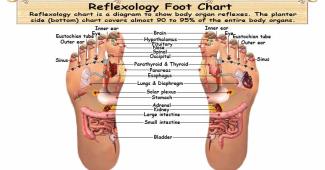
Reflexology chart or map is a diagram used to show body organ reflexes. Should learn to read a reflexology map for proper reflexology therapy.
Right body reflexes on the right foot. Left body reflexes on the left foot. Example left side body organs heart and stomach reflexes are on the left foot. Therefore, thumb-walk on the left foot is useful for the ailments of the stomach, heart, etc.
- Head and neck reflexes are on the toes. Massaging the toes is equivalent to massaging the head and neck.
- The entire spine reflexes is on the medial aspect (inner side of the foot). Working on this reflex spot is useful for ailments of the spinal disorder and nerve problems.
- The chest reflex is below the toes; work on this reflex is useful for lungs and heart ailments. Abdomen reflex is below chest reflex and pelvic reflex is below abdomen reflex.
Foot Reflexology Chart - Planter Foot Map
Reflexology foot chart (the picture above) is the body reflex in the foot soul (planter aspect). This map shows the bottom side (planter) of the foot. The Planter side chart covers almost 90 to 95% of the entire body. Planter map is the most popular and generally used reflexology chart.
Reflexology Chart - Dorsal foot map
Dorsal aspect is visible when looking down. This map shows the topside (dorsal) of the foot. The dorsal side chart covers teeth, jaw, throat, upper lymphatic, breast, and shoulder.

Reflexology Chart - Medial foot map
This map shows the inner side (medial) of the foot from the big toe to the heel. The medial chart covers cervical, thoracic, lumbar, bladder, uterus (in women) and prostate gland (in men).

Reflexology Chart - Lateral Foot Map
Lateral side is the opposite of the medial side. Lateral foot map shows the outer side (lateral) of the foot from little toe to heel. The lateral chart covers wrist, elbow, shoulder, knee, hip, sacrum, ovaries (in women) and testes (in men).

Myopia Test
Diagnosis of myopia can make by simple eye examination performed by an ophthalmologist or an optometrist.
Nearsightedness diagnosis test
The initial myopia diagnosis is by visual acuity test - asking the patient to read letters from an eye chart, which is keeping at specific distance. Based on how-much a patient can read from the chart, the doctor can be able to assess how clearly the patient can see. Other tests are performing to determine the degree of myopia.
Testing for myopia may use several procedures in order to measure how the eyes focus light and to determine the power of any optical lenses needed to correct the reduced vision.
Myopia Visual acuity test
As part of the nearsightedness, testing place eye chart (with letter or symbols) on a specific distance should identify by the person who suspects with myopia. This test measures visual acuity, which is mention as a fraction such as 20/40. The top number of the fraction is the standard distance at which testing is performing, twenty feet. The bottom number is the smallest letter-size read. A person with 20/40 visual acuity would have to get within 20 feet to identify a letter that could see clearly at forty feet in a normal eye. Normal distance visual acuity is 20/20, although many people have 20/15 (better) vision.
Nearsightedness test by Phoropter or phoroptor
It is an instrument used during an eye examination to measure refractive error and assess eyeglass prescriptions. The patient is requesting to sit behind the phoropter, and looks through it at an eye chart hanging at a specific distance. The optometrist then changes lenses and other settings, by asking the patient for their feedback on which settings give the best vision, based on this the doctor assesses the corrective lens value for the refractive error.
Myopia diagnosis by Retinoscope
It is useful to shine a light into a patient's eye for an eye doctor to examine the reflection off the retina. The light is moving back and forth across the pupil. Retinoscope is particularly useful in assessing corrective lenses for patients who are unable to give oral feedback to the eye doctor, particularly useful in assessing small kids. Retinoscope is also helpful to determine eye co-ordination, how well the eyes work together, or accommodate, to make clear vision.
This testing may do without the use of eye drops to determine how the eyes respond under normal seeing conditions. In some cases, such as for patients who cannot respond verbally or when some of the eyes focusing power may hide; eye drops may be used. They temporarily keep the eyes from changing focus while perform the test.
Using the information obtained from these tests, along with the results of other tests of eye focusing and eye teaming, the optometrist can assess myopia. He or she will also determine the power of any lens correction needed to provide clear vision. After the eye test, the optometrist can discuss options for treatment.
Myopia Causes
Some of the causes of myopia nearsightedness are hereditary, environmental factors, eyestrain and eye structure.
Number of people with myopia has increased significantly among children. For instance, in Singapore, the rate of myopia among school going child is about 75%, up from about 25% in 30 years ago.
Nearsightedness causes
- Hereditary or genetics - Myopia is common where one parent has myopic and much more common with both the parents have been myopic. That is genetic plays an important major role in the causes of nearsightedness or myopia.
- Environmental factors - are also crucial for the causes of myopia. For instance, some medical studies show the percentage of myopia is high in urban population when compared with rural population.
- Eyestrain - Chances of having myopia is increases with the increased hours of close up work such as; reading books, spending most of the time in front of computer, and watching lengthy TV shows.
- Eye structure - Most myopic’s has larger, longer eyeballs. It may be that close work requiring intensive focusing in the young developing eyeball causes it to elongate.
- Food habits - Eating too much of refined white flour increased the chances of nearsightedness.
- Children who play sports have lower chances of myopia, maybe they use more distance viewing and low close up works.
- Other health problems - Some people may experience blurred distance vision only at night. This night myopia may be due to the low level of light making it difficult for the eyes to focus properly or the increased pupil size during dark conditions, allowing more peripheral, unfocused light rays to enter the eye.
- Symptoms of nearsightedness may also be a sign of variations in blood sugar levels in persons with diabetes or an early indication of a developing cataract.
- People whom do an excessive amount of near vision work may experience false or pseudo myopia. Their blurred distance vision is causing by over use of the eyes focusing mechanism. After long periods of near work, their eyes are unable to refocus to see clearly in the distance. The symptoms are usually temporary and clear distance vision may return to normal after eye resting. However, over time constant visual stress may lead to a permanent reduction in distance vision.
An optometrist can evaluate vision and determine the cause of the vision problems.
Myopia Symptoms
Myopia symptoms are causing by the difficulty to see distance objects clearly; some of the most common symptoms are mention below.
Myopia, also called as nearsightedness, is often discovering in childhood. It is a refractive error disorder rather than from disease. Refractive error is the inability of the eye to focus the image on retina resulting in a blurred image.
Stmptoms of Nearsightedness
Common signs and symptoms of nearsightedness:
- Nearsightedness or myopia causes blurred vision.
- Trouble to see objects that are far away such as; highway signs, TV screen, and blackboards in schools.
- Eyestrain is due to more concentration to get the vision details.
- Squinting of the eye is due to; too much eyestrain, and to receive a better image.
- Frequent Headaches due to too much of eye strain.
- School Children frequently complain about their inability to see the blackboard clearly.
- Decrease in the performance at school, athletic, or at work.
Myopia symptoms of younger child
Younger children less than eight or nine years may not realize or explain about their trouble seeing distance objects. Parents may suspect myopia when a child:
- Squints (look with the eyes partly closed or glance sideways) or wrinkle the brow with displeasure.
- Placing books or objects very close to the face during reading.
- Urge to sit at the front of a classroom or theater or close to the TV or computer.
- Loose interest in the sports or other activities that requires good distance vision
- Frequent attack of headaches
Self-Reflexology therapy

Interested in self-reflexology therapy! Learn,
- How much pressure has to apply for reflexology.
- Which foot to start Right/left?
- What is uric acid crystal? In addition, how to disperse it?
- How to improve reflexology therapy by using favorable environment?
- Is there any undesirable reactions in reflexology & some safety tips?
- What are reflexology aftercare?
Start self-reflexology therapy by trying to put the conscious mind at the thumb tip to sense any irregularities beneath the surface. Feel these irregularities as congestion, grittiness, lumpiness, heat, or cold. If you have felt any irregularities, give special emphasis by massaging more or often.
6 things amazingly things help improve reflexology therapy
- Quiet and hygienic surroundings are necessary.
- Mind and body calming music help improve healing.
- Essential oil aroma gives a holistic healing environment.
- A Mild lighting gives a calming environment.
- Should have a comfortable couch, chair or trolley.
- Before every session, drink water; even if, there is no desire to drink water. This makes the session more successful by ease detoxification by breaking crystal deposits.
Start the treatment by working on the solar plexus reflex along with two minutes of deep breathing.
Which side to start for effective reflexology therapy?
There are various views about which side to start, they are:
- Start on the right foot, balances the physical aspects of the left-brain. The left foot balances the emotional aspects of the right brain. Start on the right foot; help follows the natural flow of the large intestine. Because, the large intestine begins on the right foot and expels on the left foot.
- Start on the left foot balances the most receptive side of the brain. Otherwise, the body might fail to accept the stimulation.
- Work on both right and left foot balances the body systems.
Reflexology surely benefits everyone! No matter, whether started on right or left foot.
Put your own experience and stick with the preferred side. The author suggestion is to start on the right foot for men and the left foot for women.
How much pressure is good for reflexology?
The pressure should be firm enough; but should not be severe to cause strain, pain, discomfort, or damage to the underlying tissues. Keep regular monitoring to ensure comfortable pressure without discomforts.
Below said health conditions require to apply lesser pressure than usual for reflexology therapy, they are:
- People who are aged or have osteoporosis are vulnerable to normal pressure.
- Young children with usual pressure are vulnerable to the therapy reactions.
- People undergone recent surgery need six weeks to accept full-pressure. However, the lesser pressure helps faster recovery from surgery.
- Sensitive people may experience a painful reaction to reflexology therapy with usual pressure.
Reflexology Safety tips
Reflexology is an ancient healing method, which is safe. Still, there are few cautions:
- Do not do reflexology session over four times per day.
- Work on a reflex area for less than two minutes.
- If any reflex spot is hard or painful, gently rub the spot. Be patient, it takes days or even months to normalize this specific reflex.
- For reflexology, should not use a sharp object; always use blunt tools. Before doing reflexology, cut & blunt the nails and avoid direct application.
- Do not apply direct pressure over varicose veins. Use plaster to cover a verruca. For athlete's foot, apply mild antiseptic or tea tree essential oil based cream.
- Small babies, children and aged may need a short-term treatment. Long reflexology session may cause undesirable reactions; due to excess toxin elimination.
There are no reports of harm from reflexology, still be cautious about excess detoxification.
Negative reactions of reflexology
Reflexology therapy may have few negative reactions such as feeling hot or cold, sweaty palms, increased urination, nausea, dizziness, energy variations, hyperventilation, and faintness.
If there is any negative reaction, immediately stop the reflexology treatment. These reactions are the symptoms of detoxification (actually it indicates it start healing process); this shows large quantities of toxic deposits. A sudden removal of these toxins leads to these undesirable reactions. To remove toxins slowly, do another mild and short reflexology therapy.
Reflexology contraindications
Reflexology is a safe form of therapy; still avoid treating people with some health conditions.
- Deep vein thrombosis (DVT),
- Phlebitis,
- Blood Clots
Reflexology increases blood circulation, so these health conditions will worsen. Stop treating people with blood clots; it may cause a dangerous blockage due to blood clot moves toward the lungs, heart, and brain.
Secrets about how reflexology therapy relieve pain
Reflexology reduces pain, by increasing the endorphins production. Endorphins are the body's natural painkillers. Endorphins produced pituitary is ten times powerful than morphine. Massage on the pituitary reflex encourages endorphins production; thus, lessen the pain aggravation. Give special emphasis to the pituitary reflex and before closing the reflexology session, give gentle pressure to this point for an extra 20 seconds.
After reflexology therapy care boost healing
To improve the cleansing (detoxification); drink a glass of water immediately after therapy and drink extra water for next 24 hours. Need to take enough rest to improve the healing power of reflexology therapy.
Once started the reflexology session; body tries twice harder to expel waste from every cell of the body. Drink excess water than usual for next 24 hours after the reflexology treatment. Otherwise, there may be symptoms of flu, headaches, and severe tiredness for 24 hours.
Facts about Reflexology Popularity
In Denmark, Reflexology is one of the most popular alternative therapies. In 2005, national survey showed that 21.4% of the Danish population had used reflexology massage at some point in their life and 6.1% had used it within the last 12 months.
A Norway study showed that 5.6 % of their population in 2007 had used reflexology within the last one year.
Myopia

Myopia nearsightedness is the most common vision condition in which close objects see clearly, but objects farther away appear blurred.
Myopia Nearsightedness
Nearsighted occurs if the eyeball is too long or the cornea has too-much curvature. As a result, the light entering the eye not focus correctly, and so distant objects look blurred.
It is estimated that nearsightedness affecting nearly 30 percent of the population. Some research supports the theory that nearsightedness is hereditary. There is also growing evidence that it is the influence by the visual stress of too much close work.
Nearsightedness is due to light entering the eye is focusing incorrectly, making the distant objects appear blurred while the nearer object appears clearer. Nearsightedness is a type of refractive error of the eye.
Generally, nearsighted first occurs in school-age children. Because the eye continues to grow during childhood, it typically progresses until about age 20. However, nearsighted may also develop in adults due to visual stress or health conditions such as diabetes. Nearsightedness may progress gradually or sometimes rapidly, it is often worsen during childhood and adolescence. Nearsightedness tends to run in families.
Reflexology Benefits
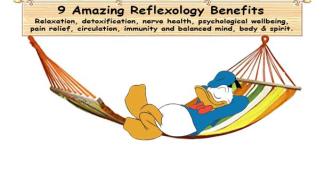
Reflexology is suitable for all age groups, and it brings relief from a wide range of acute and chronic conditions by promoting self-healing. It, furthermore, provides and maintains health and well-being.
After completed a course of reflexology treatment for a specific condition, many people find it beneficial to continue with regular treatments in order to maintain health and well-being.
Various studies confirmed that
Stress is a big factor in more than 75% of all illnesses diagnosed today with many studies putting this figure closer to 90%.
With ever-increasing levels of stress in our life, Reflexology helps us to cope with this physical, mental and emotional stresses thereby encouraging us to heal from health conditions, as well as maintain health and wellness.
9 Amazing health benefits of reflexology
For most of the people, reflexology starts showing benefits immediately once starts massaging the foot. However, few experience tiredness, weakness, need to urinate, and so symptoms; that too vanishes in the next session of reflexology massage and thereafter they can reap the benefits.
- Gives total relaxation: Reflexology slow down your heart rate, lower blood pressure, slow your breathing rate, encourage deep breathing, reduce stress, relieve depression, and reduces heart attack & stroke risk.
- Detoxification and elimination of toxins: This helps you in several different ways; boost energy, stronger immune system, anti-aging, and improved sense of wellbeing.
- Promotes self-healing: Whatever health issues you are having; reflexology surely help to cure or at-least help you manage it effectively.
- Improves nerve conduction: Reflexology stimulates over 7,000 nerves in the feet and encourages the opening and clearing of neural pathways. Reflexology interrupts pain pathways and reduces pain.
- Promotes psychological well-being: When stressed our body become more susceptible to illness and disease (As per American Medical Association, 85% of illnesses are due to stress). Reflexology reduces stress and provide total relaxation. Once the reflexology massage starts, the relaxation begins, which is confirming by EEG brain activity.
- Relief any form of pain, from a migraine to joint pain.
- Improved circulation of blood and energy: Free flow of blood to the entire body is require transporting oxygen and nutrients to the cells as well as removes metabolic wastes and toxins. Many studies show reflexology increases blood flow and relaxes the overall body, including cardiovascular system, which help pump blood naturally.
- Improved immune role: Reflexology stimulates the lymphatic system, thus reduce infection risk. Reflexology help remove toxins and induces the production of endorphins, leading to increase in immune power and sense of wellbeing.
- Well-balanced mind, body, and spirit.
By cleansing your body on a regular basis and eliminating as many toxins as possible from your environment, your body can begin to heal itself, prevent disease, and become stronger and more resilient than you ever dreamed possible! ~Dr. Edward Group III
Conditions treatable by reflexology
This gentle massage therapy may bring relief from a wide range of both acute and chronic conditions. Reflexology has been showing to be effective and assist self-healing in conditions such as:
Allergies, Arthritis, Asthma, Back pains, Blood Pressure abnormalities, Bowel disorders, Constipation, Eczema, Frozen Shoulder, Gynecological problems, Insomnia, Knee pains, Muscle tension, Neck strain, PMS/Hormonal imbalance, Respiratory disorders, Sinusitis, Stress disorders, Thyroid problems and many more.