
Astigmatism Correction
Persons with astigmatism have several options available to regain their original clear vision.
Astigmatism correction treatments
Astigmatism treatment options
- Eyeglasses
- Contact lenses
- Orthokeratology
- Laser and other refractive surgery procedures
Astigmatism correction Eyeglasses
Eyeglasses are the primary choice of correction for persons with astigmatism. They will contain a special cylindrical lens prescription to compensate for the astigmatism. This provides for additional lens power in only specific meridians of the lens. An example of a prescription for astigmatism for one eye would be -1.00 -1.25 X 180. The middle number (-1.25) is the lens power for correction of the astigmatism. The "X 180" designates the placement (axis) of the lens power. The first number (-1.00) indicates that this prescription also includes a correction for nearsightedness in addition to astigmatism.
Generally, a single vision lens is prescribing to provide clear vision at all distances. However, for patients over about age 40 who has the condition called presbyopia, a bifocal or progressive addition lens may need. These provide different lens powers to see clearly, in the distance, and to focus effectively for near vision work.
A wide variety of lens types and frame designs are now available for patients of all ages. Eyeglasses are no longer just a medical device that provides needed vision correction. Eyeglass frames are available in various shapes, sizes, colors, and materials, which not only allow for correction of vision, but also enhance appearance.
Astigmatism correction Contact lenses
For some individuals, contact lenses can offer better vision than eyeglasses. They may provide clearer vision and a wider field of view. However, since contact lenses are put-up directly on the eyes, they require regular cleaning and care to safeguard eye health.
Soft contact lenses conform to the shape of the eye; therefore, standard soft lenses may not be effective in correcting astigmatism. However, special toric soft contact lenses are available to provide a correction for many types of astigmatism. Because rigid gas permeable contact lenses maintain their regular shape while on the cornea, they offer an effective way to compensate for the cornea’s irregular shape and improve vision for persons with astigmatism and other refractive errors.
Orthokeratology (Ortho-K) involves the fitting of a series of rigid contact lenses to reshape the cornea, the front outer cover of the eye. The contact lenses are warning only for limit periods, such as overnight, and then removed. Persons with moderate amounts of astigmatism may temporarily obtain clear vision without lenses for most of their daily activities. Orthokeratology does not permanently improve vision and if stop wearing the retainer lenses; the vision may return to its original condition.
Astigmatism correction Laser’s surgery
Astigmatism can also correct by reshaping the cornea using a highly focused laser beam of light. Two commonly used procedures are photorefractive keratectomy (PRK) and laser in situ keratomileusis (LASIK).
PRK removes tissue from the superficial and internal layers of the cornea. Astigmatism LASIK does not remove tissue from the surface of the cornea, but only from its inner layer. To do this, a section of outer corneal surface is cut and folds backward to expose the inner tissue. Then a laser is useful to remove the precise amount of tissue needed and the flap of external tissue places back in the position to heal. Both procedures allow light to focus on the retina by altering the shape of the cornea.
Individuals with astigmatism have a wide range of options to correct their vision problem. In consultation with the optometrist, one can select the treatment that best meets their visual and lifestyle needs.
Astigmatism Test
Diagnosis of astigmatism is by comprehensive eye exam test, which measures how the eye focus light and determines the corrective lens needed.
Astigmatism diagnosing tests
Astigmatism examination may include:
Testing for astigmatism may use several procedures in order to measure how the eyes focus light and to determine the power of any optical lenses needed to correct the reduced vision.
Astigmatism Visual acuity test
As part of the testing, people will ask to read letters on a distance chart. This test measures visual acuity, which is writing as a fraction such as 20/40. The top number is the standard distance at which testing is performing, twenty feet. The bottom number is the smallest letter-size that can read. A person with 20/40 visual acuity would have to get within 20 feet, for a letter that should see at forty feet in order to see it clearly. Normal distance visual acuity is 20/20.
Astigmatism diagnosis by Keratometry
A keratometer is the primary instrument used to measure the curvature of the cornea. By focusing a circle of light on the cornea and measuring its reflection, it is possible to determine the exact curvature of the cornea's surface. This measurement is particularly critical in determining the proper fit for contact lenses. A more sophisticated procedure called corneal topography may perform in some cases to provide even more detail of the shape of the cornea.
Astigmatism Refraction test
Using an instrument called a phoropter, the optometrist places a series of lenses in front of the eyes and measures how they focus light. This is performing using a hand held lighted instrument called a retinoscope that automatically evaluates the focusing power of the eye. The power is then refining by patient's responses to determine the lenses that allow the clearest vision.
Using the information obtained from these tests, the optometrist can determine if one have astigmatism. These findings, combined with those of other tests performed, will allow the optometrist to determine the power of any lens correction needed to provide clear, comfortable vision, and discuss options for treatment.
Astigmatism Causes
Cause of astigmatism can be hereditary and is usually present from birth. It can change as a child grows and may decrease or worsen over time.
What causes Astigmatism?
Astigmatism occurs due to the irregular shape of the cornea or the lens inside the eye. The cornea and lens are primarily responsible for properly focusing light entering the eyes allowing us to see things clearly.
Causes of astigmatism can be hereditary and is often present at birth. It can also due to pressure from the eyelids on the cornea, incorrect posture or an increased use of the eyes for close work can cause this unwanted pressure.
The curvature of the cornea and lens causes light entering the eye to bend in order to focus it precisely on the retina at the back of the eye. In astigmatism, the surface of the cornea or lens has a somewhat different curvature in one direction than another. In the case of the cornea, instead of having a round shape like a basketball, the surface of the cornea is more like a football. As a result, the eye is unable to focus light rays to a single point causing vision to be out of focus at any distance.
Sometimes astigmatism may develop following an eye injury or eye surgery. There is also a relatively rare condition called keratoconus, where the cornea becomes progressively thinner and cone shaped. This results in a large amount of astigmatism resulting in poor vision that cannot be clearly correct with spectacles. Keratoconus usually requires contact lenses for clear vision, and it may eventually progress to a point where a corneal transplant is necessary.
Privacy Policy
Healthy-ojas, we are committed to protecting the privacy of our Web site users.
We will NOT collect any personal information about our Web site users unless it is submitted to us voluntarily as in the case of using the "Contact Us" email. In such case, we will act responsibly to protect the personal information you submitted including the contents of your correspondence with us. Your emails and their contents will be deleted as soon as there is no need for further correspondence. We will not sell, rent, lease or provide your name, email addresses or other personal information you submitted to any third party.
When you visit our site, we DO collect usage information ("site trends data") which is anonymous and is not linked to you as an individual. These are stored in our server's database which only Healthy-ojas can access and Google Analytics database which Google also has access to. Please see Google Privacy Policy. We use the site trends data to better understand how our site is used, how many pages are viewed, what search terms were used, how our site is found, the types of browsers and computer operating systems used by our visitors, and the Internet Protocol addresses from which our visitors connect to our site. This information is used to modify and improve the site. We may share ANONYMOUS summary of usage information with sponsors, advertisers, or other third parties. Such summary information CANNOT be used to identify an individual or to link an individual with a specific health condition.
We DO use Cookies on our Web site. Google as third party vendor serving advertisements, Google may collect non-PII information, “Non-personally identifiable information” is information that cannot identify a particular person. This type of information includes a user’s Internet Service Provider, a computer’s operating system and browser type, and a unique DoubleClick DART cookie ID.
For more information about the use of the DoubleClick cookie in DoubleClick’s advertising services, check out the DoubleClick Privacy FAQ.
Google's use of the DART cookie enables it to serve ads to users based on their visit to this site and other sites on the Internet. Users may opt out of the use of the DART cookie by visiting the Google ad and content network privacy policy.
By using this Web site, you signify your acceptance of our Privacy Policy. If you do not agree to this policy, please do not use our site. Healthy-ojas reserves the right, at our discretion, to change, modify, add, or remove portions from this policy at any time without notice. Therefore, users are encouraged to review this policy from time to time. Your continued use of our Web site following the posting of changes to these terms means you accept these changes.
Astigmatism
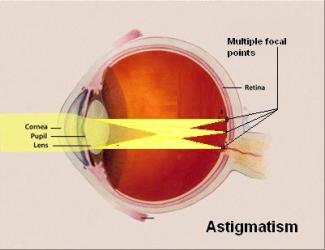
Eye astigmatism has abnormally curved cornea or lens prevents light from focusing properly on the retina. Thus, vision becomes blurring at any distance.
Eye Astigmatism
Astigmatism is a very common vision condition. Most people have some degree of astigmatism. Slight amounts of astigmatism usually do not affect vision and do not require correction or treatment. However, larger amounts cause distorted or blurred vision, eye discomfort, and headaches.
Astigmatism commonly occurs with other vision conditions like myopia nearsightedness and hyperopic farsightedness. Together these vision conditions are considering as refractive errors because they affect how the eyes refract light.
Astigmatism Symptoms
- It is difficult to see fine details (clearly), near, or far distance.
- Headaches or eyestrain with distort or blurred vision at all distances.
- Small amounts of astigmatism produce just a slightly blurred vision.
- Affect child's ability to see well in school and sports, so loss interest in studies as well as sports.
Hyperopia Correction
Hyperopia treatment or vision correction is using eyeglasses, contact lenses, and Surgical procedures.
Hyperopia treatment options
Persons with hyperopia have several options available to regain clear short-distance vision. They include:
- Eyeglasses
- Contact lenses
- Surgical procedures
Farsightedness correction by Eye glasses
Eyeglasses are the most commonly preferred correction for farsightedness. Generally, prescribe a single vision lens to provide clear vision at all distances, particularly nearer distances. Eyeglasses can be used all the time or only during short-distance viewing.
A large selection of lens types and frame designs are available for patients of all ages. Eyeglasses are no longer just a vision correction, but can also be a fashion item. They are available in a wide variety of sizes, shapes, colors, and materials, which not only correct for vision problems but also may enhance the appearance.
Farsightedness correction by Contact lenses
For some patients, contact lenses can provide better vision than eyeglasses. They may provide clear vision and a wider field of view. However, since contact lenses wear directly on the eyes, they require regular maintenance, that is cleaning and a certain amount of care is required to safeguard eye health.
Hyperopia correction Surgery
Correcting farsightedness with surgery is slightly more complicated compared with nearsightedness. People who undergo laser surgery for hyperopic are having limited chances of positive long-term results, and recovering from the surgery takes much time.
Common surgical procedures for correcting hyperopic:
- Conductive Keratoplasty
- Laser surgery
- Hyperopia LASIK
- PRK
- LASEK
- Epi-LASIK
- Laser thermal keratoplasty (LTK)
Conductive Keratoplasty (CK) - is a different type of refractive surgery, uses radiofrequency energy, and it does not involve the removal of any corneal tissue. An instrument with a tiny probe on the end is places at specific points around the periphery of the cornea, which emits energy at each point. The treatment causes the collagen to shrink, which changes the shape of the curve of the cornea. This procedure to change the shape of the cornea will nullify the refractive error of the eye, allowing the patient to see clearly. CK is an effective hyperopic treatment for mild to moderate degrees of farsightedness.
Hyperopia Laser surgery
Farsightedness can also correct by reshaping the cornea using a laser beam of light. Commonly used procedures are:
- Laser in situ keratomileusis (LASIK)
- Photorefractive keratectomy (PRK)
- Laser-Assisted in Situ Epithelial Keratomileusis (LASEK)
- Epithelial Laser in situ keratomileusis (Epi-LASIK)
Hyperopia LASIK does not remove tissue from the surface of the cornea instead from its internal layers. To perform this, a section of the outer corneal layer is cut and folds backward to expose the inner tissue. A laser beam is utilizing to remove the precise amount of corneal tissue requires reshaping the eye, and then the external cornea tissue is place-back in a position to heal. The amount of farsightedness that can correct by LASIK is limiting by the amount of corneal tissue that can remove safely by LASIK.
In PRK, a laser is useful to remove a thin layer of tissue from the cornea surface in order to change its shape and refocuses the light entering the eye on to the retina. The amount of farsightedness that can correct by PRK is limiting by the amount of corneal tissue that can remove safely by PRK.
Laser thermal keratoplasty (LTK) is a refractive surgery, which utilizes a Holmium laser for reshaping the cornea to correct low ranges of hyperopia (farsightedness). The Holmium laser is an infrared (thermal) laser that uses heat to shrink corneal tissue.
Advertisement Policy
Funding is provided by third party advertising from several providers. Third party advertising consists of relevant, targeted advertisements that are intended to supplement the information provided on the Healthy-ojas website. However, in some cases the advertisements displayed are based on automatic inclusion, and the Healthy-ojas website and its author(s) do not accept responsibility for the accuracy of statements made by these contributors, nor does the Healthy-ojas website or its author(s) accept responsibility for any errors or omissions. The products or ideas mentioned are not a warranty, endorsement or approval of ideas or products or their safety. The Healthy-ojas website and its author(s) disclaim responsibility or liability, directly or indirectly for any injury to persons resulting for the use or misuse from any ideas or products referred to or implied by any material presented.
Every effort is made to ensure that advertising and editorial content is kept separate on Healthy-ojas website. Advertising will never have any influence over the content presented. In the event that an advertiser is discussed in an article on Healthy-ojas, a full disclosure will be included.
Google Advertisements
Google Advertising appears on many pages of the Healthy-ojas website. The advertisements are clearly indicated. These ads may include items that change frequently and the Healthy-ojas website and its author(s) cannot necessarily recommend these items. It is possible that some advertisements may even contradict the recommendations made by the Healthy-ojas website and its author(s).
link/banner exchange
Healthy-ojas do not derive funds nor show advertisements from any third party afilliate program or banner exchange with the exception of google ads which are clearly marked.
Hyperopia Test
Diagnosis of hyperopia can be by simple eye examination test performed by an ophthalmologist or an optometrist.
Farsightedness tests
The initial hyperopia diagnosis is by visual acuity test - asking the patient to read letters from an eye chart, which is keeping at specific distance. Based on how-much the patient can read from the chart, the doctor can be able to assess how clearly the patient can see. Other tests are performing to determine the degree of hyperopia.
Testing for hyperopia may use several procedures in order to measure how the eyes focus light and to determine the power of any optical lenses needed to correct the reduced vision.
Hyperopia Visual acuity test
As part of the farsightedness testing, eye chart (with letter or symbols) is at a specific distance should identify by the person who is suspect with hyperopia. This test measures visual acuity. The top number of the fraction is the standard distance at which testing is performing, twenty feet. The bottom number is the smallest letter-size read.
Farsightedness test by Phoropter or phoroptor
It is an instrument used during an eye examination to measure refractive error and assess eyeglass prescriptions. The patient is requesting to sit behind the phoropter, and looks through it at an eye chart hanging at a specific distance. The optometrist then changes lenses and other settings, by asking the patient for their feedback on which settings give the best vision, based on this the doctor assesses the corrective lens value for the refractive error.
Hypersopia test by Retinoscope
It is useful to shine a light into a patient's eye for an eye doctor to examine the reflection off the retina. The light is moving back and forth across the pupil. Retinoscope is particularly useful in assessing corrective lenses for patients who are unable to give oral feedback to the eye doctor, in particular, to assess small kids. Retinoscope is also helpful to determine eye co-ordination how well the eyes work together, or accommodate, to make clear vision.
This testing may be without the use of eye drops to determine how the eyes respond under normal seeing conditions. In some cases, such as for patients who cannot respond verbally or when some of the eyes focusing power may hide; eye drops may be used. They temporarily keep the eyes from changing focus while perform testing.
Using the information obtained from these tests, along with the results of other tests of eye focusing and eye teaming, the optometrist can assess hyperopia. He or she will also determine the power of any lens correction needed to provide clear vision. After the eye test, the optometrist can discuss options for treatment.
Hyperopia Causes
Hyperopia causes are hereditary, environmental factors, eye structure, and other health conditions.
Hyperopic vision problem occurs when light rays entering the eye focus behind the retina, rather than directly on it. The eyeball of a farsighted person is shorter than normal.
Number of people with hyperopia has increased significantly with age. For instance, it affects approximately 62% of population over the age of 40 years.
Farsightedness causes
- Hereditary or genetics – similar to myopia, hyperopia also has the genetic link. One or both parents having farsighted are likely to have it.
- Environmental factors - also contribute for the causes of hyperopia.
- Eye structure - Most hyperopic’s has shorter eyeballs and or flat (fewer curves) cornea.
- Most hyperopic born farsighted - When age advances, the eyes loses its ability to accommodate for the refractive errors. Then farsightedness becomes more apparent, usually around age 40.
- Other health conditions - rarely other diseases may cause hyperopia, such as retinopathy, eye tumors, and dislocation of the lens.
An optometrist can evaluate vision and determine the cause of the vision problems.
Sometimes people confuse hyperopia with presbyopia, which also causes near vision problems but for different reasons.
Hyperopia Symptoms
Hyperopia symptoms are causes by the difficulty to see nearer objects clearly; some of the most common symptoms are mention in this page.
Hyperopia, also called as farsightedness, is mostly happening at older age, but sometime even with school going children. It is a refractive error disorder rather than from a disease. This refractive error is the inability of the eye to focus the image on retina resulting in a blurred closer image.
Common farsightedness symptoms
- Farsightedness or hyperopia causes blurred near vision.
- No trouble seeing objects that are far away, such as highway signs, TV screen, blackboards in schools, etc.
- Difficulty focusing on nearer objects
- Eyestrain occurs due to concentration to get the near object details.
- Headaches mostly after doing close work
- Feel comfortable to hold the newspaper further away from the eyes.
- Decrease in the performance of close up works such as reading, writing, etc.
Hyperopic sign and symptoms of younger child
Hyperopic child has certain symptoms depending on the severity of the condition. Some children may have no symptoms, while others may experience:
- Certain degree of photosensitivity
- Sometimes eye blinking or itching (these children rub their eye often to relieve the symptom) can be noted.
- Losing interest to do homework and study due to unclear short-distance vision.