
Baby Eye

Babies eye and its vision development from infant to five years, stages of development and how they start learning things through their vision.
Baby’s eyes are the widows to this wonderful world, without proper vision, a baby cannot be able to see and learn about this world. Vision problems occur at bout 5 % of preschoolers and 25% of school-age children. Since most vision problems starts at an early age, it becomes very important that babies need proper eye care. Untreated eye problems can worsen and develops serious problems as well as hits learning ability and personality in school.
Baby's eye vision development
Newborn infants - In newborns the sharpness of vision is not yet fully developed. Therefore, they usually prefer looking at closer objects, brighter colored or of high contrast and moving.
Three Months - At this age, they can smoothly follow a moving object. Colors and moving parts attract infants at this stage and help stimulate their visual development.
Three to six Months - At this age, the retina of the eye is almost well developed, and the baby's visual sharpness is enough to see small details to see. The infant at this stage can be able to look from near to far and far to near again. Assessment of distances (or depth) is also on development.
Six Months - At this age, the eye has developed about two-thirds of its adult size. Now the two eyes are fully working together, resulting in binocular vision. Distance vision and depth perception are still on development.
One Year Old - At this age, the vision is on its way toward full development. Eye coordination with the hands and body are naturally practice by the child, and it can be improvising by games involving; grasping, placing and catching.
Two to five Years Old - At this age, children are interested to draw and see at pictures. Stories with pictures, drawings, and symbols help the child to coordinate hearing and vision.
Eyesight

Eye vision enables us to see clearly the objects in our surroundings at different distances and under numerous conditions of light.
How does the Eye see?
The eye works by changing the curvature of the lens to bring the image to focus from any light from a single point of a distant object and/or a near object called eyesight or eye vision.
The eyes are the windows to the world; they allow us to see objects both far and near.
Light reflects off an object and enters the eye. The light enters the eye through the front window of the eye, called the cornea. A clear covering helps to focus the light. Other sides of the cornea are clearer, watery fluid is the aqueous humor.
After light passes through the aqueous humor, it passes through the pupil, the central circular opening in the colored part of the eye called the iris. Depending on the amount of light available, the iris can contract or dilate, limiting or increasing the amount of light needed that gets deeper into the eye. The light then goes through the lens, which focuses the light (Just like the lens of a camera). The suspended lens changes shape with the help of ciliary muscle to focus on light reflecting from near or distant objects. The lens focuses the light on the retina at the back of the eye.
The retina is a thin layer of tissue at the back of the eye that contains millions of tiny light-sensing nerve cells called rods and cones, which are named for their distinct shapes. Cones are concentrated in the center of the retina; an area called the macula. In bright light conditions, cones provide clear, sharp central vision and detect colors and fine details. Rods are located outside the macula and extend all the way to the outer edge of the retina. They provide peripheral or side vision. Rods also allow the eyes to detect motion and help us see in dim light and at night. These cells in the retina convert the light into electrical impulses. The optic nerve sends these impulses to the brain where it produces an image.
Visual information as impulses from the retina is transferred from the eye to the brain via the optic nerve. Because both eyes see from slightly different positions and get different images, the brain has the ability to mix properly these two images in such a way as to receive a completely clear actual picture.
Sometimes eyeball shape makes it difficult for the cornea, lens, and retina to work properly as a team. When this happens, the person's eye will be out of focus. In addition, they need to wear eyeglasses to focus images correctly onto the retina and allow them to see clearly.
Eye Anatomy

Eye visual anatomy is the assembly of complicated parts and structure that helps to see this beautiful world.
What we see is the result of a series of events between the eye, brain, and outside world.
Anatomy of Eye Parts
- Eyeballs - The eye is a small ball that sits in a little hollow area called the eye socket in the skull.
- Conjunctiva - is a mucous membrane that lines the eyelids and covers the front part of the eyeball.
- Eyelid - protects the eye and helps keep the eye clean and moist by opening and closing several times a minute called blinking. It happens both voluntarily (with our knowledge) and involuntarily (without our knowledge). If you bring your finger in front of the friend’s eye, the eyelid shoots off, that is it helps to protect from possible danger.
- Sclera - the white part of the eyeball, made of tough material covering most parts of the eyeball. There are tiny pink threads, and blood vessels that supply blood to the sclera.
- Aqueous Humor - is a clear, watery fluid that fills the front part of the eye between the cornea, lens, and iris.
- Cornea - the transparent dome in front of the eye, it transmits and focuses light into the eye. It looks like a clear glass window to view the world through.
- Iris - the colored part of the eye helps to regulate the amount of light that enters the eye. When a person has blue eyes, it really means that person has a blue iris!
- Pupil - is the dark center in the middle of the iris, which changes size in response to the amount of illumination to control the amount of light that is allowed into the eye.
- Anterior chamber - space between the cornea and the iris, filled with a special transparent fluid that nourishes the eye and keeps it healthy.
- Lens – is the transparent structure behind the iris that helps to focus light rays onto the retina.
- The choroid - is the middle layer of the eyeball, which contains veins and arteries that nourish the eye, especially the retina.
- Retina - is the nerve layer that lines the back of the eye, senses light, and creates nerve impulses that are sent through the optic nerve to the brain. The retina is comparable to the filming screen in a cinema hall.
- Macula - is a small area in the retina with special light-sensitive cells. It helps to see fine details clearly.
- Fovea - A tiny area located in the macula that is the area of the clearest vision on the retina.
- Optic nerve - the nerve that connects the eye to the brain, which carries the impulses formed by the retina to the brain, where it interprets as images.
- The ciliary muscle is suspended in a bunch of fibers, fibers in turn attached to a muscle called the ciliary muscle. It helps to change the shape of the lens to see & focus far and closer things.
- Vitreous - is the clear, jelly-like substance that fills the middle of the eye.
- Rod & cones – The retina has and uses 120 million rods and 7 million cones of special cells in each eye to process the light. Rod senses black, white, and shades of gray. They are very sensitive, and allow seeing even in the dark. Cones senses colors and needs brighter light than rods to perform well.
Visual information from the retina is transported from the eye to the brain via the optic nerve. Because both eyes see from slightly different positions, the brain can mix the two images in such a way as to receive a completely clear picture.
Sleep Reflexology
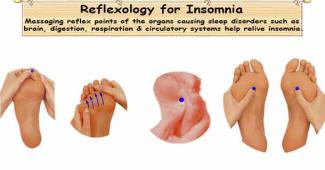
Reflexology in insomnia is simple to perform, without any side effects, provides relief from insomnia, and provides overall wellness.
Sleep disorder causes & how is reflexology helps to relieve it?
Sleep problems or disorders are mostly causing by mental stress, breathing difficulty, circulating problems and digestive disorder. These problems can be resolved by stimulating the respective organ’s reflex points. See the picture below for reflex points of the different organs.
- Mental reasons (stress, anxiety, fear, anger, etc.),
- Relived by stimulating the reflex points (brain) to calm the mind
- Breathing difficulty (narrowing of airway during sleep in sleep apnea),
- Relived by stimulating the reflex points of lungs.
- Circulation problems (restless leg syndrome)
- Relived by stimulating the reflex points of the circulatory system (heart).
- Digestive problems (sleep disturbance due to abdominal gas, pain, etc.)
- Relived by stimulating the reflex points of digesting organs (stomach, small intestine, large intestine & liver)
Reflexology massage for sleep disorders
It is advisable and preferred to start the reflexology massage treatment from:
- Endocrine glands (all the seven glands), which are controlling the entire metabolic system.
- Then continue the reflexology massage by stimulating the organ that causes sleep disorders such as brain, respiratory organ, circulating systems, and digestive organs.
Endocrine gland reflexology massage for sleep disorders
- Pituitary gland
- Pineal gland
- Thyroid & parathyroid gland
- Thymus gland
- Adrenal gland
- Pancreas gland
- Testes (for male) or Ovaries (for women)
Special attention should give to the adrenal gland, because it is responsible for stressful situations (most of the sleep disorders are causing by stressful lifestyle). Massaging adrenal reflex will make you calm by reliving stress and helps to attain calm mind. Concentrate on all seven glands, because the hormones secreted by the glands are messenger system for total control the human body system.
Reflexology massages for sleep disorder causing organs
Massaging the reflex points of the organs that cause sleep disorders can help to relive from these disorders.
- Brain – Helps to relieve mental stress, anxiety & fear
- Solar plexus - Tension and stress commonly result in a “tight chest” and “shallow breathing.” This technique is good for anxiety, improved breathing, to ease distress, anger, and pain. Oriental medicine calls this point, “Calming Spirit” and it lives up to the name.
- Respiratory system - Lungs,
- Circulatory systems - composed of the cardiovascular system (which distributes blood) and the lymphatic system (which distributes lymph). Cardiovascular system is the heart and lymphatic system contains spleen, thymus, and bone marrow.
- Stomach
Massage reflex areas of brain, solar plexus, lungs, heart, spleen, thymus, and stomach. If found any pain, numbness in these reflex areas, then special attention should be given to that particular area. Because a different sensation indicates, some minor problem linked with that related organ. If a particular point shows any positive change after massaging, then increase the frequency of massage to that particular location. If happen otherwise discards that reflex point from massaging.
Sleep Acupressure

According to Chinese Medicine, when night comes the Qi (vital energy) & blood slip into the interior, and we fall asleep. If it does not happen, he/she will get insomnia.
Insomnia Acupressure Treatment
A human body is considering as a mini nature. When the sun descends, the night is coming; meanwhile, the Qi (vital energy) and blood slip into the interior and human fall into sleep. It is a well-balanced status for a person. Now, you can get a conclusion that if Qi and blood cannot slip into the interior in the evening due to any reasons, you will get into insomnia.
Insomnia means a person cannot sleep peacefully, manifesting to be difficulty in going into sleep, easy to wake after sleep, and not easy to sleep again and so on. It is just a Traditional Chinese Medicine theory - "yang cannot enter into the yin.
How common are sleep disorders? Nowadays, sleeping problems are widespread in people of all ages. The main reason for this is today’s fast lifestyle. Young people work for 8 to 10 hours in front of the computer, the rest of the time spend with their smartphone, which affects the sleep.
Insomnia is one of the most common sleep disorders prevail 40% among adults. Out of which 10 to 15% of the adult population suffer by chronic insomnia, and balance of about 25 to 25% have occasional sleeplessness.
Why is restful sleep essential? Adequate sleep is vital for proper repair and healing the body. Regular inadequate or poor sleep quality can be damaging to your health. ; putting you on a risk that includes digestion health, heart disease, obesity, diabetes, etc.
What is acupressure? Does it improve sleep quality & quantity? This ancient Chinese acupressure therapy is by applying pressure to different points on the body called acupoints. Pressing these acupoints along the nervous system pathways stimulates proper energy flow throughout the body, which helps to treat many ailments, including insomnia.
Acupuncture is commonly used to treat insomnia in China. Clinical studies have shown acupressure may help relieve insomnia in all ages better than compared to sleep pills. Therefore, you may successfully use acupressure treatment for sleep problems without any side effect.
Acupressure insomnia treatment works by calming the mind, pain control, relieve digestive problems, improves circulation, sedative function, relieve palpitations, and pacify asthma-like symptoms.
Acupressure vs. acupuncture: Indeed, both use the same points to stimulate. But acupuncture use needles whereas acupressure use finger or another blunt instrument such as a pencil back.
Acupuncture should be practiced by a trained professional, whereas yourself or your loved one can do acupressure.
Treat Insomnia using acupressure
Acupressure is effective in treating insomnia. Many people report immediate improvements in their sleeping habits.
With acupressure, the sensation of sleep comes easily, lasts without interruption, and is more profound and more refreshing.
How to treat insomnia yourself? Here are some best acupressure points that can be stimulated to relieve insomnia and help relax the body and mind. These acupoints for insomnia based on clinical evidence: PC6 (Neiguan), SP6 (Sanyinjiao), HT7 (Shenmen), KD6 (Zhaohai), BL62 (Shenmai), DU 20 (Baihui), ST36 (Zusanli), and KD1 (Yongquan).
References:
- Evidence-Based Complementary and Alternative Medicine, Volume 2013, Article ID 163850, 10 pages.
- Journal of Acupuncture and Meridian Studies, Volume 10, Issue 2, April 2017, Pages 135-138.
Pericardium 6 (PC6)
Pericardium 6 point location: This point is in between the two tendons located about three fingers towards the elbow from the wrist crease.
PC6 indications: It is indicated for, anxiety, palpitations, emotional problems, and insomnia. It is said to calm the Heart and the spirit — familiar point for motion sickness. Also useful for chest congestion, cardiac pain, depression, dizziness, asthma, cough, irritability, and malaria.
PC6 functions: Opens the chest, regulates Heart Qi, harmonizes the Stomach, and regulates Qi.
You can stimulate PC6 acupoint with your thumb in a small circulator motion for 1 or 2 minutes in both arms. Take a deep breathe while pressing the point. This point is useful for emotional problems such as stress, fears, anxiety, sadness, and depression. Additionally, this point is helpful for nausea and vomiting problems common during pregnancy.
Spleen 6 (SP6)
Spleen 6 point location: On the inner side of the lower leg, four-finger width above the tip of the ankle bone, on the back of the shin bone.
SP6 Indications: Invigorates the circulation of Qi Blood, poor digestion, abdominal distension, a significant point for insomnia.
SP6 functions: Strengthens the Spleen and Stomach, harmonizes the Liver, strengthens the Kidneys, and nourishes Blood.
SP 6 is the most versatile point because the point crosses the Spleen, Kidney, and Liver meridians. It can treat many conditions associated with all three organs.
Heart 7 (HT7)
Heart 7 point location: Outer edge of the wrist crease (below little finger). It is the hollow spot in line with and below the little finger. For easy identification of the point, it is best to turn the hand upward and support the wrist with the fingers of the opposite hand.
HT7 indications: It is for irritability, palpitations, mania, and dementia, among other things.
This point has a sedative function. Stimulating this point help relieving insomnia caused by overexcitement, emotional issues, and cold sweat. Also, to relieve cardiac pain, palpitations, chest pain, and irritability.
HT7 is a very important acupoint for treating insomnia. Ref: European Journal of Integrative Medicine, Volume 15, October 2017, Pages 17-22
HT7 functions: Tone and regulates the heart blood and Qi.
You can stimulate HT7 acupoint with your thumb for a minute in both arms. Take a deep breathe while pressing the point. It is an excellent point for calming the mind; physical agitation, fears, palpitation, manic depression, and stress.
Kidney 6 (KD6)
Kidney 6 point location: On the inner side of the foot, in the depression below the tip of the internal malleolus.
KD 6 indication: A significant acupressure point promotes restful sleep. Help relieve insomnia, hypertension, and anxiety. Also useful for treating digestive disorders, dry and sore throat, irregular menstruation, eye problems, and epilepsy.
KD6 functions: Nourishes the Kidneys and benefits the throat and eyes.
You can stimulate KD6 acupoint with your thumb with firm pressure in both legs. This point is useful for calming the mind, reduce nightmares, and nocturnal epileptic seizures; thus helps to prevent and treat insomnia.
Urinary bladder 62 (UB62)
Urinary bladder 62 point location: In the depression directly below the external malleolus.
UB 62 indications: Epilepsy, manic psychosis, Insomnia, Headache, and neck rigidity. It also helps in curing lower back pain, spinal problems, headache, stiff neck, nervousness, and epilepsy.
UB 52 functions: Dispels wind, treats epilepsy, and benefits the eyes and head.
Stimulating BL62 acupoint with the index or middle finger with firm pressure in both legs may quiet the mind.
Governor Vessel 20 (GV20 or DU 20)
Governor Vessel 20 point location: At the midpoint of the line connecting the top of the two ears.
GV 20 indication: Vertigo, dizziness, coma, manic psychosis, headache, clear your mind (from overthinking), increase memory, resolve hemorrhoids, counteract depression, and insomnia.
GV20 functions: clears the head, calms the Shen, and dispels Interior Wind.
You can stimulate GV20 acupoint with your thumb with firm pressure. This point is often used to clear your mind (from overthinking), counteract depression, and manic psychosis; thus prevent and treat insomnia.
Stomach 36 (ST36)
Stomach 36 point location: Place four fingers below the kneecap, the point located at this level one fingerbreadth outside the shin bone.
ST36 indication: Gastric pain, abdominal distention, indigestion, abdominal pain. Also, palpitation, shortness of breath, insomnia, asthma, knee pain, depressive psychosis, and madness.
ST36 functions: Tones Qi and Blood, strengthens the spleen and stomach and stops the pain.
ST 36 is known as one of the essential points to tonify Qi and Blood and promote general wellness. If you are tired to a point you even cannot able to take a single step, this point gives you the energy to walk another three miles!
As per Chinese traditional medicine, the spirit requires to reside in the heart and blood while sleeping. So if the blood is deficient, the mind wander, causing sleeplessness. Many who are exhausted, but cannot able to get a good night sleep.
You can stimulate ST36 acupoint with your thumb with firm pressure on both sides leg. This point is useful for the abdominal problem, asthma, knee pain, and psychosis depression; thus helps to prevent and treat insomnia.
Kidney 1 (KD1)
Kidney 1 point location: Between the 1st and 2nd toes on the sole, about 1/3 distance from the base of the toes and 2/3 distance to the heel. It is at the depression below the balls of the feet. It is the location of the solar plexus in the reflexology. Stimulating this point ground your energy and induce sleep.
KD 1 indication: For headache, neck pain, dizziness, and manic psychosis. Also, constipation, dryness of mouth, and hot sensation of the sole.
You can stimulate KD1 acupoint with your thumb with firm pressure in both soles. This point is useful for neck pain, manic psychosis, dry mouth, and hot sole; thus helps to prevent and treat insomnia.
Is acupressure safe?
Acupressure is generally reporting as safe when performed by an experienced practitioner. No serious complications have been publishing, despite millions of treatments every year. Self-administered acupressure believes to be safe with proper training. Vigorous acupressure may cause bruising in sensitive individuals.
Yoga Nidra
Yoga nidra means "yogic sleep"; it works very effectively on mental-resolve, will power, resolutions and provides physical and mental calmness thus useful for insomnias.
What is Yoga nidra?
Many people testify to the unbelievable power and effectiveness of the resolution (Sankalpa) made during the practice of Yoga nidra. Resolution can use to eliminate negatives and impose positive or overcome addiction if any or to attain the goal (aim in life).
Many people in the East and the West are attracted to Yoga Practices, for they think they can find the solution to every problem therein, be it physical, mental, emotional, or spiritual! A great importance is attaches to relaxation techniques that might help a person tensed due to chronic stressful lifestyle. Yoga Nidra is one such wonderful technique for physical or mental relaxation.
Ordinary sleep and Yogic sleep
It is to understand that ordinary sleep is not a relaxation; the tensions cannot always resolve completely in ordinary sleep. Although the word 'Nidra' means sleep,
Yoga Nidra is qualitatively different relaxation. It is a 'sleep,' where all the burdens are thrown off to attain the more blissful state of awareness, a relaxation much more intense than ordinary sleep.
Yoga nidra's Neuro-physiologic relationship
There is a close relation between the body and the brain, which is proving by all scientific means. Various centers in the brain control, modify, and affect our bodily functions. In fact, there is a center in the brain for every act, whether willful or reflex, physical or mental. Stimulation of these centers leads to appropriate action, be it motor, sensory, secretary, emotive or cognitive. Thus, we have a holographic representation of the body on the brain.
It is proven that the left half of the body is representing in right half of the brain and vice-a-versa. As far as the muscular actions are concerned, the representation is in an 'upside-down manner'. Thus, at the top of this part of brain, the lowest part of our body (i.e. foot) is representing. Then, it comes ankle, leg (calf), knee, thigh, hip, trunk, shoulder, arm, elbow, wrist, palm, fingers, thumb, then neck, jaw, face, eyes, ears, tongue, taste, swallowing, etc. The same thing is applicable to sensations. Stimulation of brain-centers of sensory cortex evokes sensations on the opposite half of the body.
Yoga Nidra Practice
Asanas - first doing few asanas - practicing few postures such as child-pose, lotus-pose, or sun-salutations, then carry out Yoga nidra.
Shavasana - Then the person lies on his or her back in totally relaxed posture (Shavasana - posture simulating dead body). Eyes are lightly closed; arms are keeping with palms facing upwards, and fingers are half lifted from the ground; breathing is natural and quiet.
Resolve or Sankalpa - Before the rotation of awareness the aspirant should make a positive resolve about the aim in life. The wordings should be clear and precise. It is not expecting that the sadhaka make minor resolve like, 'I will give up smoking, or drinking, or tobacco, but he or she should think higher. A few resolves are:
- I will awaken my Vital potential
- I will be successful in all undertakings,
- I will achieve total health
- I will be in positive help to others, etc.
Rotation of Awareness - One has to visualize the part of the body mentioned by the instructor, be that a teacher or a tape. The student should not move; any part of their body unnecessarily. Quickly corresponding with the instructions, one has to shift the awareness from one part to the next. The aspirant should not imagine the next part before the instructor mentions it. The whole process is a pleasure and not a burden. There should not be any anxiety or expectation. The usual pattern is to start focusing awareness in the following sequence:
First on the right side, thumb, fingers (one by one), palm of the hand, then the wrist, the forearm, the elbow, arm, shoulder, right back, hip, thigh, knee, leg, ankle, foot, great toe, other toes of the right foot. The same sequence is repeats for the left side.
Then awareness is the focus on the proximity of the body with the carpet (ground). In the back of the head, shoulders, back and spine, thighs, heel. Next, the front of the body surface is bringing in to awareness: Face, brow, eyes, nose, lips, mouth, chin, neck, chest, abdomen, upper thighs, legs, foot, and toes, in that order.
Awareness of the Breath - After rotation of the consciousness in such a sequence, focusing attention on the act of breathing completes physical relaxation. One simply maintains awareness of breath, either at the nostril or of its passage through the navel and throat.
Relaxation at the emotional level - Next comes, relaxation at the level of feelings and emotions. Attempt is made to bring to memory the intense physical and emotional feelings; they are re-experienced or re-lived, and then effaced (remove completely from memory). Usually, this is the practice with pairs of two opposite feelings like hot and cold, lightness and heaviness, pain and pleasure, joy and sorrow, etc. Relaxation at the emotional level and building up of strong willpower is the major outcome of this procedure.
Visualization - The final stage of Yoga Nidra relates to mental relaxation. The aspirant tries to visualize the objects as described by the instructor. Usually such images and symbols are choosing that have universal significance. To quote a few symbols: mountain, river, ocean, temple, church, cross, Saint, flower, etc. The practice helps to develop self-awareness and helps in concentration or dharana ("concentration" or "single focus"). Rarely, even dhyana may be the natural outcome.
Ending the Practice - Once again, the resolve or sankalpa is intently thinking of or even visualize. Thus, consciously one tries to direct the unconscious mind about the goal in life. This time the unconscious is very receptive and therefore, may accept the suggestion from the conscious mind with more intensity. It is the claim that in due course of time, depending upon the sincerity and regularity of the sadhaka; the resolve bears fruit in sadhaka's life.
Benefits of Yoga nidra
Yoga Nidra helps in restoring mental, emotional, and physical health by way of relaxation, and makes the mind more conducive to pratyahara ('withdrawal of the senses'), dharana, and meditation.
Such a practice helps harmonize two hemispheres of the brain and the two aspects of autonomous nervous system viz. sympathetic and parasympathetic. The impressions in the subconscious are bringing to surface, experience and remove. Thus, the fixation of awareness to the body is replacing with awareness linked with subtler aspects of prana and spiritual dimensions.
Sleep Pranayam
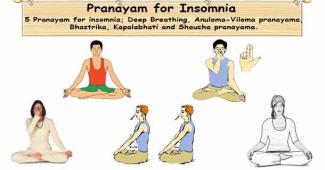
Several researchers suggest the power of breathing exercise in treating stress-related disorders such as insomnia, stress and anxiety is appealing.
Breathing Exercise for Insomnia
Mind and life are essential for the existence of man. Prana (life) enters our body while taking shape at womb and leaves us when we die. Prana is omnipresent. It is present in the air we breathe, water we drink and food we eat. You know, the most important of them is air; we cannot sustain our prana for even two minutes if we are devoid of all-important air.
Pranayama is the technique of collecting and storing more prana (life) from the air (oxygen) we breathe, or in simple word’s pranayama control life force.
Several researchers suggest the power of breathing exercise in treating stress-related disorders, asthma, and oxidative stress. Yoga practitioners who are practicing pranayama experience strong and controlled mind.
Deep Breathing Exercise
To take deep breathing, take any of the poses (Padmasana or Vajrasana) directed for meditation. Body is kept erecting and without giving stress to any part of the body or without making any movements. Your stomach is almost empty. Put your hands-on knees. Straighten up your head and close your eyes.
- Take a breath slowly through both the nostrils. Chest will push forward a little when the lungs are full.
- Retain a breath in the lungs for a little while. (In-breath)
- Slowly exhale (slower than inhalation), make sure no air is in the lungs.
- Do not inhale for a few moments (Out-breath).
On the first-day practice, this cycle for five times a day and gradually increase it to ten times a session. It should practice after savasana or corpse-pose. Never allow to break the rhythm of breathing in or breathing out. Anyone can practice pranayama any time and anywhere. Whenever you feel under pressure, take six to eight deep breaths, and you will experience better control of mind. Though it is not necessary to keep the eyes shut, do not allow the sights to distract you.
Alternate Nasal Pranayama (Anuloma-Viloma Pranayama)
It otherwise called as nadisodhana pranayama or nervous cleansing pranayama. Take a meditation pose. Extend and keep your left hand palms down on the right knee.
- Raise right hand, put index, and center finger between eyebrows. Keep the thumb on right and ring finger on left of the nose.
- Close your eyes and calm your breathing (and mind) down. Relax all muscles.
- Completely breathe out. Expel all the air.
- Use your thumb to close right nostril. Fill your lungs by taking breath through your left nostril only.
- After fully filling your lungs, close your left nostril with the small and the ring finger.
- Open right nostril and fully expel the breath inside. Keep the breath out for two or three seconds.
Take to breathe through your right nostril. Repeat the complete cycle three times as a beginning and increase it to up to ten cycles. It does not break the breathing in or breathing out process any time while practicing pranayama. Never keep your mouth opened. Mind is calm and listens to the movement of breathing only. This pacifies mind. It balances prana of different nerves. It cleans brain cells and opens previously unopened alveoli of the lungs.
Practice this for a few days before attempting pranayama 3.
Bhastrika Pranayama
Bhastrika literally means bellows. This pranayama step got its name from the fact that the breathing resembles the action of bellows. Sit in a meditation pose. Put your left hand palm-down on your right knee.
- Put your index and middle finger between the eyebrows, leaving thumb and ring finger free.
- Close right nostril with the thumb. Briskly breathe in and out through the left nostril for ten times.
- Release the thumb and take in breathe through both the nostrils, slowly and deeply. Close both the nostrils with thumb and ring finger to keep the breath-inside.
- Release both fingers before you feel breathless. Slowly, but steadily release your breathe completely.
Take two or three regular breathing. Repeat the whole process by closing the left nostril and breathing through the right. Beginners need to practice only one cycle only. You can gradually increase the number of cycles to 15-20 a day over time. This is not indicating for persons with hypertension (high blood pressure) and heart diseases.
Benefits: Bhastrika, the third step of pranayama eliminates germs and accumulated wastes from lungs. It is beneficial for persons suffering from asthma and tuberculosis. It is also to note that the persons practicing this step experience the release of mucus on larger quantities. Nothing to worry, it is the method of expelling wastes from the lungs.
Kapalabhati Pranayama
Sit in a meditative pose and close your eyes. Put both hand’s palm-down on knees. Put the right hand on the right knee and the left hand on the left knee. Briskly breathe in and out. Expel air with some force. There is no need to inhale with pressure. Begin with ten rounds of breathing in and out; you can increase it to 30-50. At the end of a session, take a deep breathe and exhale slowly; Rest on a while.
Benefits: It strengthens and calms down mind. It cleanses brain and flushes out worries and negative thoughts. It also reduces the production of mucus.
Shaucha Pranayama
This cleanses lungs take any comfortable yoga pose. No need to shut eyes, keep hands-on knees.
- Slowly take a deep breath as if to fill your lungs.
- Retain air inside as far as you do not feel as uncomfortable.
- Without taking in any air through the nose or mouth, forcefully blow the air out through the mouth. Slowly bend forward so that your forehead touches the ground. Completely breathe out in ten to fifteen such blowing out. Adjust both the processes in such a way that breathing out will be complete while your forehead nears the ground.
- Once you find there is no air left in the lungs rise and breathe as usually.
- Repeat the steps five times.
Benefits: Both the lungs are cleansed and developed.
Insomnia Sleep Yoga
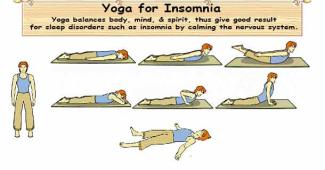
Yoga balances body, mind, & spirit, thus give good result for sleep disorders such as insomnia by calming the nervous system.
Yoga information
If you are new to yoga want to practice yoga with maximum benefit and without yoga injury, then we advise you to read. Yoga tips for beginners, Yoga safety tips to avoid yoga injury & Benefits of yoga pose.
Start Yoga session with Warm-up: Most of the Yoga Masters insisted not to practice yoga poses straight away, instead they emphasized to do some warm-up exercises before yoga session.
Yoga sleep therapy
Yoga is beneficial for your sleep in various ways. Asanas, pranayama, yoga-nidra are the helpful tools in your efforts to reestablish a restful night’s sleep.
Besides the above-mentioned asana and pranayama, practice of yoga nidra and meditation gives the best result.
Tadasana yoga sleep therapy
The Mountain Pose: The Sanskrit word tada means mountain. This posture otherwise called by the name samasthiti-asana. Sama means unmoved, equilibrium, and sthiti means standing upright or firmly, abiding, remaining, thus samasthiti means standing firmly without moving.
Tadasana step by step procedure
- Stand with both feet touching from the heel to the big toe, keeping the back straight and the arms pressed slightly against the sides with palms facing inward.
- Slightly tighten or flex the muscles in the knees, thighs, stomach, and buttocks maintaining a firm posture. Balance your weight evenly on both feet.
- Inhale through the nostrils, lift the buttocks off the legs arching the back, thrusting the abdomen forward, and tilt the head as far back as possible.
Many common ailments and discomforts can trace to poor posture. If the spine is not properly aligning or have, tightness or stiffness in the back may cause an imbalance in the body. When this imbalance becomes chronic, many kinds of disorders arise in the organs, glands, and nervous system. The proper execution and continual practice of the tada-asana along with other postures help to re-train the body to stand correctly and reverse the negative effects of poor posture.
Salabhasana yoga sleep therapy (Locust pose)
To perform this asana successfully, concentrate on every muscle being an exercise, try to remain relaxed.
Salabhasana step-by-step procedure
- Lie faces down with your forehead resting on the mat, your legs out behind you, the soles of your feet facing upward, and your arms by your sides, palms downwards. Stretch the neck by pushing the chin as forward as possible, so that it can rest on the mat. Breathe out slowly.
- Breathe in, and leaning slightly on your left arm, contract the muscles in the small of your back and lift your left leg. It is important to keep your pelvis on the mat, not to twist it, and to keep your left arm from shoulder to fingertips firmly on the mat. Keep your left leg straight as you lift it. Hold the position for a few seconds, then lower your leg as your breathe out, repeat with the right leg.
Bhujangasana yoga sleep therapy (Cobra Posture)
It is a popular asana, and it is always a practice as the first in a series of backward bending movements. In this asana, the spine is arched backward gently promoting flexibility.
Bhujangasana step-by-step procedure
- Lie straight on your stomach, keeping the palms on the floor below the shoulder blades and the elbows touching the middle part of the body. Bend the head and neck backward.
- Inhale and raise the head and chest, above the naval area, upwards. Tighten the legs allover from the waist down to the toes.
- Hold breathes and retains in the same position for about six seconds.
- Exhale and simultaneously lower the head towards the floor. Relax your body and rest with your right or left cheek on the floor for about 6 seconds. Now you have completed one round of bhujanga asana.
Do not practice this asana during pregnancy.
Shavasana sleep yoga therapy (Blissful Relaxation)
First, lie on your back with hands a little apart from the body with palms upward and with feet a little apart. You can use a pillow under the head if you so desire.
Close your eyes, take two or three deep and long breaths. Feel that you are growing lighter and feel that you are floating in the "blue sky.” Enjoy this "blissful relaxation" technique (Shiv Asana) for five or ten minutes.
Finish Yoga session with Savasana: well-experienced Yoga Guru’s always end a yoga session with a totally relaxing yoga pose called as “Savasana”; it helps to gain the most from the yoga poses you have just done. Furthermore, make you more relaxed, very simple asana but very difficult to attain perfection.
Are yoga’s safe? Yoga has well been tolerating in studies, with few side effects reported in healthy people. Yoga poses that put pressure on the uterus, such as an abdominal exercise, should avoid during pregnancy. People with disc disease, fragile or atherosclerotic neck arteries, risk of blood clots, extremely high or low blood pressure, glaucoma, retinal detachment, ear problems, severe osteoporosis, or cervical spondylitis should avoid some yoga poses. Certain yoga breathing techniques should avoid in people with heart or lung disease.
Insomnia Sleep Herbal

Insomnia are due to psychological disorders; grief, stress, depression, and anxiety.
Herbs help to get sound sleep by calming down & nourishing the nervous system.
Ayurvedic Causes of Insomnia: In the Ayurvedic teachings, insomnia is a fire disorder and its health restoring strategies encompass cooling off the burning in vata (nerve humour) and pitta (fire). The treatment concentrates on cooling off this bad junction by re-balancing pitta.
Herbal remedy’s sleep-insomnia
Require a good night's sleep, consider trying the following eight sleep-promoting herbs. These 8 herbs help to get sound sleep by nourishing the nervous system, sedative, pain relieving, relaxing, reduce stress. calming, improves depression, reduce anxiety, and sleep inducing.
A traditional herbal remedy for sleep disorder has calming effect on the nervous system also effective in treating nervous digestion.
Calamus root sleeps herbal [Acorus calamus L.]
Calamus root - used as a sedative and painkiller.
Calamus was first to be discovered by the Indian herbalists. The dried root has been use to treat memory impairment, melancholia, insomnia, and epilepsy. In Europe, in the late 1800s, physicians used calamus extract for stomach upset, but also use them as a sedative and painkiller. In North American, some Indians cultivated calamus and used it as a hallucinogen.
Chamomile sleep herbal [Anthemis nobilis]
Chamomile - enjoy its effects as a treatment for sleeplessness.
It has proven a very effective sleep aid, and it can be administered in a variety of ways, including being brewed as a tea and used in a sachet placed under your pillow. Unlike some herbal sleep remedies, you do not need to use chamomile regularly to enjoy its effects as a treatment for sleeplessness. It can use on the spot to provide quick relief for sleeplessness and anxiety. Chamomile tea, which is making from the dried flowers and leaves of this common plant, often proves most effective when sipped a half an hour to forty-five minutes before going to bed. Chamomile can prove especially helpful in relieving the symptoms of mild insomnia (also known as transient insomnia).
Valerian root sleep herbal [valeriana officinalis]
Valerian root - for its ability to promote relaxation, sleep, and improve stress symptoms.
It is the use as a sleep aid to help insomnia and other sleeping problems. Herbal remedy that is being promoted for its ability to promote relaxation sleep, and improve stress symptoms. Valerian is a central nervous system relaxer, and as such has been use as a calming sleep aid for over 1,000 years. When taken in the proper dosage, Valerian can induce restful sleep without grogginess the next morning, unlike prescription drugs.
Valerian has a wide range of uses in the home medicine cabinet. It is an effective stress reducer, and has benefited in cases of nervous tension, depression, irritability, hysteria, panic, anxiety, fear, stomach cramping, indigestion due to nervousness, delusions, exhaustion, and, of course, nervous sleeplessness. It also appears to have real benefits in cases of sciatica, multiple sclerosis, epilepsy, shingles, and peripheral neuropathy, including numbness, tingling, muscle weakness, and pain in the extremities. Testing has revealed that it eases muscle cramping, rheumatic pain, migraines, uterine cramps, intestinal colic, and stress-related heart problems and hypertension. It has shown some benefit in behavioral problems in both adults and children. It is the use to treat attention-deficit disorders, hyperactivity, anxiety headaches, and bedwetting, and it has shown some promise in helping reduce thumb sucking and nail biting in children. It has a stabilizing effect on blood pressure and can help regulate arrhythmias.
Lastly, Valerian is useful as a digestive aid, is helpful in cases of gas, diarrhea, and cramps, and alleviates the pain of ulcers. In the respiratory tract, it is believing to be of benefit in reducing the discomfort of asthma attacks. Valerian often seems only to work when taken over longer periods (several weeks), though many users find that it takes effect immediately.
Jatamansi sleeps herbal [Nordostachys jatamansi DC]
Jatamansi used for treating insomnia, mental instability, and is used as a memory enhancer.
Its root is the use in Ayurveda. The plant is finding in Himalaya. Jatamansi is the use for treating insomnia, mental instability, and is the use as a memory enhancer. Paste if applied externally helps in inflammation, burning sensation and inflammation due to injuries. Internally, it helps in indigestion, flatulence, liver diseases, breathing difficulty, dysurea and for mental alertness. Hair oil helps to promote hair growth and calms anxiety. It is the use in Ayurvedic formulations for headache, loss of memory, improves renal function, regulation of blood pressure, aphrodisiac, and induces sleep. It is helpful in general debility and weakness caused by insomnia. The plant has a rich history of medicinal use and has value for centuries in Ayurvedic (Indian) and Unani (ancient Greco-Arab) systems of medicine. The scientific literature contains primarily phytochemical and animal studies of the plant's activity on the nervous system.
Passion Flower sleeps herbal
Passion Flower has a wonderfully calming and sedative action.
It has been describing as sedative, hypnotic, anxiolytic, and antispasmodic. Sources reveal the ability of passionflower to decrease aggressiveness, restlessness, hypermotility (unable to stop or slow down physical movement), and to raise the pain threshold. There are several other applications of passionflower; these include neuralgia (nerve pain), seizures, spasmodic asthma, nervousness, palpitations, high blood pressure, and pain. Other non-nervous systems related conditions for which passion flower may be of use include stomach upset, menopause symptoms, burns, and hemorrhoids (topical application). Outside of its use in the central nervous system as a calmative, it appears to have some antibacterial and antifungal effects.
As mentioned earlier, the passionflower has a wonderfully calming and sedative action, and it acts as a muscle relaxant. When one uses passionflower extract before going to sleep, one can wake up feeling completely refreshed and alert as never before. This is because passionflower has a sedative and antispasmodic action, and this relaxes spasms and tension if any in one's muscles.
St John's wort sleep herbal [Hypericum]
St John's wort is used for depression, anxiety, and/or sleep disorders.
It is today most widely known as an herbal treatment for major depression. In some countries, such as Germany, it is commonly prescribing for mild depression especially in children and adolescents, where cost is a concern. Standardized extracts are generally available over the counter; however, in some countries (such as Ireland), a prescription is required. Extracts are usually in tablet or capsule form, and in teabags and tinctures. St. John's wort has been use for centuries to treat mental disorders and nerve pain.
St. John's wort has been use as a sedative and a treatment for malaria, as well as a balm for wounds, burns, and insect bites. Today, St. John's wort is the use by some for depression, anxiety, and/or sleep disorders. In Germany, more than fifty percent of depression, anxiety, and sleep disorders are treating with Hypericum.St. John's Wort can limit the effectiveness of many prescribed medications such as blood thinners, birth control pills and some anticancer medications.
Skullcap sleep herbal [Scutellaria lateriflora]
Skullcap is a nervine and sedative; so useful for insomnia.
Skullcap is a powerful medicinal herb; it is the use in alternative medicine as an anti-inflammatory, antispasmodic, slightly astringent, emmenagogue, febrifuge, nervine, sedative and strongly tonic. Some valuable constituents found in the plant are scutellarin, catalpol, other volatile oils, bitter iridoids, and tannins. Scientific studies are proving this a valuable plant in many areas for mental disorders. Skullcap is the use in the treatment of a wide range of nervous conditions, including epilepsy, insomnia, hysteria, anxiety, delirium tremens, withdrawal from barbiturates and tranquilizers. A medicinal infusion of the plant is the helpful to promote menstruation; it should not give it to pregnant women since it can induce a miscarriage, and the infusion is useful in the treatment of throat infections. The infusion is helpful for nervous headaches, neuralgia and in headache arising from incessant coughing, pain, and inducing sleep when necessary, without any unpleasant symptoms following. Skullcap is currently being use as an alternative medicine to treat ADD and a number of nerve disorders. It should be use with caution, because in overdose, it causes giddiness, stupor, confusion, and twitching.
Ashwagandha sleep herbal [Withania somnifera]
Ashwagandha has sedative effect and can be used to encourage restful sleep.
Indian Ginseng" directly opposes the reaction of stress by reducing the amount of Cortisol released by the adrenal glands of our body. Long-term production of Cortisol has the adverse effect on our health like high blood pressure, Stomach Ulcers, Immune depression, and Insomnia. Ashwagandha also has a sedative effect, which claims the adrenaline fueled anxiety that accompanies stressful life styles, thereby dealing with another factor that is a result and a cause of stress indeed. Ashwagandha has often been use to treat primary anxiety states. If your sleep is disturbed, this sedative effect can use to encourage restful sleep, again helping the body or recover from the effects of stress. This ayurvedic herb has use in India as an adaptogen for centuries. It is helping to increase the body's resistance towards adverse influences. It is the use for Stress, general debility, depression & moodiness, aging, fatigue (temporary and chronic), anxiety, depressed immunity, sexual debility in males, infertility, memory loss, and hormonal imbalances. Take with lots of liquid, milk, honey and ginger when under weight, bone weakness and premature aging are present.
Are Herbal remedies safe?
Remember that herbs are medicines, thus it too has some side effects. Herbal remedies can also interact with other medicines. It is best to get registered herbal practitioner’s advice before taking it, particularly if the treatment is for pregnant women, breast-feeding mother, child, or older people.
Cognitive Therapy

Cognitive-behavioral therapy helps to uncover (know) and change distortions of thought, which may be causing psychological problems or insomnia.
Cognitive-behavioral therapy is the base on the idea that our thought causes our feelings and behaviors, not external things. Thus by changing the way of thinking can result in better feel /act.
Insight of cognitive-behavioral therapy
Thoughts mediate between stimuli (such as external events), and emotions. A stimulus brings out a though, which in turn give rise an emotion. Clearly that it is not the stimulus itself bring out emotional response directly, but our evaluation (thought or judgment) about the stimulus.
Two assumptions support the approach of the cognitive-behavioral therapist:
- Capable of becoming aware of his or her own thoughts and of changing them,
- Sometimes the thoughts bring out by stimuli distort or otherwise fail to reflect reality accurately.
Let see a common example of alternative thoughts or beliefs about the same experience and their resulting emotions:
Stimuli: One attended an interview and not selected.
A low sprite person
Thought: I am fundamentally incompetent to this job.
Emotion: Depressed, might be less likely to apply for similar jobs in the future.
A high sprite person
Thought: The competitive candidates are exceptionally strong.
Emotion: It disappointed but not depressed, tries to increase knowledge and might be likely to apply for similar jobs in the future.
Thus, cognitive-behavioral therapy conveys that psychological distress is causing by undesired thoughts about the stimuli-giving rise to disastrous emotions.
The objective of CBT is to correct the thoughts to prevent disastrous emotion even if the stimuli are negative characteristic.
CBT sleep insomnia
Cognitive-behavioral therapy has been finding to be effective in reducing medication usage in the treatment of sleep-related problems. CBT can improve the outcome and reduce sleep medication consumption in the treatment of chronic sleep problems. Persistent improvement in sleep quality & quantity and significant improvement in vitality, physical and emotional health can be absorbed during CBT treatments.
The most important aspect of cognitive behavior therapy (CBT) for sleep disorders is that it actually provides treatment for the cause and not just for the symptoms as medication does.
CBT helps to reduce worry, anxiety, and fear that can disturb the normal sleep cycle by providing accurate information regarding sleep. For example, CBT helps to recognize that one got more (enough) sleep than his or her thought (that is it is a common misconception that lighter sleep stages as wakefulness) and support to understand that one need less sleep than his/her thought (that is just five-hour sleep is enough). Thus, CBT help to reduce anxiety about not getting enough sleep and lead to being able to relax and sleep better.
In addition, the technique help people identify challenge and replace negative, inaccurate sleep thoughts with accurate, positive ones. Negative sleep thoughts can occur during the night (I would not be able to function tomorrow if I do not get enough sleep) as well as during the day (I got an awful night last night, so I will have a terrible working). Positive sleep thoughts are used to replace the negative thoughts with more accurate information (even if I not get enough sleep tonight, I can be able to perform well at work tomorrow, that happen many other nights like this).