
Colorblindness Symptoms
Symptoms of color vision deficiency can vary from one person to be other.
Symptoms of mild color vision deficiency
- Trouble distinguishing different colors and viewing brightness of color in a usual way
- Inability to differentiate between different color shades of the same or similar colors
Mostly, the symptoms may be so mild that most of them do not know they are colorblind. A parent or teacher may find the signs of color blindness when a child is learning his or her colors.
Stages of color blindness
Stages of color blindness can classify into two major types; partial color blindness (mild cases of color blindness) and total color blindness. Color blindness symptoms are varying from person to person.
Types of color blindness
There are two types of color blindness; the most common type is the inability to differentiate between red and green colors, and the other uncommon type is the inability to differentiate between blue and yellow colors.
In case of partial color blindness (mild cases), the person may not be able to differentiate between the shades of red and green colors, or the blue and yellow colors and/or not able to see the color brightness as done by normal persons. However, in the case of total color blindness, the person may not be able to see any colors except black, white, and gray.
Colorblindness
Color blindness is more appropriately mentioned as color vision deficiency, is the inability of the eye to differentiate between various colors.
Colour Blindness
Many people think that colorblind people only can see black & white pictures, but it is not true people with color blindness have trouble seeing the difference between certain colors.
Color blindness is considering as a mild vision disability; in some situations, colorblind individuals have an advantage as compared with normal color vision. Some studies show that color-blind peoples are better at penetrating certain color, and it has been suggested that this may be the evolutionary explanation for the surprisingly high frequency of congenital red-green color blindness.
Colour blindness Facts
- Color blindness is most often inherited. It is passing from generation to generation on the X chromosome.
- 5%-8% of men and 0.5% of women are colorblind.
- Most color impaired can see all colors. Very few colorblind people can only see in black in white (less than 1%).
- In World War II, colorblind men were sent on special missions, because their decreased ability to see green led to an increased ability to see through or detect camouflage.
- Everyone is colorblind at birth
- Red/green color blindness is the most common form (99%). 75% of people with red/green color blindness have trouble with green perception while 24% have trouble with red perception.
- Blue/yellow color blindness and total color blindness (i.e., seeing only shades of gray) are very rare. (Currently, there is no easily available screening test for blue/yellow color blindness.)
- There is no treatment for color blindness.
Retina Cones and Color vision
To understand about color blindness need to know about the cones in your eye’s retina. Small cones are cells on the retina, a stamp-sized area at the back of the eye.
There are three types of cones; each one is responsible for red, blue, or green color vision. Each cone is sensitive to those colors and their combinations. All three types of cones are requiring seeing different colors properly. If any of this cone does not work properly, nor do not have the right combination, then the brain does not able to get the right message about the colors. For example, color blind may see a green leaf as tan or gray.
Presbyopia Treatment
Presbyopia treatment options may include eyeglasses, contact lenses, and surgery; choose the best based on the condition and patients opinion.
Presbyopia treatment options
There are many options of treatment available for presbyopia, they are:
- Eye glasses
- Contact lenses
- Surgery
Eye glasses for Presbyopia
Eyeglasses with bifocal or progressive addition lenses (PALs) are the most common used presbyopia correction.
Bifocal means two focal points: the main part of the spectacle lens contains power for a distance vision, while the lower portion of the spectacle lens contains the power for close vision.
Progressive addition lenses (PALs) are slightly similar to bifocal lenses, but they provide a more gradual power transition between the two long and short distances, without any visible line between them.
Reading glasses is another choice for presbyopia. Bifocals and PALs, which are usually, wear most of the time all day; whereas reading glasses is, worn just during close work.
Contact lenses of Presbyopia
Presbyopic's can also choose multi-focal contact lenses, available in gas permeable or soft lens materials. Another type of contact lens available for the correction of presbyopia is a mono-vision, in which one eye is prescribing for distance vision, and the other eye is prescribing for near vision. The brain can learn and choose one eye or the other for different tasks (short and long distance). Some people are feeling happy with this solution, whereas others feel unhappy and complain of reduced visual clarity with mono-vision.
Surgery for Presbyopia
For those who do not want to use glasses or contact lenses, doctors may suggest a surgical procedure for the correction of presbyopia. Artificial lens (IOLs for cataract surgery) implants such as multi-focal lenses or accommodating lenses that replace the eye's natural lens.
Conductive keratoplasty or NearVision CK treatment utilizes radio waves to create large curvature in the cornea for a higher "+" power to improve near vision. Performing this procedure is on one eye only for a mono-vision correction. Studies have shown that Near Vision CK effectively correct presbyopia, but the correction is temporary and loss’s effectiveness over time.
LASIK also can perform to create a mono-vision, in which one eye is correct for near vision while the other eye is for distance vision. As the result, the brain can merge these two images, and create a blend zone (which is in focus for both eyes). This helps the patient to see close, intermediate and distance objects without glasses.
PresbyLASIK - Multifocal LASIK is a laser-vision correction surgery that changes the eye’s cornea shape to create different power zones for seeing at close and distance objects.
Multifocal LASIK can create more than one power on the front surface of the eye, which helps to see simultaneously through different zones providing clearer near, intermediate and distance vision. The brain can select the correct zone it needs to see through to get the sharpest vision, depending on whether an object is near, intermediate or far away.
Presbyopia Symptoms
Presbyopia is the inability to focus properly the closer objects. It is the cause by natural aging process and produces symptoms of eyestrain & headache.
Sign and symptoms of presbyopia
- Decreased focusing ability for near objects
- Therefore, they need to hold books, newspapers, and other reading materials at arm's length to get the sharp focus and clearer letter or images.
- Long term close-up work can cause eye strain
- Prolong eyestrain causes head ache or fatigue.
Causes of Presbyopia
Presbyopia is purely causing by an aging process, just like graying of hair and development of wrinkles. Therefore, presbyopia is different from astigmatism, nearsightedness, and farsightedness, which are relating to the shape of the eyeball and are causes by genetic and environmental factors.
Just like development of wrinkles with aging because of decrease in elasticity of skin, the crystalline lens losses, its elasticity, and it will not become thick to focus the object as needed.
Just like decrease in our body strength with aging, the ciliary muscles gradually lose its strength to contract and help to change the shape of the crystalline lens. Thus, it becomes difficult to focus the neared object as needed and causing blurred nearer objects.
Diagnosis test for Presbyopia
Presbyopia can diagnose through a comprehensive eye examination. Testing for presbyopia measures how the eyes focus light and determine the power of any optical lenses needed to compensate for reduced vision.
Presbyopia
Presbyopia is a vision condition where the eye progressively losses its ability to focus (eye accommodation) on nearer objects with age.
Presbyopia
Presbyopia may develop due to loss of elasticity of the crystalline lens. Other contributing factors are changes in the lens curvature and loss of strength of the ciliary muscles (the muscles that change lens curvature by bending and straightening the lens).
Graying of hair and development of wrinkles are considering as normal with aging, similarly presbyopia is also considering as the natural course of aging.
Eye Accommodation
Accommodation is the process in which the eye increases its optical power (the degree to which the lens converges or diverges from the light) by modifying the curvature of the eye lens with the help of ciliary muscle. This is important to produce a clear image of an object that is closer to the eye.
Eye accommodation is a physiological act of adjusting crystalline lens elements to alter the refractive power and bring objects that are nearer to the eye into clear sharp focus.
To focus on distant objects the ciliary muscles relax and make the eye lens thin. This increases the focal length of the eye lens and thus distance objects are seeing clearly. However, to focus on nearby objects the ciliary muscles contracts and make the eye lens thick. This decreases the focal length of the eye and which helps to see nearer objects clearly.
Aging makes the ciliary muscles losses in original strength as well as the crystalline lens losses its elasticity thus accommodation becomes difficult, which end up in presbyopia (an age-related vision problem).
Eye accommodation decreases with age
Eye accommodation is good when the age is below 40 years, during this period the eye can compare with an auto-focus camera (gets sharp pictures with varying object distance). After age 40, eye accommodation, mechanism looses its ability and develops presbyopic eye, which can compare with a fixed-focus camera (not able to get sharp pictures with varying object distance).
Lazy eye correction
Lazy eye or amblyopia correction options include glasses, eye drops, vision therapy, and/or patching and amblyopia surgery.
Amblyopia treatment options
Recent medical research has proven that amblyopia is successfully treating up to the age of 17. Treating amblyopia involves making the child use the eye with the reduced vision (weaker eye). Currently, there are two ways used to do this:
Atropine
A drop of an atropine drug is placing in the stronger eye once a day to blur the vision so that the child will prefer to use the eye with amblyopia. Treatment with atropine also stimulates vision in the weaker eye and helps the part of the brain that manages vision develop more completely.
Adhesive patching
An opaque, adhesive patch is warning over the stronger eye for weeks to months. This therapy forces the child to use the eye with amblyopia. It stimulates vision in the weaker eye and completely develops the part of the brain that controls the vision.
Clinical trial treatment of amblyopia with parches shows an amazing positive result with children from an age of 7 through 17.
Early diagnosis increases the chance for a complete recovery from lazy eye. This is the reason why eye specialist recommends a comprehensive optometric examination by the age of 6 months and again at age 3. Lazy eye will not go away, until with a proper treatment that too before age of 17 years. If not diagnosed until the pre-teen, teen, or adult years, treatment takes longer and is often less effective.
Surgery and patch treatment
Some time in addition to a patch treatment, doctor may recommend surgery for the crossed/wandering eye. Surgery only makes the eyes appear straight by cutting and stretching muscles to reposition the eye, just a cosmetic fix, not a visual correction. However, this surgery support or helps faster recovery even for acute cases of lazy eye.
Seven Vital Chakras

In Sanskrit, ‘chakra’ means ‘wheel of life,’ there are seven chakras, which are aligned in an ascending column from the base of the spine to the top of the head, i.e. seven energy centers.
Human Chakra
Seven chakras are the energy center that resides along the spine from the base to the crown of the head, which is maintaining the entire system in harmony. Chakra is a Sanskrit word, meaning wheel with spikes radiating out from the center Point. If there is any disturbance or disharmony in this chakra leads to physical or psychological problems. The main tasks of Chakras are absorbing and distributing Prana (Life Force) to our physical body.
Rainbow and Seven Chakras
Human chakra works with the energies from light. The chakras of the aura mirror the rainbow, mapping color into our personal aura. The seven color rays in the rainbow contain energy that can energies the seven chakras and influence our emotions as well as the physical body. The chakra’s color intensity indicates your present physical, emotional, and spiritual state.
Musical notes and seven Chakras
Whether you are listening the music of India (seven basic music notes are SA, Re, Ga, Ma, Pa, Dha and Ni.) or Western music (seven basic music notes are C, D, E, F, G, A & B). Wherever you go, there are only seven notes. Then ‘Sa or C’ raises kundalini at mooladara chakra, 'Re or D' swadhishtana, 'Ga or E' Manipura, 'Ma or F' anahatha, 'Pa or G' vishudhi, 'Dha or A' ajna, ‘Ni or B’ sahasrara.
Seven Chakras, Kundalini and Astrology
There is a strong link between astrology and the human chakras. The planetary position makes an influence on the chakra’s spinning or energy level, which in-turn manipulate your physical and mental state. Due to this, our mental and physical ability changes accordingly affect the result that we named it as luck or fate.
Chakras in Yoga
According to the yogic teachings, as we breathe, prana (air) is drawn and distributed into the body by the channels called Nadis ("nerve" in English). There are 72,000 Nadis, or channels, in the ethereal subtle anatomy of humans. Among the 14 major Nadis, three are of fundamental import: Sushumna, Ida and Pingala. Ida is in the left of the spine, whereas Pingala is in the right of the spine, mirroring the Ida. Sushumna is along the spinal cord in the center, through the seven chakras mooladhara at the base, and Sahasrara at the crown.
What is Kundalini?
Kundalini is a sleeping dormant potential in the human organism. The serpent, or snake, is one of the oldest widespread symbols used by the human to represent it as the dual expression of good and evil.
There is a strong corollary between the double-coiled snakes around a single shaft and its relationship to the spinal tracts. Indian medicine has been referring it to as the Ida (female), Pingala (male) and Sushumna (balance), which comprises the kundalini, or power centers of the body.
{"preview_thumbnail":"/drupal8/sites/default/files/styles/video_embed_wysiwyg_preview/public/video_thumbnails/d81Vim2DfaE.jpg?itok=DHmRgBBg","video_url":"https://youtu.be/d81Vim2DfaE","settings":{"responsive":1,"width":"854","height":"480","autoplay":0},"settings_summary":["Embedded Video (Responsive)."]}
Human chakra & Kundalini are common to every religion & region
Human chakra is not only specific to Hinduism or Buddhism, instead to every religion from Christianity, Islam, Jainism, etc. It is not only specific to Asian countries, instead common to every part of this globe.
- Hindu Upanishads: Kundalini has been explaining in a spiritual term as the god Shiva resides in Sahasrara Chakra, while the god Shakti lies dormant in the Muladhara chakra. Once Kundalini Shakthi (energy) is awakened that originates at the base of the spine rises through Seven Chakras and reaches Sahasrara Chakra, where Shiva and Shakti live in full harmony.
- Buddhism, Vajrayana and Kundalini: Tummo in Buddhism and kundalini are different terms and ways used for the same thing, awakening the dormant power within the human body.
- Christianity, Bible and Kundalini: The Bible in Revelation 5:1 states, "And I saw in the right hand of him that sat on the throne a book written within and on the backside, sealed with seven seals." Seven seals mean seven chakras that need to be activated one by one from Muladhara to Sahasrara or all together with the help of Jesus, to reach Holy Spirit.
- Israel, Christianity, Yahweh and Moses: Once Yahweh sent venomous snakes, and they bite the people and many Israelites died. The people came to Moses and said, ‘We sinned when we spoke against Yahweh and against you. Pray that Yahweh will take the snakes away from us.’ So Moses prayed for the people. Yahweh said to Moses, ‘Make a snake and put it up on a pole; anyone who is bitten can look at it and live.’ This lifting up of the brass serpent (may be symbolizing the awakening of dormant power – kundalini) on a pole is generally held to be a prefigured of Christ, to cure humanity from the "snakebite" of original sin.
- Islam and the chakras: an incident relates directly to the progressive awakening of the chakras. It tells Mohammed's night journey to heaven in which he passes through the seven heavens into the presence of Allah. Mohammed started to ascend a golden ladder lowered from heaven. Accompanied by Gabriel, he then proceeded to pass through the seven heavenly realms (means chakras). The color of the rainbow is in the Quran symbolizing "Seven Heavens."
- Traditional Chinese Medicine, Acupuncture and Kundalini: As per TCM's chakra theory, the life force (Chi or Qi) is flowing through a complex network of pathways, or meridians, between the two poles of yin/earth energy and yang/heaven energy. The central governor vessel meridian corresponds to the Sushumna nadi in both location and function. It begins at the base of the spine and ascends to the top of the head. The Taoist practice of shoshuten, or “Circulation of Light,” in which “ki (Chi) energy is raised from the tip of the coccyx to the top of the head” is comparable to kundalini.
- American Kundalini link: A sculpture of the Aztec god Quetzalcoatl has on the crown of his head a 1000-petal sunburst of spiritual illumination and the serpent of the liberated spinal fire.
- Australian Kundalini link: In about 30,000 to 40,000 years ago, the Australian people are linking by some common spiritual beliefs, among them the Rainbow Serpent, also known as the Rainbow Snake. However, like Kundalini-Shakti, the Rainbow Serpent can also be a destructive force if not properly respected.
- European Kundalini link: Europeans used a diagram of a seven-pointed star to map a pathway for human development. Bavaria, Gichtel laid-out the seven classical planets within the framework of the human body. He then included a spiral line that, alternating up and down, maps-out a pathway to transformation.
- St. Martin's Cross, Scotland: this 8th century Celtic cross features a sun design with serpent bosses. The serpent symbolized regeneration and healing. Christ was the sun, the Light of the World.
- Egyptian Kundalini: In Egypt “Ka” represents the energy body, while “sekhem” is like prana, is the life force that runs through all subtle channels of the body. Heka, the god of magic whose name means, “Activating the Ka,” is depicted as holding two entwined snakes, this is closely resembled to kundalini serpents. In the Hermetic tradition, spiritual awakening is symbolized by the caduceus a staff entwined with two serpents sometimes surmounted with wings suggestive of the sixth chakra (Harris).
What are the seven chakras?
Chakras are a concept common to several disciplines of alternative medicines. Most commonly, there are Seven Chakras, they are:
- First Chakra is otherwise calling as Base, Root or Muladhara chakra.
- Second Chakra is otherwise calling as Sacral, Sex or Swadhisthana chakra.
- Third Chakra is otherwise calling as Solar Plexus, Novel or Manipura chakra.
- Fourth Chakra is otherwise calling as Heart or Anahata chakra.
- Fifth Chakra is otherwise calling as Throat or Vishudha chakra.
- Sixth Chakra is otherwise calling as Brow, Ajna or Third eye chakra.
- Seventh Chakra is otherwise calling as Crown or Sahasrara chakra.
Seven chakras and health
Seven chakras reside along the spine from the base to the crown of the head. Each chakra is connecting with a set of specific glands and/or organs; it governs and provides energy to these glands/organs. The health of the energy center (Chakra) is reflecting in the health of the organs and systems in that particular region. Additionally, chakras are not only responsible for physical, but also to emotional and mental well-being.
Imbalances in chakras lead to imbalances in body, mind, and spirit.” This imbalance lead to health conditions such as diabetes, cholesterol, high blood pressure, sleep disorders, etc.
Alternative medicine and seven chakras
An alternative medicine treatment based on the chakra re-balancing can have more chances to get a positive result from treatment. For example, if you are doing yoga to manage your diabetes; most yoga masters suggest you to do yoga pose involving abdominal compression to tune up pancreas. However, your treatment should involve yoga poses to tune up master glands and thyroid glands, which are responsible for overall body control and metabolism respectively. This harmonizes your entire body and tries healing your condition.
Acupressure
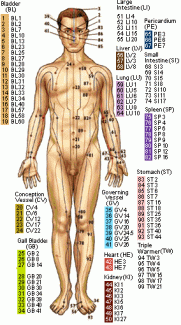
Acupressure encourages the body to promote natural holistic healing. Precise stimulate pressure is applying to certain points (acupoints), to ensure the free flow of qi.
Before applying any alternative medicine’s therapy, you should be aware that many of these therapies have not evaluated in scientific studies. Often, only limited information is available about their safety and effectiveness.
Acupressure Meridians and Acupoints
TCM believes that there exists in the human body a network of pathways called meridian. Through which qi and “blood” circulate, and by which internal organs connects to and coordinate with superficial organs and tissues, thus creating an integral whole. The meridian system consists of 12 pairs of regular meridians is a six pairs of yin and six pairs of yang meridians, eight extra meridians, 12 collateral, and their connective parts.
Acupuncture points found along the meridians under the skin. Each acupuncture point is anatomically located and has its own specific therapeutic effects. There have been 361 acupuncture points identified along the 14 meridians. The meridian system explains the physiological functions and pathological changes in the human body as well as to guide the diagnosis and treatment of diseases in TCM. Acupuncture and Moxibustion, Tuina, and Qigong are therapeutic techniques based mainly on the meridian theory.
Acupressure benefits
Qi regulates overall physical and emotional balance such as spiritual, emotional, mental, and physical balance. The opposite forces are yin and yang, which influences Qi. When yin and yang are balance, they work together with the natural flow of qi and support the body achieve and maintain health. It is accepted belief that acupressure can balance yin and yang, unblocked and normalize a natural flow of energy, thus restores health to the body and mind.
Lazyeye Test
A lazy eye should need to diagnose and treat as early as possible, preferably before the age of six years.
Lazy eye diagnosis test
It is always difficult to know whether a child has a lazy eye because they cannot realize that there is something wrong with their vision. Therefore, a lazy eye may not know until the child has their first eye test.
An eye exam by a pediatrician or the 20/20 eye chart screening is not adequate for the diagnosis of amblyopia. The most important diagnostic tools are the special visual acuity tests other than the 20/20 letter charts currently used by schools, pediatricians, and eye doctors. Examination with cycloplegic drops can be necessary to detect this condition in the young.
Children should give a routine eye examination before they start schooling. If a child has a lazy eye, it is possible to diagnose and treat the condition at its early stages.
If the ophthalmologist suspects a lazy eye after a routine eye exam, a detailed full eye examination will need in order to confirm diagnosis. Each eye will test separately to determine whether there is any long or short sightedness. Both eyes will also be diagnosed together to see if there is any squint.
During their eye test, the structure of the child’s eyes also been examined to determine whether there are any abnormalities, such as astigmatism (where the surface of the lens is uneven, causing blurred vision).
Amblyopia Lazyeye

Amblyopia or lazy eye is the vision of one of the eyes is reducing because the eye and the brains are not coordinating (working together) properly.
Amblyopia Lazy Eye
The eye looks normal, but it is not being use normally because the brain is favoring the other eye. Simply, amblyopia is a dysfunction of the brain which blocks vision from one eye because it cannot use the vision of two eyes together.
It means that one eye has not developed normally and always has blurred vision; even with the best choice of glasses or a contact, which prescribed.
Lazy eye amblyopia sign and symptoms
Symptoms may include noticeably favoring one eye or a tendency to bump into objects on one side. Symptoms are not always obvious.
Lazy eye amblyopia causes
Children with normal vision start learning to use both eyes together in their first few months from birth. Their brain develops the ability to make the pictures coming in from both left and right eyes and merge these two pictures into an actual single image, known as normal two-eyed vision.
Anything that interferes with clear vision in either eye during the critical period (birth to six years of age) can cause amblyopia. The most common causes of amblyopia are:
- Constant strabismus (constant turn of one eye) may develop amblyopia called Strabismus Amblyopia,
- One eye is more nearsighted, farsighted, or astigmatic than the other called Refractive Amblyopia
- Blockage of an eye due to cataract, trauma, lid droop, etc
Amblyopia is a neurologically active process. In other words, the loss of vision takes place in the brain. If one eye sees clearly and the other sees a blur, the brain can inhibit (block, ignore, suppress) the eye with the blur. The brain can also suppress one eye to avoid double vision. The inhibition process (suppression) can result in a permanent decrease in the vision in the blurry eye that cannot correct with glasses, lenses, or lasik surgery.