
Eye Problems
Common eye problems are classifying into two types; vision-related problems and eye-related diseases.
Eye conditions are classified into two categories
- Conditions related to vision – refractive errors of the vision, such as myopia, hyperopia, Astigmatism, Presbyopia, Color blindness, and Night blindness.
- Conditions related to the eye – eye diseases such as glaucoma, cataracts, diabetes retinopathy, dry eye syndrome, macular degeneration, and retinal detachment. Eye infections are conjunctivitis or pinkeye, Stye (a bump on the eyelid) and blepharitis.
Common vision problems (Refractive errors)
- Myopia - Myopia or nearsightedness is the most common vision problem, affecting more than one-third of the population (approximately 33%). Nearsightedness has difficulty seeing distance objects clearly, but the near vision is quite clear.
- Hyperopia - Hyperopia or farsightedness is the second most common vision problem, affecting one in four of the population (25%). Farsightedness has difficulty seeing the nearer objects clearly, but distance vision is quite clear.
- Astigmatism - Astigmatism is a common vision problem where the cornea is asymmetrically. Eyeglasses or toric contact lenses with different powers in two meridians are necessary to correct astigmatism.
- Amblyopia or lazy eye is the vision of one of the eyes is reducing because the eye and the brains are not coordinating (working together) properly.
- Presbyopia - Presbyopia is a common among older people (a normal process of aging); aging to make the eye lens loss its flexibility and thus its ability to accommodate and to produce a clear vision of near objects become difficult.
- Color Blindness - Color blindness should correctly mention as color vision deficiency, a problem related with color vision. These problems may range from a slight difficulty in identifying different color shades to not being able to identify any color.
- Night Blindness - Night blindness or nyctalopia is the inability to see clearly at night or in dull light. It is not a disorder by itself, but a symptom of an underlying disorder, commonly untreated myopia.
- Strabismus – are also commonly called as cross-eyed or wall eyed. It is a vision condition with inability to align both eyes concurrently under normal conditions. One or both of their eyes will turn in, out, up, or down.
Common eye problems or eye diseases
- Dry Eye Syndrome - Eyes feel dry, irritated, and painful then dry eye syndrome may suspect. Due to air conditioners, pollution, global worming, and cigarette smoke, only few people have left from the irritating symptoms of dry eyes.
- Glaucoma - Glaucoma is an eye disorder commonly associated with an unsafe buildup of internal eye pressure called as intraocular pressure or IOP. It can permanently damage the optic nerves that transmit visual information to the brain.
- Cataracts – Aging process make the eye lens lose its transparency, become both yellowish and cloudy called as cataract.
- Diabetes eye problems - Diabetes causes damages to numerous organs and tissues in the body, including the eyes.
- Macular Degeneration - It is the leading cause of blindness in people over the age of 65. Macular degeneration is often calling by AMD or ARMD. It is degeneration of the macula, part of the retina responsible for the sharp, central vision required to reading.
- Retinal detachment - occurs when a tear/hole form in the retina, permit fluid from the middle of the eye to flow underneath. This makes the layers of the retina to separate. Since the retina is responsible for sensing light entering the eye and sending nerve impulses to the brain. If the retina detaches, it no longer works as expected causing vision loss in the affected spot.
- Eye infections - Eyes can get infections from bacteria, fungi, viruses or other microbial agents. It can occur in different parts of the eye and can affect just one or both eyes. The most common eye infections are Conjunctivitis (or pinkeye), Stye (a bump on the eyelid) and blepharitis (Eyelid Inflammation).
- Retinitis pigmentosa (RP) - Retinitis pigmentosa is an eye disease that affects the retina. In RP, the retina cells start to degenerate, which causes side (peripheral) vision and night vision to diminish, and gradually affects the central vision as well.
Eye Symptoms Adults
Any unusual change in the eyes or vision needs further investigation.
Eye problem’s symptoms among adults
Some common eye problem’s symptoms among adults are:
- Difficulty adopting to dark rooms
- Difficulty focusing the near or distant objects
- Squinting or blinking may be due to light sensitivity
- Iris color change
- Red rimmed or swollen eye lids
- Frequent pain in or around eyes
- Blur or Double vision
- Appearance of dark spot at the center of viewing
- edges of the viewing appear distorted or wavy
- watery eyes (too much of tears)
- Dry eyes, itching or burning
- Viewing with spots or ghost like images
Serious eye symptoms of adults
Symptoms of serious problems need emergency medical attention:
- Sudden loss of vision
- Sudden blur vision
- Light flashes or dark spots
- Halos or rainbows around light
- Curtain over vision
- Loss of peripheral or side vision
If have any signs of serious eye problems, see an eye doctor for a complete eye exam. Even if have no signs, regular eye exams are recommended. It is emphasizing for those with diabetes and high blood pressure. Early detection and treatment are important for preventing vision loss.
Eye Symptoms Children
Any unusual change in the eyes or vision is considering as eye symptoms, which needs further investigation.
Child Eye Symptoms
Eye symptoms in children can be classifying into three categories; they are, eye appearance symptoms, child behavioral eye symptoms and eye symptoms expressed by the child.
Now let us see some common eye problems and their symptoms among children.
Eye’s appearance symptoms
- Crossed eyes (eyes do not coordinate with each other)
- eyelids are red rimmed (inflamed) or swollen
- watery red eye
Child behavioral eye symptoms
- rubs eyes frequently
- closes or covering one eye
- tilts head during seeing
- difficulty reading or doing close work, otherwise holds objects close to eyes to see
- blinking frequently or bad disposition when doing close up work
- blur vision or hard to see
- squints eyes (eyes partly closed or glance sideways)
Eye’s symptoms expressed by the child
- Itching, burning, scratchy or cannot see clearly.
- After a close up work, there is dizziness, headache, or feel sick/nausea.
- Blurred or double vision
The child may still have an eye problem, even if he/she does not have symptoms or complains. Therefore, it is advisable to have an eye exam.
Reflexology
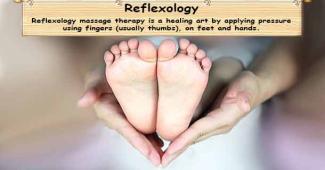
Reflexology massage therapy is a healing art by applying pressure using fingers (usually thumbs), on feet and hands (sometime in ear lobes) to activate reflex points of the organs in the body.
How Reflexologies make you healthier?
In Japan, there is a proverb
"The foot is the gate of ten thousand different illnesses."
Reflexology is the holistic healing massage technique that improve circulation, induce relaxation and enable homeostasis (remain stable). This encourages your healing systems to maintain wellbeing. This way thousands of different illnesses are expel out through the foot as exit gate.
Literally, reflexology means “Reflex” is an involuntary or instinctive movement in response to a “stimulus” or in the sense of reflection or mirror image. The reflexes on our feet and hands act as mirror images of the body.
As per American Medical Association, 85% of illnesses are contributing by stress and tension. Reflexology can induce relaxation and clearing this nervous stress and tension and induce self-healing.
8 body system Reflexology
Reflexology is massaging the foot or hand; it stimulate body organ reflexes. The eight body systems are Skeletal, Muscular, Neurological, Respiratory, Digestive, Endocrine, Genitourinary and Vascular. By balancing the eight body systems, it harmonizes the body and creating well-being.
This reflex point or area shows nerve ending of human glands, organs and other body parts in the feet, hand or ear in a three-dimension form. Right foot reflexes correspond to the right-side organs or body parts such as liver, gallbladder, and the front part colon. Left foot reflexes correspond to the left-side organs or body parts such as heart, spleen, and the end part colon. Outer foot toe-side reflexes correspond to the shoulder. Inner foot big-toe-side reflexes correspond to the center body parts such as the spine. Upper-body parts are close to the toes; mid-body parts are close to the middle foot, and bottom body parts are close to the heels.
People spell reflexology wrongly as reflexolgy, relexology, and refexology; also called as foot massage, foot therapy, and foot treatment.
Aim of Reflexology therapy
The aim of reflexology therapy is to restore healthy mind and body as quick as possible. Reflexology rebalances, clean, and renew internal energy, thus improves health and well-being.
Is reflexology real? How does it work?
Reflexology is a manipulative therapy; used alone or in combination with other treatments. It releases self-healing energy.
Does reflexology truly work? Can it heal?
- It stimulates 2,000 neurotransmitters and nerve ending, available between head to toe.
- Reflexology improves circulation by removing crystals such as uric acid or calcium deposits in the reflexes.
- By improving entire body blood circulation and energy flow, help efficient transportation of essential hormones, oxygen, and nutrients to the cells.
- Improvement in the lymphatic circulation, help expel waste products and harmful microorganisms and thus boost immune efficiency.
- It relaxes the entire body; thus, induce sleep and ease insomnia or other sleep disorder. This support repair and rebuilt organs during the night.
How do you use reflexology chart or map?
Reflexology charts are useful to locate reflex points of the body organs. Always follow your preferred reflexology chart.
Terminology used to refer reflex location:
- Dorsal is the topside of the foot.
- Plantar is the bottom side of the foot (sole).
- Medial is the center (middle). The reflex of medial side means the side towards the middle of the body.
- Lateral is the opposite of the medial.
Eyeglass Contact Prescription

Contact lens or eyeglasses prescription is a written order by an eye doctor to an optician for vision correction eyeglasses or contact lenses.
Contact lens or eyeglass prescription specifies the parameters to which the eyeglasses or contact lenses are to make in order to correct blurred vision due to refractive errors.
Eyeglasses Prescription
Eye test prescription is similar to the one in the shown diagram.
| S or Sph | C or Cyl | Axis | Prism | VA | Rdg Add | Near VA | |
| Right Eye(OD) | |||||||
| Left Eye (OS) |
Look at the prescription for glasses or lenses; there will be numbers listed under the headings of OS and OD. These are Latin abbreviations; OS (oculus sinister) means the left eye, and OD (oculus dextrus) means the right eye. Occasionally, there will be a notation for OU, which means something involving both eyes (right as well as left).
In general, anything that is away from zero numbers on the prescription, the worse the eyesight and more the vision correction that requires. A plus sign in front of the number means farsighted, and a minus sign means nearsighted. These numbers are representing with a unit called diopters; the unit used to measure the correction or focusing power of the lens that is required. Diopter is often abbreviating as "D."
For example, if the prescription says -1.00, means to have one diopter of nearsightedness. This is a mild amount of nearsightedness. If the prescription says -4.25, that means to have 4 and 1/4 diopters of nearsightedness. This is more nearsighted than -1.00, and requires stronger (thicker) lenses. Similarly, +1.00 would be a small amount of farsightedness, and +5 would be more.
For people who have astigmatism, there will be three numbers in the prescription. The general form for writing these numbers is S x C x Axis.
The S or sph refers to the "spherical" portion of the prescription, which is the degree of nearsightedness or farsightedness discussed above.
The C or cyl refers to the "cylinder" or astigmatism, and can be a negative or a positive number. It measures in diopters the degree of astigmatism that one have. The bigger this number, the more astigmatism one have. Astigmatism is caused when the eye is not perfectly spherical (such as a football) it shaped slightly elongated (such as a rugby ball). This causes the vision to distort for both distance and near objects. The cylinder may be plus or minus regardless of whether the sphere is positive or negative.
The "axis" represents the orientation of the cylinder in degrees (from 0-180) angle at which the lens is set into the frame. It reveals where the difference in the astigmatism occurs. It is not enough to specify how much astigmatism there is; it also has to know where the difference in curvature is taking place.
The “prism” is usually prescribing in lenses to help one to use the eyes together. Some people's eyes have a tendency to try to pull apart when they are in use; one goes up and down, and another goes in and out. These are all due to muscle imbalances or fixation. Prism is the correction needed (if any) to align the eyes, so that they are looking straight and working together. A prism in a lens will bend the path of light without altering its focus.
"VA" stands for visual acuity, indicates the standard of vision (for each eye) when corrected. It may or may not be included in the prescription and is usually presented as a fraction. In the UK, VA is measures at 6meters, so the numerator is 6 (e.g. 6/6). In the US, VA is measures at 20 feet, so the numerator is 20 (e.g. 20/20). The larger the denominator, the worse the eye sees, so a VA of 6/12 (or 20/40) is half as good as 6/6 (or 20/20).
"Rdg add" stands for reading addition, indicates the additional positive power that is required to make the eyes to focus for close work. This is usually needed for patients over 40 to 45 years, since focusing ability declines with aging/older (presbyopia). If a reading addition is stated, this means it to need different spectacle prescriptions for reading and for distance.
"Near VA" indicates the smallest sized print that can read with the prescription. It is written as Nx where x is a number indicating the print size. N5 is the smallest sized type that will normally find, and N8 is the usual size of normal newsprint.
Here are two examples of what prescriptions for eyes with astigmatism could look like.
-2.00 +1.50 x 180
+3.50 +3.00 x 45
The first prescription means that the person has 2 diopters of nearsightedness with 1.5 diopters of astigmatism and an axis of 180 degrees.
The second prescription means that the person has 3.5 diopters of farsightedness with 3 diopters of astigmatism and an axis of 45 degrees.
Contact Lens prescription
How do you read Contact lens prescription?
| Eye | Power (sphere) | BC | Dia | Brand |
| OD (Right) | ||||
| OS (Left) |
Explanation for symbols
OD – Right eye
OS – Left eye
OU – Both eyes
BC – Base curve, inside curve of the contact lens (value range from 8.0 to 9.5)
Dia – Diameter, Size of the contact lens. The range is from 13.0 to 15.0 millimeters.
Pow or Power – Spherical value, Strength of the corrective lens in diopter
for astigmatism correction
PL or Plano - No refractive error
Cyl – is Cylinder, Strength of the astigmatism.
Axis – is orientation of the astigmatism, where the difference in curvature is taking place.
Add – is bifocal plus power for near distance. This is usually needed for patients over 40 to 45 years, since focusing ability declines with aging/older (presbyopia).
Eye Checkup Schedule
Everyone should be aware that eye exams for children are extremely important, because vision problems are more common in children.
Eye problems occur at about 5 % of preschoolers and 25% of school-age children. Since most vision defects starts at an early age, it becomes more important that children need proper eye care.
Leading eye organizations carried out different studies and suggested a schedule for children’s eye health checkup:
Newborn infants - eyes should check while they are in the hospital nursery. It is a general eye health check up and includes a red reflex test. This examination can help to assess many congenital eye problems some of those are very serious and may permanently threaten vision.
Regular eye exam at six month, three years, and five years - pediatricians should assess history and a vision exam to see if there are any problems exist. Vision screenings should perform by assessing visual acuity test and ocular alignment test.
If an eye problem is suspecting – then the child should be referring for a comprehensive professional eye examination for earlier detection and proper treatment to avoid any complications.
Eye Examination
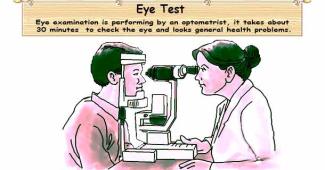
Eye examination is performing by an optometrist, and it takes about 30 minutes, to check the eye health and looks for signs of general health problems.
What happens in an eye examination?
The eye exam test may take longer if extra tests are required to depend upon the individual eye condition. In an eye test, the optometrist will check the eye health and look for symptoms of general health problems. The eye vision testing will normally include the following elements:
- Health history and eye symptoms
- Eye testing
- Vision testing
- Eye movements and co-ordination
Health history and symptoms
Optometrist starts examining eye, by asking certain questions about the health and eye symptoms if any. They will ask why having the eyes examined, whether it is a routine checkup or have any specific reason. If experiencing any problems with the eyes or vision the practitioner will need to know the symptoms, how long have had them, and if there are any sudden or slow symptoms over time.
Optometrist will also need to know about the general health, including:
- Medications that are taking,
- whether suffer from headaches,
- have any family history of eye problems,
- Ask about the previous spectacles or contact lenses.
Eye testing
Examining eyes both externally and internally, enable an assessment to the eye health to identify any other underlying medical problems. The eye interior will assess using an ophthalmoscope, a special torch with shiny light on the pupil allowing a detailed study of the internal structures and pupil reflexes will test.
Other tests, which may carry if necessary that include; glaucoma or color vision deficiency. If over 40, it recommends checking for glaucoma, because aging increases the chances of developing glaucoma. Glaucoma has no prior symptom and normally noticed only after some sight has already affected.
Glaucoma examination involves; assessing internal eye, measuring inside pressure of the eye, and checking the visual fields to make sure do not have any abnormal blind spots. Many optometrists are now advice some extra tests, such as photography of the interior and exterior of the eye.
Dilated eye exam - is a painless procedure in which an optometrist assesses the eyes to find for vision problems and eye diseases. Dilation drops are dropped into the eyes to dilate (or widen) the pupils. Optometrist uses a special magnifying lens to assess retina to find any signs of damage and other eye problems (such as diabetic retinopathy or age-related macular degeneration). It also allows the doctor to assess damage to the optic nerve that occurs when a person has glaucoma. After the dilated eye exam, the close-up vision may remain blurred for several hours due to the eye drop used during the examination.
Vision testing
Vision tests are performing to assess many functions of the eye vision. These tests are useful to measure the ability to the eye to see objects at near and far distances, check for gaps/defects in the field of vision, and check the ability to see various colors.
- Visual acuity tests - are the most common tests used to assess eye vision. It measures the ability of the eye to see objects at near and far distances. It involves reading letters or symbols of different sizes on an eye chart. Usually, each eye is testing by individually and then both eyes may test together, with or without corrective lenses.
- Refraction test - is a test that measures the refractive errors (such as nearsightedness or farsightedness) of the eye to assess the need for corrective lenses. It is usually performing after a visual acuity test. Refractive errors occur when light rays entering the eye cannot focus exactly on the retina, and causes blurred vision. Refraction test is the routine eye examination for people who already wear glasses or contact lenses. It will also perform if the results of the visual acuity tests show that the eyesight is below normal and need to correct by glasses.
- Visual field tests - are useful to check for gaps in the peripheral (side) vision. The entire visual field is the complete area seen when gazing is fixes in one direction. The total visual area is seeing by both eyes, and it includes the central visual field (which provides the highest degree of details) and the peripheral visual fields (which provide a comparably low degree of details).
- Color vision tests – are used to check the ability to see colors. It is useful to assess color blindness in people with family history of color blindness or to those who have retinal or optic nerve disease.
Remember to take the spectacles or contact lenses when attend for an eye examination. Vision will measure both with and without spectacles or lenses to check for any problems with the eyesight.
Eye movements and co-ordination
Eye movements and co-ordination test are useful to check that both eyes are working together, and that improper stress is not placing on the eye muscles. Proper muscle balance is the must for those who use computers or read for prolonged periods.
At the end of the examination a prescription for spectacles or contact lenses, or a statement, which confirms that, the eyes do not need correction. If you need medical treatment for an eye condition, then the patient may refer to a doctor or hospital.
Patients will help by optometrist in choosing spectacles or contact lenses. If contact lenses are you choice, then they will give advice on the different types of lenses, the procedures for fixing lenses and other information about caring and cleaning lenses.
If not satisfied with the spectacles or contact lenses consult an optometrist, they will be happy to correct or make minor adjustment to the spectacles where possible.
Eye Test
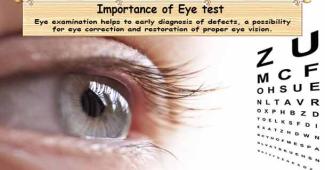
Eye exam helps to early diagnosis of defects, a possibility for eye correction and restoration of proper eye vision.
Importance of having an Eye Examination
The eye examination is a vital health check and should be part of everyone's normal health regime. Here are the important reasons to have a regular eye exam:
- Only have one pair of eyes. Once lost, eyesight may never replace.
- Unlike teeth, eyes do not usually hurt when there is something unusual or wrong.
- Eye exam can help diagnose early signs of potentially eye blinding conditions, such as glaucoma.
- Early problem detection increases the chances of successful treatment. This is particularly true for younger child and the elderly.
- Eye examination can also help to find a number of other underlying health problems, such as hypertension or diabetes.
- Eye exam checks, whether eye vision needs correcting with eyeglasses and determines the best form of correction for the eyesight.
- Proper vision helps to perform efficiently during working and playing, means a better quality of life.
- For young kids, proper eyesight is vital for learning. An eye exam can detect any eyesight problems, which may affect their school performance.
- Failing eyesight is common with people getting older, until by having an eye examination and treating eyesight problems can improve their quality of life.
- Poor eyesight is dangerous, particularly during driving not only to the individual but also to others.
Unless otherwise advised by the doctor should have an eye examination every two years. It may be necessary to have examinations more frequently depending on the age and medical history.
Eye Myths & Facts
Eye fact and myths should properly distinguish, to know the procedure for good eye care is the first step for protecting the eyesight.
Eye Myth & Facts
There are various myths regarding eye, come on let us prove it wrong with facts.
- Myth: Failure to use proper glasses will further increase the power of the eyes.
- Fact: Corrective glasses or contacts are requiring improving eye vision, still using the eyes with or without glasses do not hurt them further.
- Myth: Reading in dim light can hurt eyes.
- Fact: Reading in dim light can cause eyestrain, but it will not hurt the eyes.
- Myth: Eating carrots will improve eye vision.
- Fact: It is a truth that carrots are high in Vitamin A an essential vitamin for eyesight, but only a small quantity is enough for good eye vision.
- Myth: Nothing can do to prevent vision loss.
- Fact: Regular eye exams and proper treatment if necessary can stop vision loss.
- Myth: Eye exam is needed only when have any eye problems.
- Fact: Everyone should do a regular eye exam, whether or not have any signs of problems.
- Myth: Never watch TV at a close distance.
- Fact: There is no scientific evidence that says watching TV at a close distance is bad for the eyes.
- Myth: There is no need to exam eyes until 40s and 50s years old.
- Fact: Eye disease can happen at any age, thus need a periodic eye exam.
Some interesting eye facts
- Eyes are the most complex organs next to brain.
- Eyes are made of more than two million working parts.
- Tears are mean to protect the eye. It contains natural antibiotics; it prevents the eye from dry out and contain certain fats that limit the evaporation of tears.
- Eyes external muscles that move the eyes are the strongest muscles in the human body for that particular job. They are 100 times more powerful than requirement.
- Eyes begin to develop two weeks after conception.
- Eyelashes work like windshields to take away the dust, other impurities, and tears that form to protect the eyes from drying out.
- Eyes are always the same size from birth to death without growth.
- Older we are the less the tears we produce.
- Can use the eyes as much as one can - they do not wear out.
- Blinking helps to wash eyeballs with tears and keeps them clean and moist. Furthermore, if something is about to hit the eye, eyelid blinks without our knowledge.
- Number one cause of blindness in adults is diabetes.
- Human eyeball weighs approximately 28 grams.
- The cornea is the only living tissue in the human body that does not contain any blood vessels.
- Research has indicated that a tight necktie increase the risk of glaucoma.
- All babies are color blind when they are born.
- Iris is a colored muscle. Thus, few individuals have BLUE, BROWN, GREEN, GRAY OR BLACK, colored eye that is the color of the iris.
- A normal person blinks about 12 times a minute. That is a 10,080 blinks in 14 waking hours. In addition, an approximately 10,000,000 eye blinks a year!
- During eye blink, eye shuts for 0.3 seconds, that shut off time total will be 30 minutes each day!
- An eagle can be able to see a rabbit about 1 mile or 1760 yards away. A normal person required to be about 550 yards away to see the same rabbit.
- The human eyeball measures about 1 inch (2.5 cm) in diameter. Only 1/6th is exposing to the front portion.
- Retina is about the size of a postage stamp with 130 million light sensitive cells.
- Smoking increases the risk of some eye diseases such as age-related macular degeneration and cataracts.
Eye care Professional
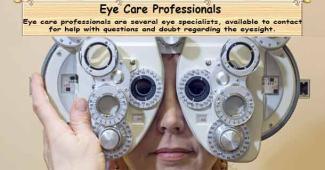
Eye care professionals are several eye specialists, available to contact for help with questions and doubt regarding the eyesight.
Eye care Professionals
Based on the qualification and their job functions, there are various eye care professionals are there to help us regarding our eye problems.
The following is the details of eye specialists and their functions.
- Ophthalmologist (Eye doctors, Eye Dr, Eye Surgeon) -An ophthalmologist is a physician (doctor of medicine or doctor of osteopathy) who specializes in the care of the eyes and visual system. The ophthalmologist get educates by lengthy medical education, training, and experience. They are qualified to diagnose, treat, and manage all eyes and visual system problems, and are licensed to practice medicine and surgery. They are medically trained specialist who can provide total eye care: vision services, contact lenses, eyeglasses, eye examinations, medical eye care, surgical eye care and diagnose general diseases of the body.
- Optometrist -Optometrist, also called doctors of optometry (O.D.) is a health-care professional licensed to provide primary eye care services. These include comprehensive eye health and vision examinations; diagnosis and treatment of eye and vision problems; the diagnose of general health problems; prescribing eye glasses, contact lenses, low vision rehabilitation or therapy and medications; performing certain surgical procedures.
- Opticians -An optician is a professional who designs, finish, and fit eyeglasses and contact lenses, based on an eye doctor's prescription. The optician may also do low vision aids and artificial eyes.
- Ophthalmic Nurses -They perform ophthalmic examinations, patient assessments, teach regarding their eye conditions, assist eye surgery, and emotional support to patients & their families. Goals of ophthalmic nurses are to assist patients to maximize their vision, prevent eye disease through education, and enhance the patient's life quality.
- Orthotists -An orthotist is an allied health professional in ophthalmology, coordinate with an ophthalmologist in the diagnostic and therapeutic assessment of strabismus, amblyopia, diplopia, and binocular-function disturbances. They are experts in the visual assessment of nonverbal patients. They may also be skilled in refraction, visual field testing, electrophysiologic testing, contact lens evaluation, and low vision assessment.
- Ophthalmic Personnel -They are ophthalmic; assistants, technicians, and medical technologists. They are qualified to assist the ophthalmologist such as history taking and basic tonometry, visual field testing and ophthalmic photography, depending on their level of qualification.
- Para-optometric -They work under doctor of optometry, collect patient data, administer routine yet technical tests of the patient's visual capabilities, and assists in-office management. The para-optometric may assist the optometrist in providing examination and treatment care such as contact lenses, low vision, vision therapy and optical dispensing and office management.